When the need arises to build infrastructure of this nature, we can follow different construction methods, which will be selected based on a series of factors that influence the project’s development.
Among the various factors are the following: geological, constructive, aerodynamic y functional, among others. The first ones are imposed by the land and depending on the quality For this, various theoretical cross-sections can be used: in materials with good geotechnical properties, a semicircular arch with straight ends can be used; and for materials of average quality, horseshoe-shaped cross-sections are considered more suitable; for soils with poor geotechnical properties, closed cross-sections with a counter-vault should be used, adopting a shape as circular as possible.
The structural constraints can influence the shape and size of the tunnel cross-section. Thus, when excavation is performed using a tunnel boring machine, a circular cross-section is required. However, when we excavate using conventional methods, we have a greater variety of cross-section types. On the other hand, the aerodynamic factors determine the cross-sectional area.
The The final features will also influence the final section –and therefore in the choice of construction system– bearing in mind that the tunnel must allow for vehicle traffic. The vertical dimension is determined by the clear height and the type of platform, and the horizontal dimension must accommodate vehicle traffic as well as auxiliary lanes that allow for the rapid evacuation of passengers in the event of an accident or emergency.
In addition to these, there are other factors that may also limit the tunnel's design (economic, safety, etc.).
Taking into account the factors discussed above, we will select the most suitable construction method for our project. These systems fall into three main categories: false tunnel, cut-and-cover, and underground excavation.
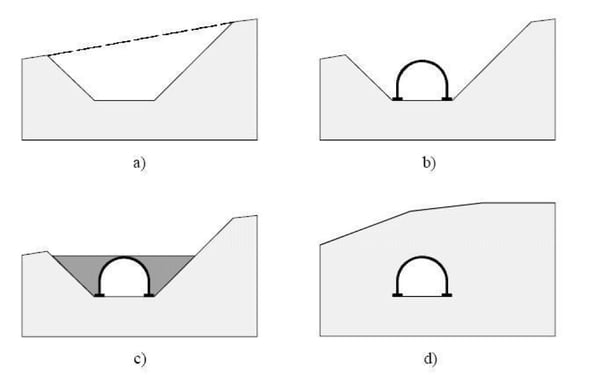
The cut-and-cover construction method requires a large amount of surface land, which is why it is used in certain suburban areas. This method consists of the following phases:
- Excavation of the trench down to the counter-vault level
- Construction of a countervault
- Construction of Side Walls
- Construction of a vault using a formwork carriage
- Waterproofing, side backfilling, and backfilling above the keystone until the site is restored to its original use.
This construction method offers several advantages, such as reduce dependence on skilled labor, possibility of do several at the same time and the independence of the land crossed eliminating on-site treatments. In addition, the Uncertainties regarding safety, timing, and cost are decreasing.
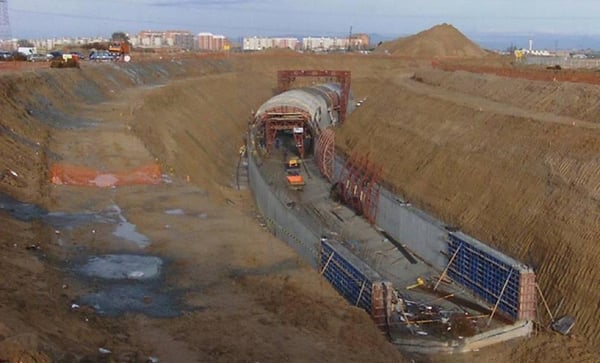
Among its disadvantages are the large amount of land it occupies and the potential historical and cultural impact it may have.
Cut-and-cover
Open-cut construction requires that the area over which the tunnel runs be temporarily occupied.
The cut-and-cover method is primarily used in urban areas with above-ground routes and where there are no nearby buildings, and in interurban areas where it is possible to excavate a trench.
This is a method used, for example, in the construction of subway stations.
Underground excavation (in a mine)
Within this category, there are different implementation systems:
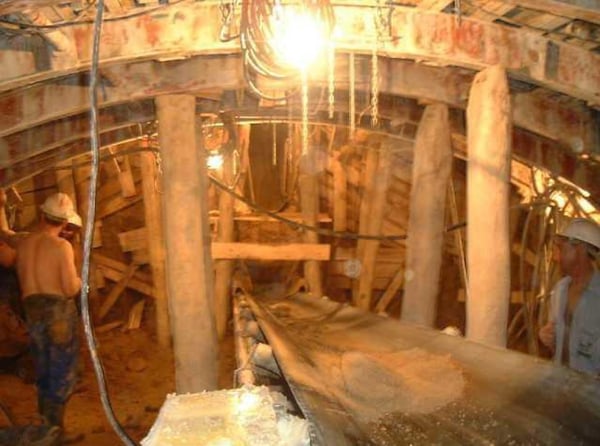
- Manual excavation in phases (for tunnels and caverns): to open small or large working faces.
- Excavation Using Explosives
- Mechanical excavation using conventional methods: such as work involving excavators or hydraulic hammers, pile-driving equipment, or mechanical pre-cutting.
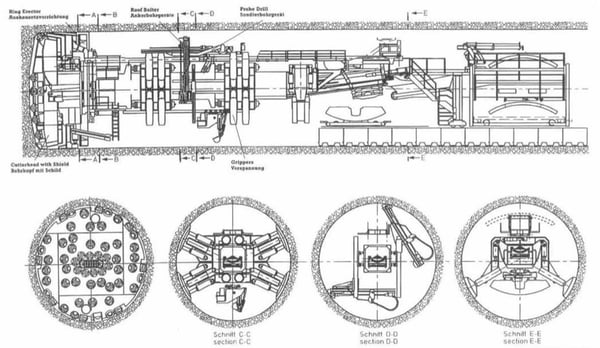
- Mechanical excavation using integrated machines: these include open-face tunnel boring machines, mechanically-supported tunnel boring machines, compressed-air-supported tunnel boring machines, hydroshield tunnel boring machines, and earth-pressure balance (EPB) tunnel boring machines.
Check out our course:
Master's Degree in Civil Infrastructure Management and Operations