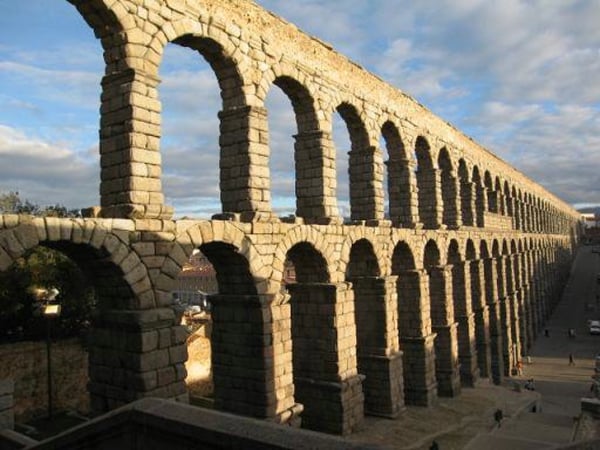
As we reported last week, the Segovia Aqueduct—one of the most important examples of Roman engineering in Spain—is younger than previously thought. The construction of this aqueduct was previously thought to have taken place in the last third of the 1st century A.D.
This Roman engineering marvel is located in the city of Segovia, Spain, and was built to carry water from the mountains to the city.
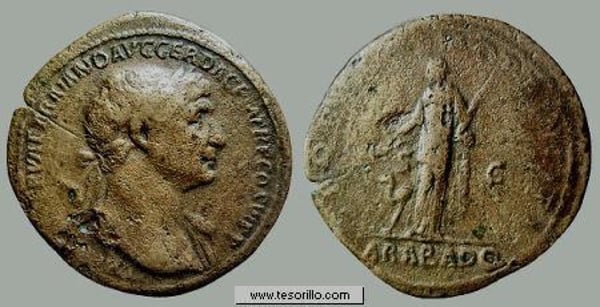
The following items have been found in the holes for the pillars: Hispanic terra sigillata pottery and a sestertius of Trajan, an ancient Roman coin, minted between 112 and 116. The Segovia Aqueduct, therefore, dates from the 2nd century A.D.
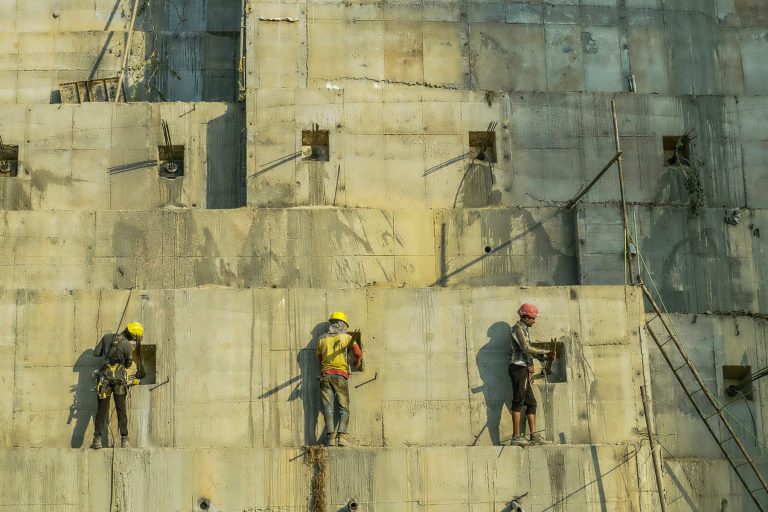
During its construction, the Romans used sturdy formwork and scaffolding, as well as hoisting wheels to lift the ashlars that were at greater heights.
This structure consisted of about 166 arches and about 20,400 granite blocks. The water flowed through the open-air aqueduct, except for one section where the channel was buried. The aqueduct is widest at its base and becomes narrower as it rises.
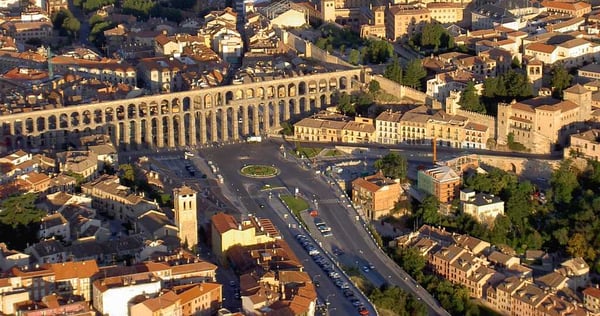
The The aqueduct's maximum height is about 28 meters, and its length is more than 15 meters. The slope of this structure ranges from 0.3 and 5.53 %, and the maximum flow rate of about 20 liters per second.
The Segovia Aqueduct, the most important example of Roman civil engineering in Spain, was declared Designated a UNESCO World Heritage Site in 1985.