Originally published on March 29, 2022, Updated on October 2, 2024.
The textile architecture It is a very interesting alternative that adds a new spatial dimension to buildings.
Every October 2, the World Architecture Day gives us the opportunity to celebrate the art and science of designing spaces that improve our quality of life. This date not only recognizes the work of professionals in this field, but also fosters dialogue about the new trends that are shaping the future of our cities. In this context, Textile architecture has emerged as a prominent concept that combines aesthetics and functionality with a sustainable approach.
Textile architecture is any architectural design that uses fabric as its primary material, both in defining and enclosing living spaces. Textile structures provide spacious and aesthetically pleasing enclosures for wide variety in terms of shapes. One of the main advantages of using fabric as a cladding or roofing material is the light transmission into the structure, which provides high overall levels of natural light to the living spaces inside. These architectural specialties offer innovative and efficient solutions for various types of buildings.
The Origins of Textile Architecture
Traditionally, we find examples of textile structures in figures familiar to us all, such as the tents of nomadic peoples or the sails of ships. However, the origins of our contemporary textile structure technology can be found in the 19th century. As the spinning and weaving of fabrics became mechanized following the Industrial Revolution, it became possible to create large portable tents for the traveling circuses, which were very common in the latter part of that century. These advances have led to the development of specialties in textile architecture which are essential today in the design and construction of innovative spaces.
.jpg)
Traditional traveling circus tent, the origins of textile architecture. Wikipedia
Characteristics and Structures of Textile Architecture
The textile structures are made of constant thickness and a flexible, deformable nature, but they require a small number of rigid elements to provide support and tension for the fabric. The foundation of its formal and functional design lies in its structural stability, which requires maintaining a constant tensile force on the material—the fabric—and this can be achieved in two ways:
-
Applying tensile stress from the perimeter, or from intermediate points or lines. This is what is known as textile structures ttension-loaded. The tension mechanism of these structures is, broadly speaking, similar to that of an umbrella's fabric.
-
Applying Continuous, perpendicular air pressure across the entire surface, in what are known as inflatable structures. The tension mechanism of these structures is similar to that of a beach mat.
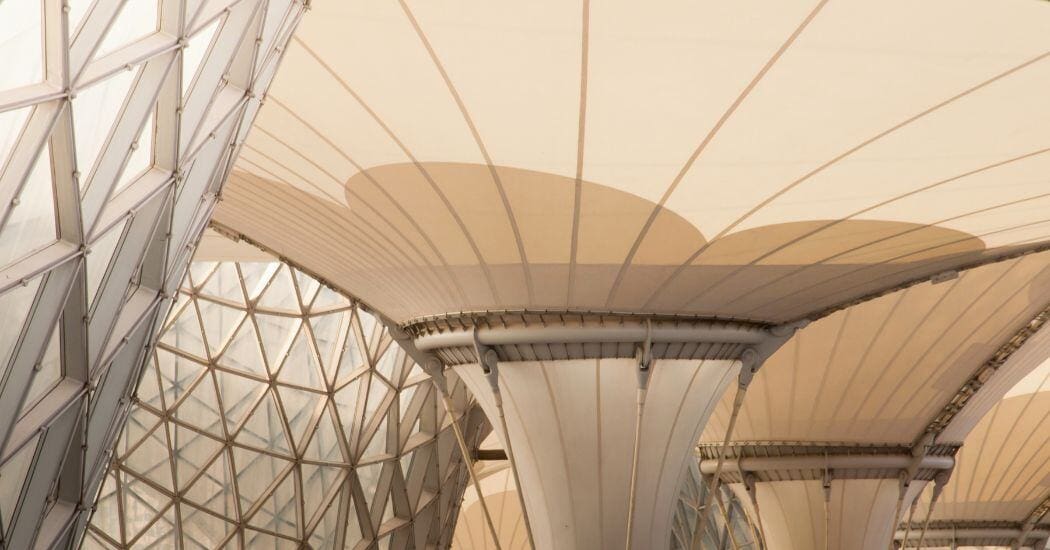
-1.jpg)
Equestrian Center in Luxelakes Eco-City / Chengdu Wide Horizon Investment Group. Archdaily
Structural Factors
There are three fundamental structural factors in a textile structure: surface shape, prestress levels, and surface deformability.
Shape of the Surface
Most contemporary textile structures are based on a surface geometry “anti-clastic”, that is, a structure subjected solely to tensile stress, with no bending or compressive stresses. It consists of a set of “arch-shaped” tension members that act in opposition to a similar set of “suspended” members; that is, there are a series of upward and downward movements that terminate at the edge and at the attachment points. Physically, the two sets of elements represent the two directions of the textile yarn (the weft and the warp) within the membrane. This configuration has a valuable property: it can be fully prestressed without significant changes to its overall shape.
Prestressed
Prestressing contributes significantly to the membrane stiffness because their different curvatures interact to counteract what would otherwise be significant deformations. The deformation of the “hanging” curvature caused by the various stresses acting on the structure is counteracted by the “arc” voltages”. The actual prestressing values used in practice generally represent a small fraction of the membrane's ultimate strength. The prestressing level can also be set so that it Prevent voltage drop in both directions, in a specific area of the surface beneath the applied load. These values are generally determined in conjunction with the selection of the shape.
Deformability
Unlike in more conventional building construction methods, deformability is considered to be a useful and important characteristic of textile structures. In fact, due to their relatively low surface stiffness—both in-plane and out-of-plane—changes in shape are a primary response of the textile structure to externally applied loads, in conjunction with changes in the stress distribution across the entire surface. In addition, The deformations that develop in the membrane material are greater in magnitude, in several respects, than, for example, those of steel. Consequently, textile structures exhibit much greater deformations and geometric changes under load than conventional frame structures. Overall stability is ensured by the adequate flexibility of the membrane’s supports, as well as by the membrane’s own deformability.
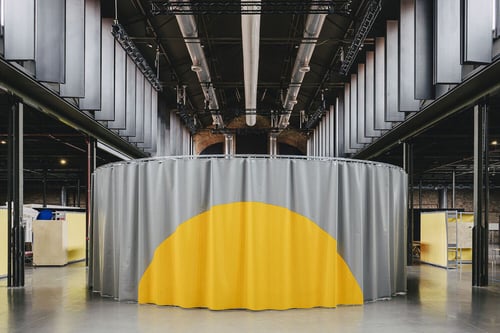
Defining interior spaces with textile architecture. Archdaily
In Structuralia We want to help you with your education by offering a course in Expert in Textile Architecture which will be of great help to you. At our school, we offer you a wide variety of specialized training programs and extensive experience in the industry. In celebration of the World Architecture Day, we invite you to explore the extensive catalog of courses and specialized master's programs in architecture offered by Structuralia. Don't miss this opportunity to expand your knowledge and skills in these fascinating areas of architecture.