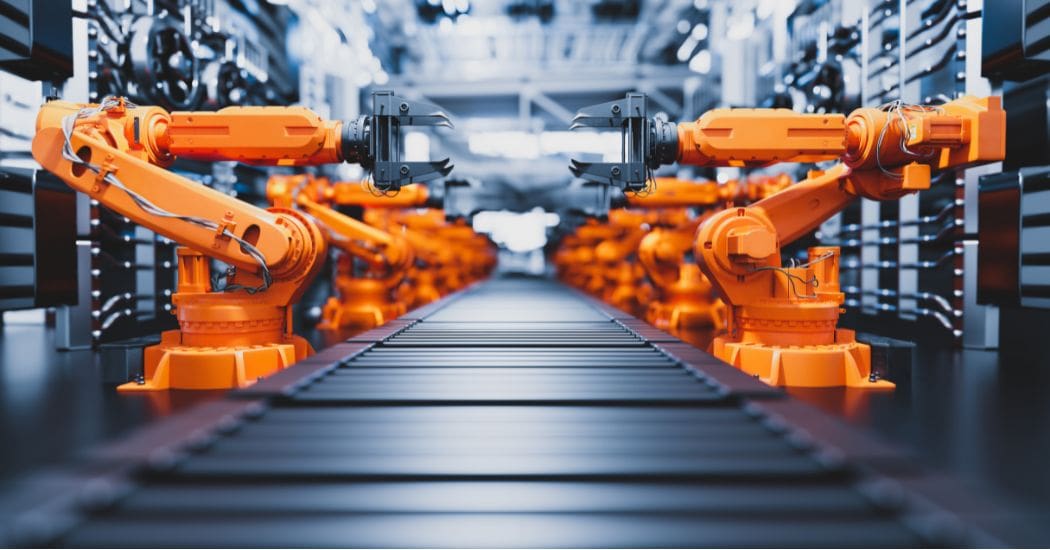
The Industrial Process Automation and Examples They form an indivisible whole that may be the key to implementing this strategy in any company. We’ll review its characteristics and main advantages.
We live in a time when the digital transformation It is becoming a necessity for most sectors. Current market demands require new systems optimizing resources to deliver a final product that is good quality. In that regard, the automation of industrial processes is essential for respond to meet any current and future demands.
What is industrial process automation?
It consists of the application of various technologies for monitor y control a computerized process, machine, or device that generally performs repetitive tasks or functions. The purpose of its implementation in industry is none other than improve and reduce the workload human. This allows for the production of a greater number of products, reducing both cost and time, without compromising the quality of the final result.
To do this, you need to:
-
Control Systems. Robotics and computer science help us understand all the details of a company's various processes. PLCs (programmable logic controllers), computers, PACs (programmable automation controllers), and other communication devices are the most common.
-
Information Technology. It is used to replace personnel in the operation of machinery and processes. After the mechanization of an industry, automation is the next step.
 Source: revistaderobots.com
Where is industrial automation used?
It is commonly found in several sectors that are essential to the economy:
- The food industry.
- The manufacture of chemicals or healthcare facilities.
- The graphic arts.
- The treatment of raw materials.
- The telecommunications.
- The automotive industry.
Automation also affects the process and service management. It is also responsible for increasing the efficiency by helping to identify maintenance errors, design a service or product, and even predict future trends.
Types of Industrial Process Automation and Practical Examples
The result will depend on the type of automation chosen. The process is divided into three main types:
1. Fixed
Fixed automation is used to handle operations that are they repeat constantly, which helps to significantly increase production. To this end, it uses various pieces of equipment dedicated to assembly and processing in a fixed sequence.
They are frequently used in processes involving distillates, conveyors and in painting workshops. Although it is commonly used, it does not allow for rescheduling production, which means that this type of machine must always be used to produce the same product.
2. The Flexible One
It belongs to the intermediate category and is the one best suited to the production volume of the relevant industry. Its characteristics are:
-
-
The use of a control team It allows for changes to the design of the product in question, if necessary. All you have to do is enter the codes for human operators using commands.
-
Allows manufacture various products, but by sharing the process and without slowing down the pace of production
-
This is the most common option in automobiles, self-driving vehicles, and computer numerical control (CNC) machines.
3. The Programmable One
Its main advantage is that stay ahead of demand of products and speed up or slow down production as needed, since:
-
-
Fits a production volume: medium or high in batches. To do this, it is essential to devote the necessary time to configuration so that you can save time later when you need to change or redesign the system to produce a new product.
-
Contribute to streamline production at key moments, resulting in cost savings and greater flexibility in meeting customer needs.
-
It is typically the most widely used option in CNC machines and tools, industrial robotics, steel rolling, and paper mills, among other industries.
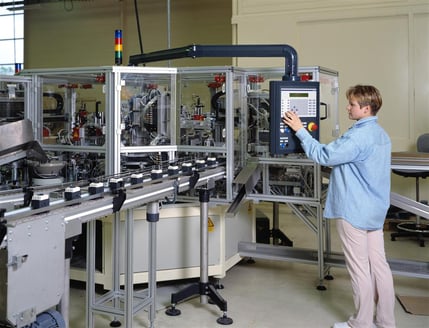
Source: www.inesem.es/revistadigital/gestion-integrada/
Benefits of Industrial Automation
After reviewing the types and examples, it is also important to highlight the benefits of automation:
1. Cost reduction
By integrating production and various processes, the time required and the need for an operator are reduced. Thus, the business owner reduces its investment in recruiting and make the most of the talent available to achieve the objectives set for Industry 4.0.
2. Increased Productivity
The higher the level of automation, the more options for produce more and to monitor each process. This is the case with large-scale production, which, thanks to this innovation, can take place around the clock without interruption.
3. Improving Quality
The human error factor and we ensure that quality is consistent and uniform. All we need to do is control and monitor each process to verify that each item is manufactured correctly.
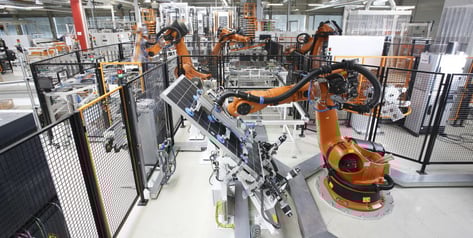
Source: www.edsrobotics.com
4. Improving safety conditions in the industry
Employees They won't risk getting into accidents, since their job will be solely to monitor the proper operation of the machinery. Robots and devices help improve safety.
5. Increased adaptability
Every time we renew the machinery, it is necessary to train employees. However, using a robot or machine ensures that it can fully adapt to any task, which means making the most of work time and providing greater flexibility.
6. Understand the metrics for each machine
Each one generates data that is collected for further analysis. This benefit helps in making better choices regarding the type of machinery to be purchased in the future and facilitates decision-making.
7. Reduce routine inspections
This type of review is essential when there are employees, but not when production is automated. The control techniques, especially those that operate in a closed-loop system, are responsible for ensuring quality.
In short, industrial automation involves the improved production and the cost reduction. Likewise, rescheduling work hours and adjusting workload help to improve processes people within the industry.
To this end, there are various types of automation that make it easier to tailor digital transformation to each specific industry and improve productivity. At Structuralia, we offer a Master's Degree in Digital Transformation Designed to train professionals who want to pursue a career in industrial process automation.