Berthing and mooring facilities are structures that provide ships with suitable and safe conditions for their stay in port and/or to enable the port operations necessary for loading, unloading, and passenger transfer.
In this regard, the most important component is the spring, so today we’re presenting the main types available and their most notable features… Don’t miss it!
Gravity-fed springs
Gravity Docks have a smaller specific surface area (area per unit volume) than pile foundations, so their Deterioration occurs more slowly than those. Thus, we distinguish three major groups:
Drawer springs
Consisting of a wall made up of boxes resting on a bench, with sufficient weight to withstand both the thrust exerted by the fill material on its backface and that exerted by the ships.
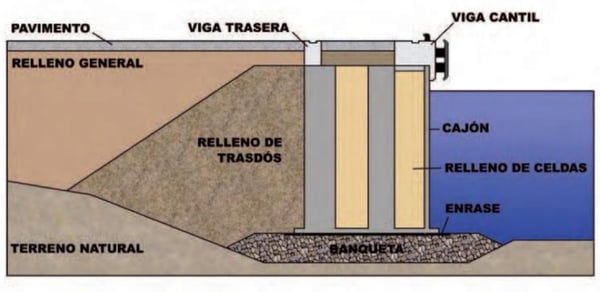
The caissons used in the construction of piers are quite large, typically ranging within the following dimensions: Height: 15–25 m and Width: 12–18 m. For this reason, caisson piers are usually installed in areas of deep drafts (over 15 m). Likewise, caisson piers feature heavily reinforced, slender concrete structures, so the midfield attack is more likely than with other types, which should be taken into account.
Precast Block Springs
These springs consist of a set of precast concrete blocks, all of which are placed on a foundation made of monolithic material or breakwater that has been properly leveled.
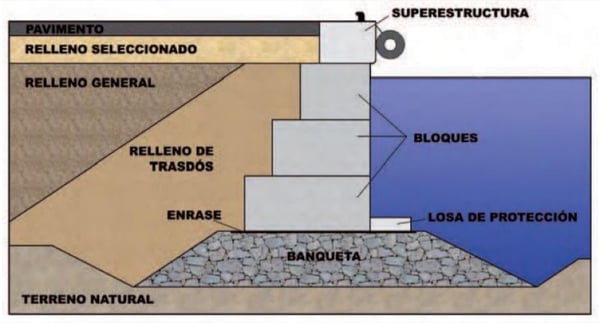
Block docks are installed in areas where the The clearances are small, and it is not possible to build a caisson pier. The blocks are very massive, with little or no reinforcement, and, unlike the previous types, block piers have many more joints.
Submerged concrete piers
This type of spring, “in situ” concrete pouring”, is appropriate in the following cases:
- When the ground on which the foundation is built has high load-bearing capacity and it is not very deformable.
- In sheltered areas where it is possible to work with Hs < 1 m.
- For docks with draft depths of less than 10/12 m.
- If there are no open areas available for a yard of precast concrete blocks.
- If there is no equipment for transporting and installing precast blocks.
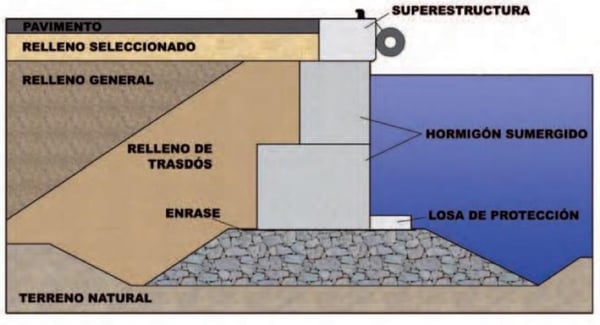
At these docks, the concrete mix must be such that it allows for pumpable, which requires a a consistency between fluid and plastic and a tMaximum aggregate size of 25 mm, have a fine particle size distribution, and set quickly.
Pile Springs
These are structures consisting of a platform supported by piles that transfer the loads to the ground. Their use is particularly recommended in the following cases:
- When the foundation soil has low load-bearing capacity and/or is highly deformable.
- In seismic zones where structures with lower mass perform better.
- In places where the goal is to eliminate wave reflection.
- In areas with deep water where it is not economically feasible to build a gravity pier.
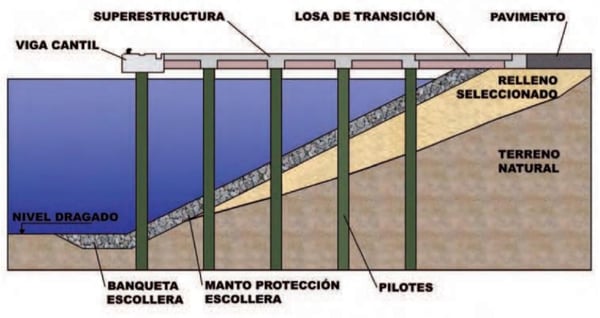
Pile foundations are classified based on whether or not they are constructed in place, and if so, whether they are constructed from a marine platform or from the sea using floating equipment. In the case of cast-in-place piles, these are made of concrete, and a metal casing is required, which may or may not be left in place after the concrete has set (permanent casing). Precast piles can be made of metal or concrete (usually prestressed).
A reinforced concrete superstructure in the form of a framework of beams, joists, and slabs (floor system) is installed on top of the piles. Pile wharves have high specific surface area (surface area per unit volume), so it deteriorates rapidly if the design (cracking) and materials are not adequate.
Screen Springs
These types of springs are structures consisting of a retaining wall concrete that transfers loads to the natural ground through its flush mounting on it, and to its back face using a system of anchor.
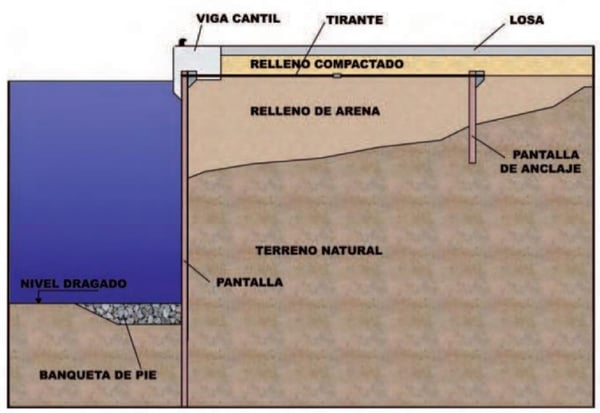
Screen piers can be made of sheet piles (metal or concrete) or consist of a continuous concrete screen. These piers These are the ones with the largest specific surface area and the shortest service life.
If you'd like to learn more about the fascinating world of ports, be sure to check out our upcoming graduate program: