When addressing problems with a building’s foundation, we can either work on the foundation itself or on the ground beneath it. In this post, we’ll review the most commonly used techniques for both approaches.
The most commonly used techniques in the field (treatment and improvement) are usually the injections or jet grouting, and the most commonly used ones on the foundations themselves are the superficial and deep settlement. These represent a solution that should only be used in cases where it is not possible to limit the damage using other methods, as they have significant aesthetic, economic, and functional implications.
Injections
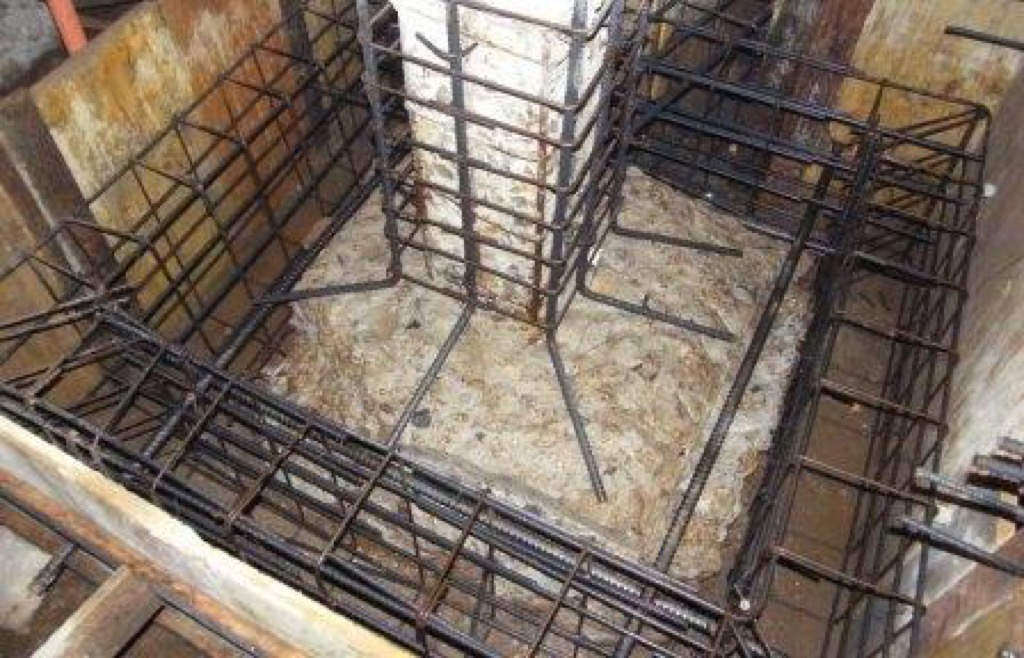
These are used to reduce the permeability and compressibility of the soil and increase its bearing capacity; various materials can be used, such as silica gels, resins, polyurethanes, or microcement, among others.
Silt and clay are considered non-injectable soils, since only coarse granular soils can be easily injected. Even so, it may be possible to treat them using this technique by creating injection masses through the fragmentation of the soil using hydraulic pressure.
Despite the improvements they bring to the site, grouting also has some disadvantages, such as the difficulty in calculating its range and the potential risk of grout leakage.
Jet Grouting
This technique is increasingly being used as a solution for buildings with foundation problems. It offers advantages over grouting, such as much more precise control over the grout, which is confined to the desired area.
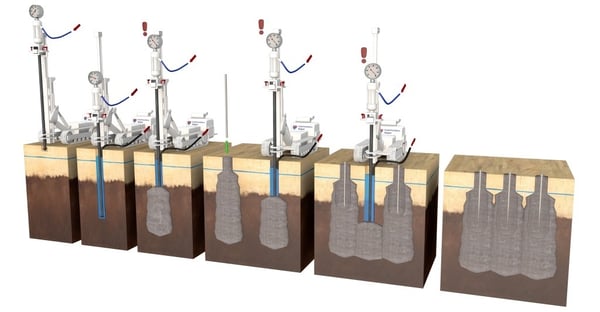
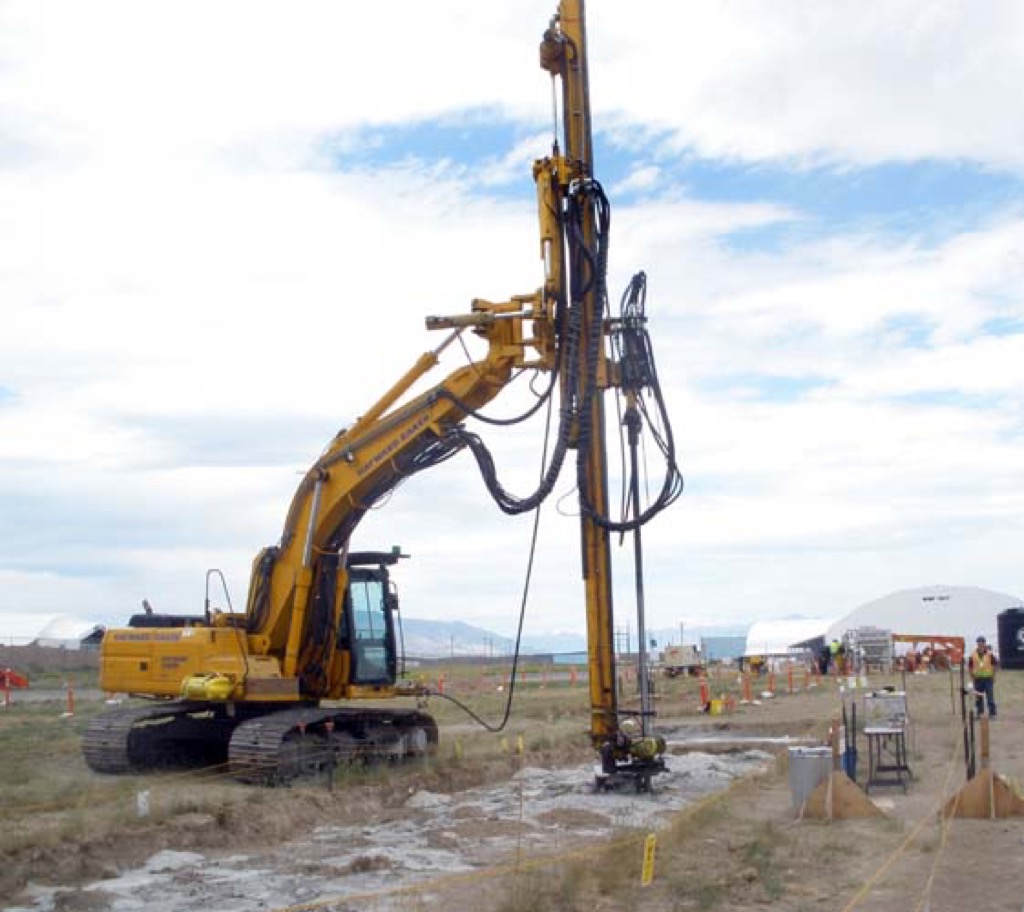
Jet grouting began to be used to reduce ground deformation during excavations near buildings. The technique involves creating columns of improved soil beneath or adjacent to the foundation using a pipe equipped with a cutting head that injects water under pressure.
The same pipe injects cement slurry once the desired depth has been reached. As the pipe is withdrawn, a rotating motion is performed, thereby creating a column of soil mixed with cement.
To improve flexural strength and facilitate connection to the structure, a rebar can be embedded at the top of the column.
Superficial settlement
These are repairs or reinforcements to the foundations, the purpose of which is to increase the load-bearing surface area. This type of underpinning is used less and less due to the high labor costs and the risks associated with this type of excavation. They are classified into two main types:
1. Increase in floor area
Recommended when the foundation rests on stable soil, but the effective mechanical cross-sections are smaller than required.
The depth of the bearing surface is usually increased when there is a more stable layer at a shallow depth (below the foundation's bearing surface).
It is very common to install shoring to ensure the stability of the soil along the walls of excavations.
Deep settlement
It involves adding new elements to the deep foundation, typically using micropiles less than 20 meters long. The process may vary depending on the type of micropile, but generally includes the following steps:
• Drilling
• Installation of continuous tubular reinforcement
• Application of the grout, either by gravity or by pressure injection.
Deep foundations can be constructed in the following ways:
- Passing through the foundations: This is the simplest solution for underpinning with micropiles and for creating basements beneath existing buildings. It involves passing through the existing foundation, thereby avoiding the need for excavation near the foundation and minimizing potential movement during the repair. To pass through foundations, they must have sufficient depth.
- Along the perimeter of the foundations
If the foundation does not meet the above criteria, the micropiles must be installed along the perimeter of the foundation. - As temporary shoring for the existing structure
Check out our course:
Master's Degree in Building Renovation and Energy Conservation