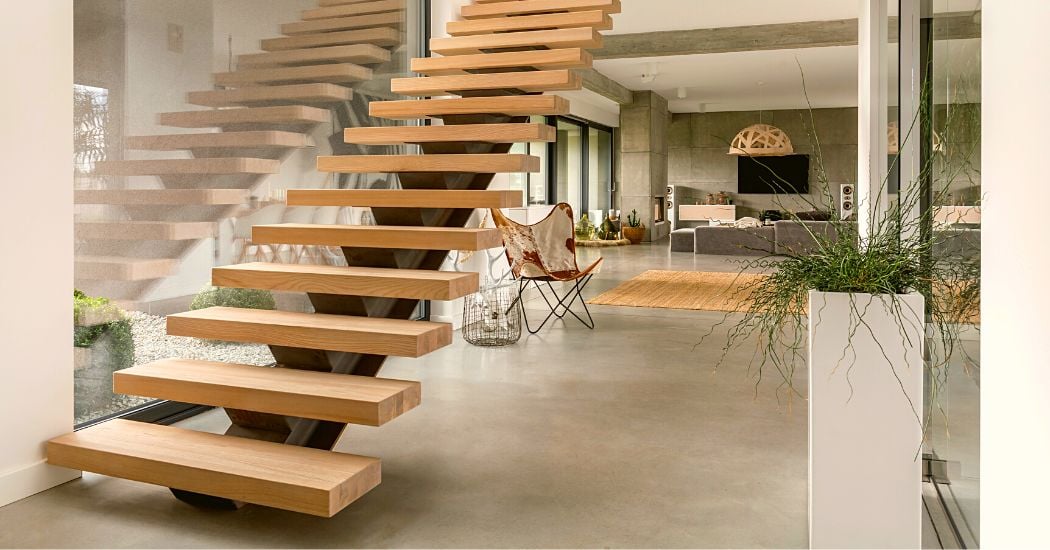
The tread and riser must be calculated precisely for the functional design of a staircase. The Blondel's Law This is the formula that's commonly used. Find out about this and more in this blog post.
Tread and riser: How to Calculate Them When Building a Staircase
The tread and riser, as parts of a staircase, are designed to connect spaces on different levels within a building and to serve as circulation elements.
Stairs are designed to to offer safety and comfort a those who use them. They are used in most buildings, so it is essential for any architect or engineer to know the method for their design and calculation.
Parts of a Staircase
The most important element is the step or step, consisting of two parts: the horizontal part, which is called footprint, and another vertical dimension that determines the height of the step, called riser. In addition to:
- Start.
- Plateau.
- Rest.
- Cantilever.
- Railing.
- Handrails.
How do you calculate the design of a staircase?
The first piece of information you need to know is the height the height difference that the staircase must bridge. Then, the pending from the staircase and the distance (or length) that will be needed.
The following will apply: Blondel's Law, whose formula makes it possible to determine the tread and riser how to use a ladder efficiently.
 How to Calculate a Staircase. Source: energy-reform-malaga
Calculation of the tread and riser
This calculation is defined by the following equation:
2 risers + 1 tread = 64 cm.
For example, if you want to build a staircase to go up one level that is 2.50 m high:
A riser is defined as the distance between 18 and 19 centimeters, which is a recognized standard for comfort and safety. In this case, 18 cm will be used.
The number of steps:
height (cm) / riser
In this case:
250 / 18 = 13.88
The decimal is rounded, so the staircase will have 14 steps.
It is Calculate the riser height:
Height of the staircase in cm / Number of steps.
In this example, it will be:
250 / 14 = 17.85 cm.
Now apply the formula:
tread width = 64 cm – (2 × 17.85)
Therefore, the tread width will be 28.30 cm.
As a result, you will have a staircase that has:
Calculating the length
Now, it's time to calculate the length of the ladder and its slope:
For the length, the following formula is used:
(Number of steps – 1) × (tread width / 100).
When you substitute the values from the example, the calculation looks like this:
(14 – 1) × (28.30 / 100) = 3.68 meters.
To calculate the angle, the following function will be applied:
Tangent arc = height of the staircase / length of the staircase
2.50 / 3.68 = 0.679
Then convert to degrees using a scientific calculator. In this example, the result is 34.19°.
Complementary Formulas
This formula works very well for optimal sequences. However, in the case of steep stairs and for low-traffic areas, we recommend using:
2 risers + 1 tread = 63 cm.
In places that can accommodate wide stairs, mainly outdoors, the function changes to:
2 risers + 1 tread = 65 cm.
In the graduate programs at Structuralia It is possible to explore the topic in greater depth and perform precise calculations to design and build all types of staircases, including those made of spiral and helical.
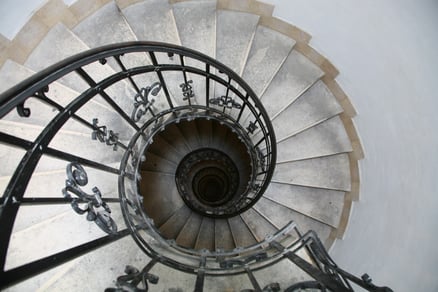 Source: Envato
The Master's Degree in BIM for Advanced Interior Architecture Design, for example, trains professionals who can effectively handle the conceptualization, management, and development of any project.
In summary, staircases must meet a series of standards in order to function properly. The calculation of the total length and the step length It will depend on the total height and the number of steps. In the Blondel's Law There are variations to adapt it to the requirements of each location.
On Structuralia We train professionals Experts in architecture and engineering who can tackle any building challenge, including the design, calculation of treads and risers, and construction of staircases for residential or industrial use.