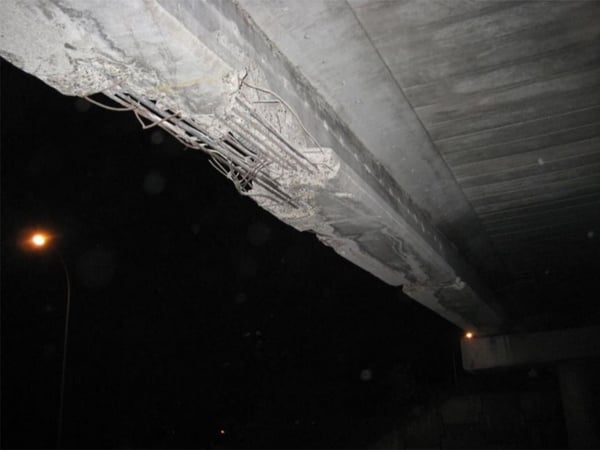
In addition to the deterioration inherent in the materials used to build a bridge’s structure, it is common to see damage to specific components, such as the outermost beams of the deck. This is usually caused by an impact from a vehicle exceeding the permitted height limit or by trucks whose drivers failed to lower the dump trailer.
Given this situation, it is reasonable to expect maintenance and repair work on these components, with the aim of minimizing damage to the rest of the infrastructure. We will therefore examine some methods that could restore the capacity and strength of a damaged beam.
Depending on the severity of the damage, there are different types of repairs:
Repairing Chips with Grout-Type Mortar
Effective when impacts have caused chipping without structural damage. In this case, the steps to be taken are generally as follows:
- Chipping of deteriorated concrete areas using a low-power jackhammer.
- Vigorous blasting with high-pressure water and/or silica sand to remove rust from the rebar.
- Manually brush the rebar with a wire-bristle brush to remove any remaining rust.
- Passivation of reinforcing bars with an anti-corrosion coating and bonding layer for concrete reinforcing bars, based on cement and modified epoxy resins, cement paste enhanced with epoxy resin and corrosion inhibitors.
- Application of a high-adhesion, non-shrink mortar to fill the surface and restore its original shape.
- Concrete protective coating, designed to waterproof the concrete surface with one or two coats of resin-based paint.
Structural reinforcement of the damaged beam
In other cases, the impacted beam has a fracture that extends into the reinforcement. This situation is more serious than the previous one, but it is still possible to restore the beam’s load-bearing capacity using the following methods:
- Reinforcement of the beam. This system involves installing a reinforcement cage using the narrowest part of a T-beam and subsequently filling the void. This work must be carried out at night, when traffic is lighter and allows for complete road closures with traffic diverted to an alternate route.
Structural Reinforcement with Carbon Fiber
Carbon fiber sheet or tape is a high-performance material used in structural reinforcement that addresses most existing challenges. This type of material is used to reinforce beams in sharp, by installing a U-shaped lining at the ends of the beams.
It can also be used as a supplement to bend beams, although in this field it is often replaced by carbon-fiber laminates for convenience.
The tensile strength of the carbon fiber sheet will be around 4,900 MPa, and it will have a Young's modulus of approximately 230 GPa.
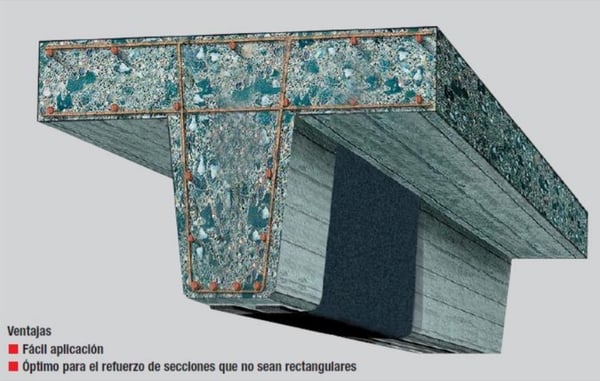
The vast majority of bridges built are of the double-T girder type, although in recent construction projects it is very common to use trough girders for building a girder bridge. In any case, we recommend that you check out the post titled «5 Ways to Reinforce a Beam That Every Engineer Should Know» which details other methods of structural reinforcement.
Demolition of the damaged beam and replacement with a new one
When the damage to a beam makes it irreparable, the only solution is to demolish that beam and replace it with a completely new one. This is a very complex problem, as this type of work has a significant impact on traffic on the road, in addition to being very costly.
If you'd like to learn more about the maintenance of masonry structures on roads, feel free to check out our master's program.