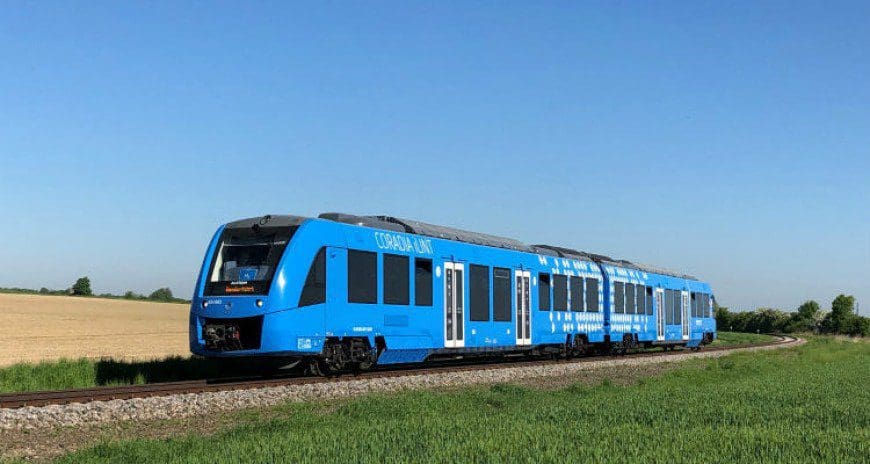
This week, news broke that the Coradia iLint, the world’s first hydrogen-powered train, has received certification from the German Railway Authority (EBA) to begin passenger service. In this post, we’ll tell you a little more about this innovative transportation project.
Hydrogen as a Sustainable Energy Source
The Hydrogen is an efficient and sustainable alternative for emission-free power generation on non-electrified rail lines. This has been demonstrated by the French corporation Alstom, who was responsible for designing this pioneering railroad, whose The first two prototypes will begin service this coming September on the Elbe-Weser railway line in the German state of Lower Saxony.
Germany has a rail fleet that exceeds 4,000 diesel vehicles on the road at present. The Coradia iLint,powered by hydrogen fuel cells, is being promoted as an alternative to diesel power. It is a train that produces absolutely no carbon dioxide emissions, emitting only steam and condensed water.
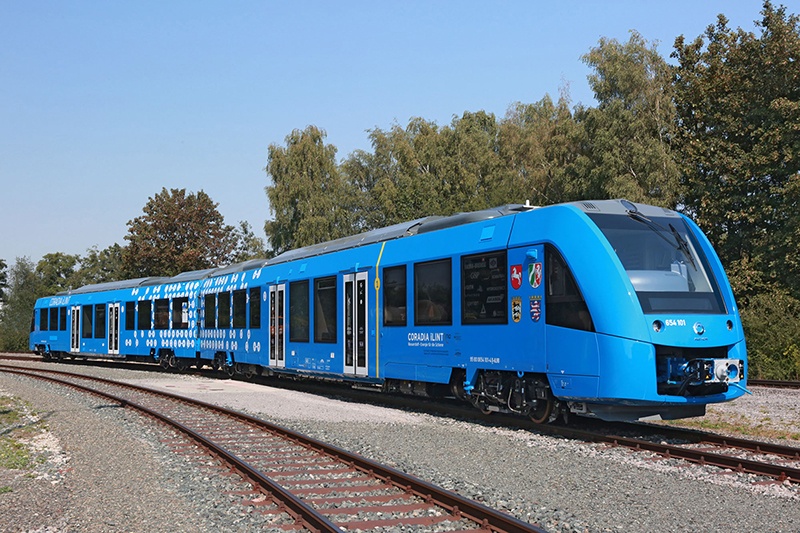
Image: Alstom
Its design is intended not only to combat environmental pollution but also to combat noise pollution, operating with a low noise level.
Design and Technology of the Coradia iLint
These trains are self-propelled by electric drive systems. The prototype's primary energy source consists of fuel cells powered on demand with hydrogen. These generate electricity through a system that mixes hydrogen stored in tanks with oxygen from the outside environment, a process that does not produce any pollutants whatsoever. Furthermore, electricity is generated without the need for a generator or turbine, making the process faster and more efficient than traditional systems.
Furthermore, these trains are also fuel-efficient, as the system is also capable of storing energy from the cells in lithium-ion batteries. Storage occurs at times when the energy generated is not necessary for traction. Kinetic energy is also stored during the electric braking process, which is used later on to provide support during the acceleration phases.
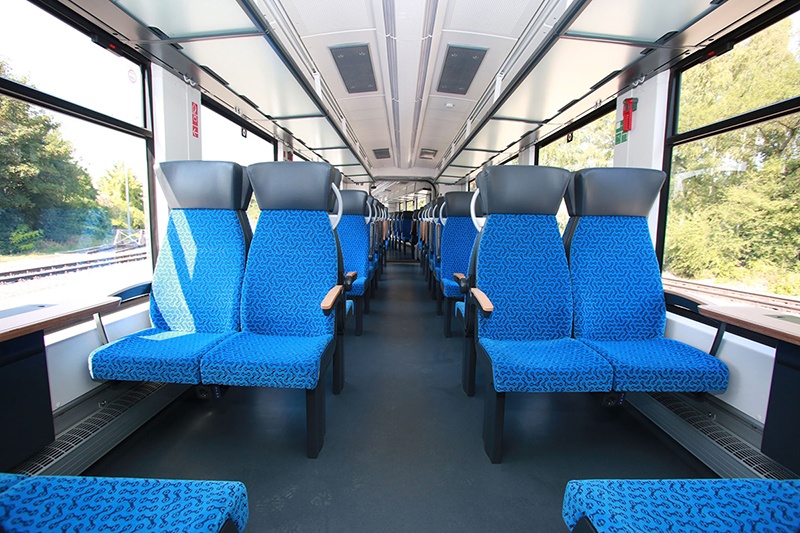
Image: Alstom
With regard to the braking phases, The fuel cells are deactivated during these stages, while the propulsion system recovers the electricity generated by the engines. In this way, the system is capable of harness the vehicle's kinetic energy during the braking process.
Features of the Coradia iLint
The Coradia iLint can reach a a speed of 140 kilometers per hour and has a a driving range of 1,000 kilometers without refueling, with performance comparable to the most modern diesel trains developed by the same company. Each of these trains can accommodate a maximum of 300 passengers.
Given the system's performance and efficiency, everything suggests that this is just the beginning of hydrogen's integration into the efficient development of the railway sector in Europe.