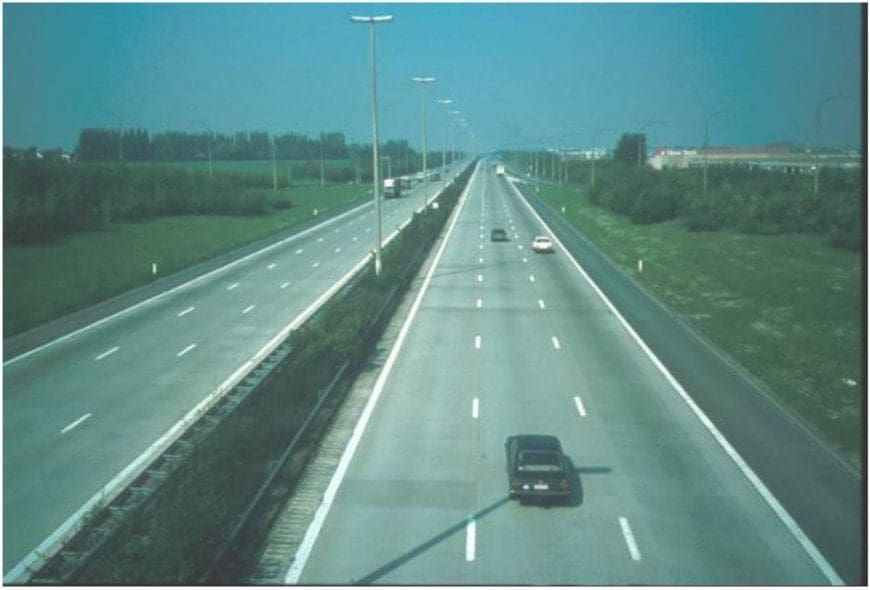
When we talk about continuous reinforced concrete pavements, we’re referring to a type of rigid concrete pavement characterized by the absence of transverse joints. If you’d like to learn more about the characteristics and uses of this type of pavement, we’ll tell you all about it here.
In these floors, unlike in most concrete structures, the armor They are not arranged in such a way as to bear tensile loads, which concrete cannot withstand due to its low tensile strength (on the order of 3.5 MPa), but rather to Keep the fissures sutured and closed that inevitably form due to concrete shrinkage, as well as stresses caused by traffic loads and temperature gradients.
For a reinforced concrete floor to be considered continuous, it must have a certain length, in the range of 400 meters, since that is the only way there will be a stationary central region.
Experiments have shown that the required amount of steel in the longitudinal reinforcement of a continuous reinforced concrete slab is proportional to the length of the a slab about 150–200 meters wide of this, remaining a constant based on that value. Thus, these pavements are heavily reinforced in the longitudinal direction and form a continuous structure—that is, without transverse joints. In this way, The slab is interrupted only in the extremes on the pavement and in the vicinity of masonry work of some importance.
The geometric dimension of the longitudinal reinforcement The design of a continuous reinforced concrete slab depends on several factors, including the elastic limit, the elastic limit of the reinforcing steel, and the characteristic flexural-tensile strength of the concrete. With HP-4.5 concrete (4.5 MPa), these values are values between 0.65 and 0.71 TP3T. They have typically been used as reinforcement in this type of paving high-yield-strength corrugated bars (510–620 MPa).
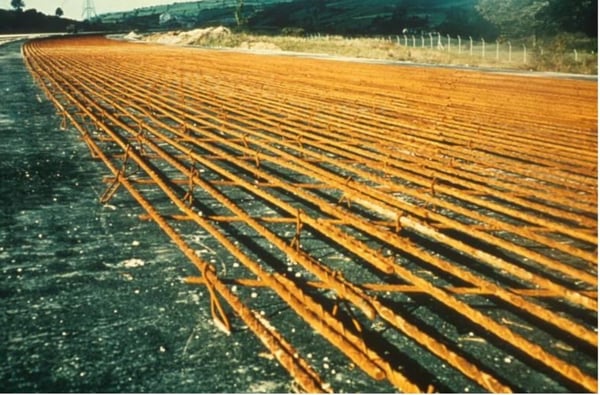
Longitudinal Reinforcement in Continuous Reinforced Concrete Pavement
Because they lack transverse joints, continuous reinforced concrete slabs undergo a process of random transverse cracking, which begins after construction and that usually stabilize in four or five years service life of the infrastructure. The distance between cracks and their width are inversely proportional to the amount of steel used.
According to empirical data, it is considered to be A final distance between cracks of between 1 and 3 mm is desirable (with the most favorable value between 1.5 and 2 m) and that the opening of these, in terms of surface area, does not exceed 0.5 mm, to reduce the risk of corrosion. Likewise, the crack distribution should be as homogeneous as much as possible, so as to ensure that loads are transferred through the crack without any unevenness or deterioration caused by traffic.
This type of pavement began to be developed in the United States in the 1940s, and it took more than a decade before its use began to be tested in Europe, with Belgium being the first country to both install it on pilot sections and use it routinely on major highways and roads.
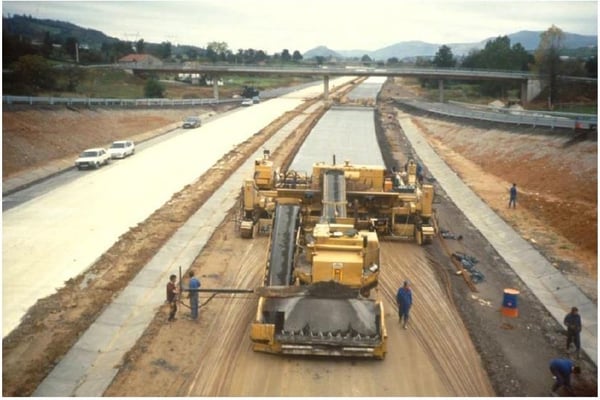
Construction of a Continuous Reinforced Concrete Slab
Early in its history, steel was placed in the upper third of the slab, not only to keep cracks in the upper portion from opening up, but also to serve as “skin reinforcement” and resist concrete spalling caused by traffic.
Advances in technology have led to a current preference for the The reinforcement should be positioned halfway through the thickness. As a result, in addition to reduce the risk of corrosion, the surface regularity, by eliminating the “reflection” of the structural framework on the pavement surface—which appeared as slight undulations that caused discomfort to users.
The distance between the longitudinal bars is generally of the order of 15 cm to allow concrete to be poured between the rebar. The cross braces, for their part, are installed to support the longitudinal reinforcing bars and to maintain their relative position. However, in recent years, the use of equipment equipped with guides has become increasingly common during construction; these guides position the longitudinal reinforcing bars in their final locations as the concrete is poured. In these cases, the transverse reinforcing bars are omitted.
The fields of application The applications for continuous reinforced concrete pavements are very diverse. Although their high initial cost compared to flexible pavements means that the natural scope of application for these pavements is surfaces subjected to high levels of heavy traffic, especially in highways or major roads.
Initially, these pavements were used primarily on road surfaces made of new construction, although its use has become more widespread in recent years as reinforcement of existing pavements, both rigid and flexible, as well as in the reconstruction of lanes for heavy vehicles on highways.
Another application for this type of flooring is in the airport runways. Notable examples include Narita Airport (Tokyo) and the reinforcement and extension of the runway at the French base in Lorient-Lann-Bihoué. In addition, they are also used in roundabouts, tunnels, industrial platforms, as well as in cStop in areas where speed limits are expected to vary, since the short distance between the cracks that form in the pavement divides it into short-length pseudo-slabs, which can easily accommodate the movements of the subgrade.
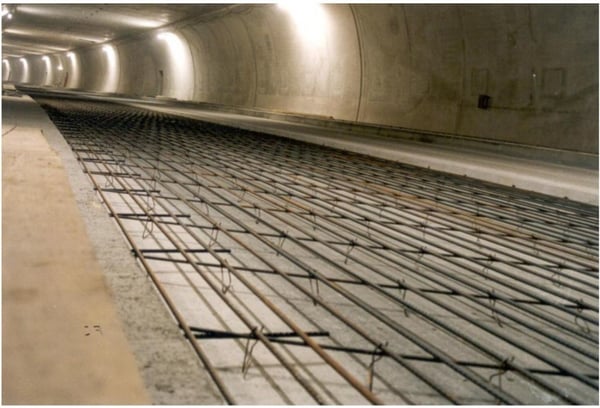
Tunnel Floor Reinforcement