Originally published on December 3, 2024; updated on August 26, 2025
A few days ago, we told you about 5 Ways to Reinforce a Beam that every engineer should know—in which we aimed to highlight some of the most commonly used methods for rehabilitating members subjected to bending. Today, we want to do the same for columns—the members that bear the compressive forces in our structures. Are you going to miss it?
In the years leading up to the aforementioned economic crisis, there was a global “boom” in housing and infrastructure construction, which has resulted in a wide variety of structures that now need to be maintained.
Given that we are in the midst of a recovery process and in light of the above, it is reasonable to expect that investments in renovation and maintenance will grow exponentially, creating new business opportunities.
Concrete columns or piers are the structural elements that primarily bear the compressive forces of a structure. They are so important that, if not strictly calculated, they could cause the immediate collapse of the structure they support by violating an ultimate limit state. Examples such as the construction of the Arco Gateway in the United States, demonstrate how the engineering of large structures requires extreme precision in calculating the elements that bear the main loads.
Reinforced Concrete Columns: Definition
A reinforced concrete column It is a vertical structural element that primarily resists compressive forces. It is composed of concrete and steel reinforcement, which allows it to withstand heavy loads. Proper sizing is essential, as an error in its calculation or a defect in its construction can lead to the collapse of the structure.
In certain cases, it is necessary to use techniques such as Reinforcement of concrete columns to improve its strength, stiffness, or durability, whether due to a change in structural use, a defect in the original concrete, or insufficient reinforcement.
Here's an explanation 5 Ways to Reinforce a Column That Every Engineer Should Know.
When should you use these techniques?
- Original concrete with very low strength.
- Insufficient amount of rebar.
- Change in structural use.
1. Section Enlargement
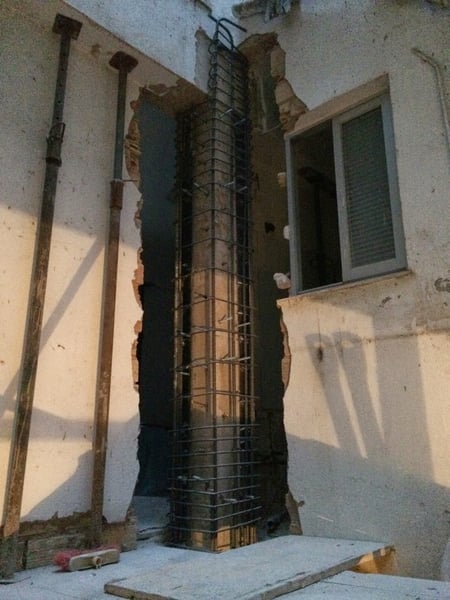
Section enlargement involves increasing both the concrete area and the amount of reinforcing steel in the column. It is one of the most commonly used techniques for Reinforcement of Reinforced Concrete Columns.
The bond between the new reinforcing bars and the obsolete ones becomes very important if their condition still allows them to withstand some tensile force. For this reason, it is sometimes appropriate to cut out a section to gain access to these reinforcing bars, as shown in the image, where some connecting forks.
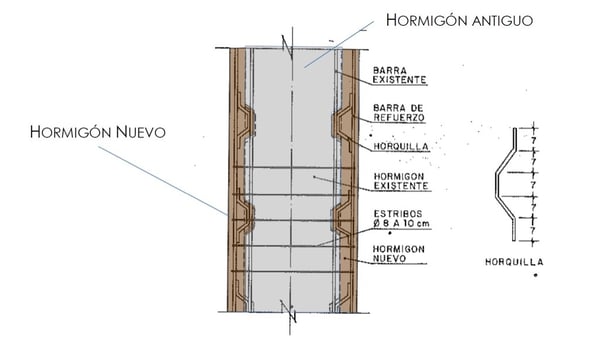
Similarly, the original concrete section is usually chiseled away by about 3 centimeters in order to achieve a proper adhesion between the different types of concrete. It should be noted that these two materials should, if possible, have the the same elastic limit, because otherwise, they might warp differently and not be effective.
Advantages of section enlargement:
- It's a very common solution in various applications, as well as being the most radical and effective in the most complex cases.
- It offers the possibility of correct any errors in the calculation of concrete strength or the amount of reinforcing steel.
- Affordable.
Disadvantages Section growth:
- Technical training is required to calculate the screed in detail.
- If the original pillar is located in very poor condition, the screed must be designed to support all loads on its own, which requires a more detailed analysis. Furthermore, in this case, the structure must be shored up to relieve the load on the element in question; otherwise, the reinforcement will only act against the excess loads.
- Modifying the section will result in a change in structural stiffness, which will lead to a new distribution of stresses in the structure that must be taken into account.
2. Column Bracing
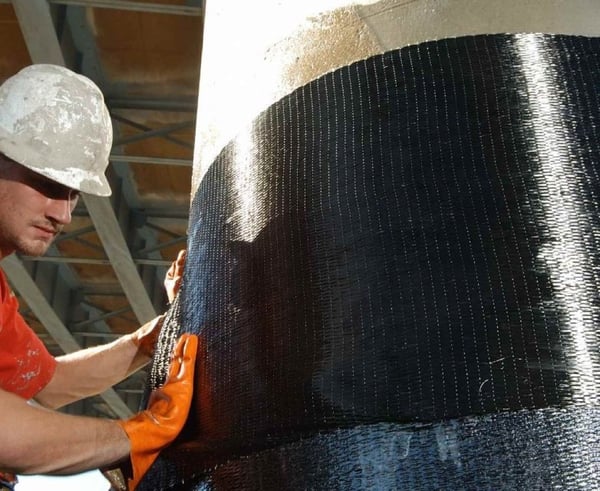
This technique achieves an effective increased resilience of the existing concrete, serving as a supplement. It is clear that confining the element will dramatically improve its compressive performance, but it will also become significantly stiffer. Several options are presented here:
Carbon-fiber-reinforced
Advantages of Carbon Fiber Strapping
- It is one of the most widely used solutions, given its simplicity.
- Very effective, given the material's high elastic limit.
- It features a very quick installation.
- It significantly strengthens the cutter.
Disadvantages of carbon fiber strapping:
- The The price is the highest, since it's made of carbon fiber.
- It does not affect primitive armor if necessary.
Below, we highlight some common mistakes made when implementing this solution:
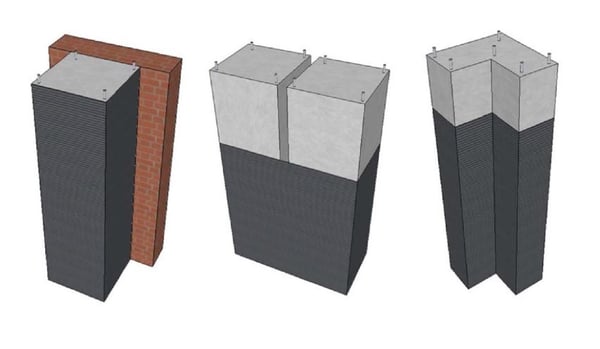
3. Banded with a metal band
The pillar grating It involves encasing them in welded metal profiles that contain the concrete.
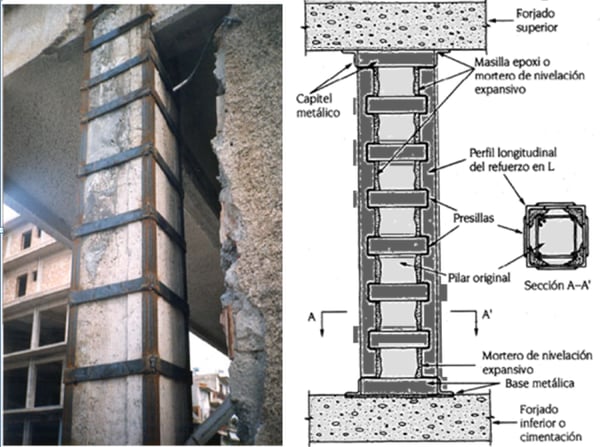
Advantages of strapping with metal strapping:
- It offers the same advantages as carbon-fiber strapping, which has rendered this solution obsolete.
- It is more affordable than the previous lockdown.
- Strengthen notably sharp.
Disadvantages of strapping with metal strapping:
- Its placement is more complex than that of carbon fiber, and this is often a drawback when deciding on this solution.
- Requires welding performed by a specialist technician.
- It does not affect primitive armor if necessary.
4. Metal casing
The column cladding It is a technique that combines the advantages of metal strapping with carbon fiber reinforcement.
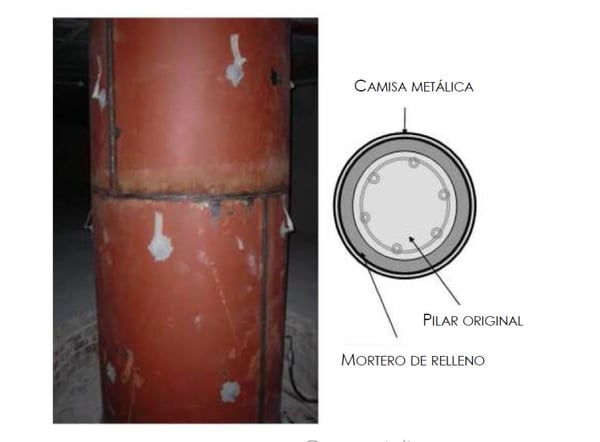
Advantages of metal casing:
- It highlights the advantages of metal strapping, combined with the carbon fiber reinforcement.
- It significantly strengthens the cutter.
Disadvantages of metal casing:
- It makes the section much stiffer and it can become a problem in some cases.
- It does not affect primitive armor if necessary.
5. Reinforced with rolled steel
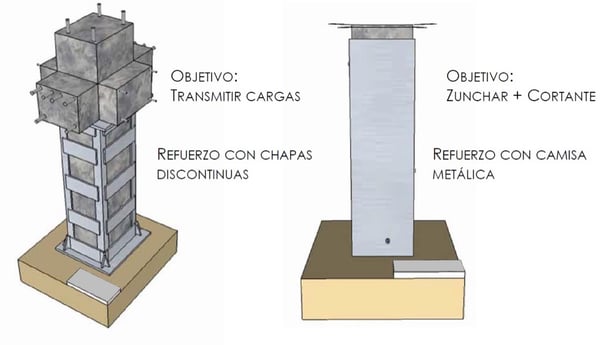
Advantages of rolled steel strapping:
- Like the previous one, it offers the advantages of metal strapping, combined with the carbon fiber reinforcement.
- It significantly strengthens the cutter.
Disadvantages of rolled steel strapping:
- It makes the section much stiffer and it can become a problem in some cases.
- It does not affect primitive armor if necessary.
In general, the reinforcement should be designed to withstand the loads on its own, without relying on the rehabilitated column. Furthermore, it is necessary to ensure continuity with the columns of the immediately upper and lower floor slabs in order to ensure proper transmission of the loads.
In any case, the restoration of a pillar requires a specific, individualized assessment, to which we hope to contribute with these insights.
If you'd like to learn more about Structural Rehabilitation, feel free to check out our upcoming graduate program:
Master's Degree in Building Renovation and Energy Conservation