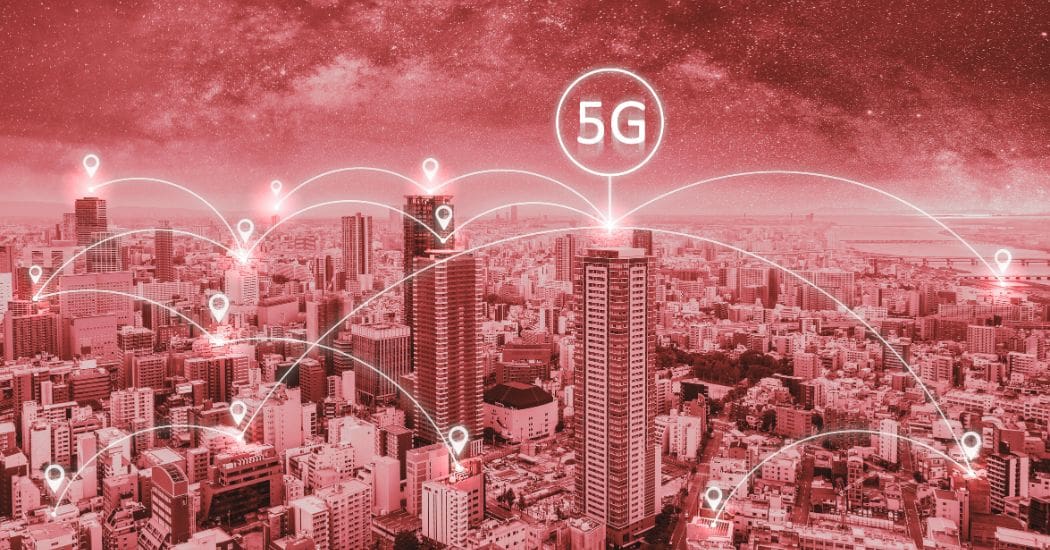
5G technology is accelerating the digital transformation of our cities, enabling more efficient, secure, and connected services.
Sectors such as healthcare, security, leisure, transportation, and especially telecommunications have been improved thanks to these new advancements. Technologies such as Big Data, the Internet of Things (IoT), Artificial Intelligence (AI), and cloud computing are now commonplace, and many companies—and even the general public—use them in their daily lives.
One of the most significant recent advances involves mobile networks—what is known as 5G—but What are mobile networks? Mobile networks can be defined as a telecommunications system that enables wireless communication and facilitates the exchange of data between devices via radio waves.
What is 5G, and how is it different from 4G?
The 5G It is the fifth generation of mobile networks and represents a qualitative leap forward compared to its predecessor, the 4G. It's not just about faster speeds; it's a technological evolution designed to support a hyperconnected world.
With much higher upload and download speeds, lower latency, and a more stable connection, 5G enables faster, smoother, and more reliable communications. Its ability to connect millions of devices simultaneously makes it the technological foundation for key developments such as smart cities, the Internet of Things (IoT), and autonomous vehicles.
Features of 5G
Although we've already briefly discussed the main features of 5G, let's take a closer look at them:
Low latency
5G offers a response time of less than 1 millisecond between sending and receiving data. This feature is crucial for autonomous vehicles, remote surgery, and any technology that operates in real time.
High transmission speed
It reaches a theoretical maximum speed of up to 10 Gbps (gigabits per second), although this has only been achieved in laboratories under optimal conditions. Although network speed depends heavily on location, it generally ranges between 200 and 500 Mbps (megabits per second)—a speed far superior to that of the previous generation, 4G.
Greater connectivity
Thanks to its greater capacity, it allows millions of devices to be connected to a single mobile network per square kilometer, making it ideal for so-called “smart cities.”.
Energy Efficiency
It consumes less energy per transmitted bit and improves the battery life of devices connected to the network.
High device density
It allows many devices to be connected at the same time without negatively affecting network quality.
5G as a cornerstone in the development of the so-called “Smart Cities”.
The concept of Smart City, or intelligent city In Spanish, this refers to an urban environment that uses telecommunications and digital technology to improve the quality of life for its citizens, optimize public services, and promote sustainable development.
These cities are the answer to the challenges of climate change, overpopulation, and the scarcity of strategic resources.
To this end, cities are integrating sensors, digital platforms, artificial intelligence, and big data management and analysis into their infrastructure to make more efficient decisions in areas such as transportation, energy, waste management, public safety, and health.
As we can see, for a smart city to function effectively, it is essential to have a connectivity network Powerful, stable, and fast—exactly what the 5G mobile network offers.
5G Applications in Cities
Among the many applications that 5G enables in a smart city, traffic management stands out as a prime example. Intelligent traffic systems adjust traffic lights based on the flow of vehicles or pedestrians, significantly reducing traffic congestion.
It is also key to the use of autonomous vehicles, as they rely on ultra-fast communications to operate safely.
Similarly, many public services will be improved through real-time monitoring, enabling an immediate response to any emergency or public need.
In addition, 5G facilitates the automation of certain building services, the efficient use of energy through smart grids, and equitable access to digital services in neighborhoods far from the city center.
Future Outlook and Challenges
5G was first rolled out in 2018, specifically in Brussels, and since then it has gradually improved communications and a wide range of digital services. However, its evolution toward widespread adoption still faces technical, economic, and social challenges.
Without a doubt, 5G has made it possible for us to talk about Industry 4.0 today, which enables the automation of many processes, predictive maintenance, and the use of robots to handle the most repetitive and simple tasks in the production chain.
Although the outlook for 5G is promising, there are certain concerns that could limit its development:
The widespread use of real-time data raises concerns about the control, storage, and use of personal information, with many citizens fearing a loss of freedoms related to individual privacy.
For many of these new technologies to function optimally, it is necessary to establish clear, common rules among countries so that the 5G ecosystem can operate on a global scale; however, we see that the world’s major powers (primarily the U.S. and China) are reluctant to strengthen ties and collaborate.
On the other hand, excessive regulation in regions such as the EU may limit research and technological development in this field.
Conclusions
As we can see, 5G has the potential to lay the groundwork for a hyperconnected world that is more environmentally responsible, but its development must be accompanied by policies that support its growth, sustained investment, and a clear strategy for overcoming the challenges it currently faces.