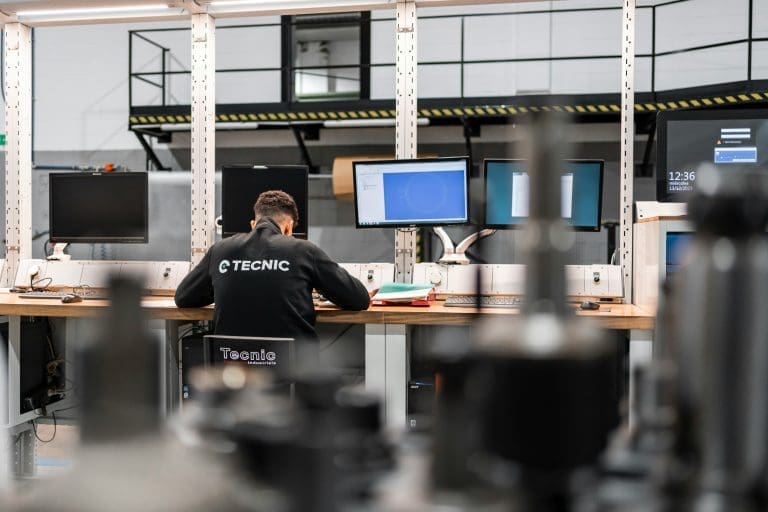
The unstoppable advance of new technologies has transformed the needs of the workplace, which in turn has led to a shift in the demand for professional profiles. In fact, according to the 13th "Most Wanted" Report According to Spring Professional, 85% of the jobs that will exist in 2030 do not yet exist.
However, what is known is that eBig Data, the Internet of Things (IoT), and artificial intelligence will play a major role across all sectors in the coming years. This is a scenario that cannot be overlooked in either the European or Latin American markets.
And with regard to engineering, it is worth noting that professionals in this industry are already talking about a 4.0 paradigm in which there are an increasing number of challenges related to the digital age: from process automation and large-scale data integration until the reorganization of value chains, and the production systems.
The Keys to Tackling the Industry's Challenges
With that in mind, here are the steps every engineer should take to adapt to the new digital landscape in which the industry operates:
1. Integrate digitalization into the company
This is the main challenge facing the fields of engineering and construction. The fact is that integration into digital work environments entails the adapting new technologies to the various professional tasks within companies. Of course, the goal is to improve performance and competitiveness.
2. BIM Implementation
Some European countries, such as France and the United Kingdom, have already had to resort to mandatory use of BIM methodology when carrying out all of its government projects. Spanish regulations will also become mandatory very soon, so their implementation in Latin America is only a matter of time.
Specifically, it is a single information model from which all project stakeholders operate; therefore, its implementation requires an action plan that encompasses all of them.
3. Cloud Solutions
Advances in information technology have enabled the development of the Cloud computing, distributed processing systems, storage virtualization, and streaming. And today, it is essential to adopt various types of next-generation networks in infrastructure.
4. Incorporate technological tools
New technologies have been developed to make our lives easier and more comfortable, as well as to simplify certain tasks in our daily lives and at work. In the world of engineering, this translates to optimizing project efficiency.
In this context, the sector currently has a range of tools that already offer enormous potential: the use of drones, sensors integrated into smart infrastructure, construction robotics, sensors and embedded systems, 3D printers, and augmented, mixed, and virtual reality.
5. Data Analytics, Big Data, and Machine Learning in Industrial Environments
Within the framework of Industry 4.0, companies in the sector need to interact with different systems. This is where Big Data plays an important role, as its systems process a larger volumes of data at speeds unthinkable for traditional systems. In this context, it is worth noting the implementation of the machine learning (or Machine Learning) in businesses, a discipline that develops systems that Through algorithms, they learn to detect behavioral patterns.
6. Turn cities into Smart Cities
Technological advances have also reached the construction industry. So much so that today's challenges include the incorporating information and communication technologies to optimize cities' resources and use them efficiently. This is what is known as Smart Cities And to implement them, it is necessary to rely on energy-saving optimization, home automation, smart sensor systems, the interconnection of urban services, and smart mobility solutions.
7. Adapt professional training to new technologies
When it comes to putting all of the above into practice, it is essential to adopt the specific knowledge needed to master the new tools, procedures, and methodologies calls to revolutionize the workplace. What's more, in order to meet the needs of companies in the sector, these firms are beginning to require their professionals to undergo specialized training in this area.
Now that you know how to tackle today’s engineering challenges, what are you waiting for to bring your 4.0 knowledge up to date? Structuralia It offers numerous graduate programs in engineering, infrastructure, energy, and construction. Feel free to learn more about the different programs!