The Hydraulic pumps are essential to the industry, and there are two main types you should know about.
Hydraulics is one of the most interesting branches of physics, which is concerned with the study of the specific properties of liquids and their mechanical properties. The development of this field has brought many advances for humanity, as it has allowed us to take advantage of the properties of fluids such as water and oil in transportation, machinery, industrial processes, and even energy production. And one of the fundamental devices in this field is the hydraulic pumps.
Hydraulic pumps can be considered the fluid mechanics instrument most widely used in large- and small-scale industrial processes around the world. This is due to its ease of use and the possibilities it offers the use of this type of pump.
What Is it a hydraulic pump?
It is a type of device that is responsible for to set a fluid of any kind in motion, while being able to vary the force used to do so. For these reasons, pumps are considered fluid-handling machines, since their mechanical system is capable of exchange energy with the fluid they contain. Based on their internal operation, we can classify them into two types: positive-displacement and rotodynamic.
Positive-displacement (volumetric) pumps
These types of pumps work because of compression caused by an internal or external factor, which is capable of filling the space occupied by the fluid inside the pump. It expels the fluid through the outlet at varying pressures into a container or another type of device, such as a single-acting cylinder.
Because of the way these pumps move the liquid—where the movement may be slower, but more force can be applied to the fluid, are ideal for transporting or moving viscous liquids such as creams, jams, and oils, and for powering mechanisms that require high pressure, such as pistons or hydraulic tools.
1. Lobe Pumps
This subcategory of rotary positive-displacement hydraulic pumps consists of pumps that Inside, there are two lobes that rotate simultaneously in opposite directions to direct the liquid or fluid from the inlet to the outlet. When the lobes rotate, a vacuum is created that draws the liquid in through the inlet.
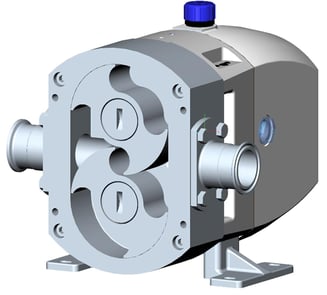 3D model of a lobe-type hydraulic pump. Inter-company
Rotodynamic Pumps (Centrifugal)
On the other hand, these types of pumps have inlet and outlet ports, which They are hydraulically connected by an open channel, so the fluid circulates exclusively inside the pump and moves in a “countercurrent” direction. These pumps take advantage of the centrifugal force of a rotating object that pushes the fluid away from the axis, and at the same time draws more fluid into the pump.
Since the operating principle of this type of hydraulic pump is based on the dynamics generated by the high-speed movement of a rotor, its applications are limited to liquids or fluids that are not affected by a sudden increase in their velocity. Therefore, it works very well for transporting water, irrigation systems, and fertilizer application; however, it is incompatible with certain industries, such as the pharmaceutical and food industries.
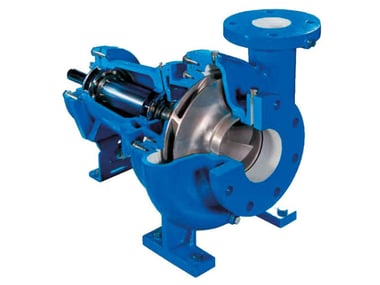 Example of a centrifugal pump. Keep going
Each of these pumps are essential in many industrial processes which are used to manufacture the products we consume every day, and each one is particularly well-suited for a different type of process. The same models of these hydraulic pumps are used in larger-scale industries such as construction, steel manufacturing, mining, and even in fields that require much greater precision, such as the cooling of computer components.