The carbonation of concrete It is a natural chemical reaction that occurs when this material comes into contact with steel and can turn into a structural pathology, In this article, we'll give you many more details and explain how to prevent it.
What is concrete carbonation, and how can it be prevented?
Concrete Although it is a relatively easy-to-use material in construction—and, above all, a very common one—it has a number of complex chemical processes. One of them is carbonation of concrete, which in some cases is considered a defect because it alters the material's properties in such a way that it can ultimately affect the mechanical strength of concrete.
Actually carbonation of concrete It is a natural process that this material undergoes throughout its lifespan; while it is true that it can become more severe and with the involvement of other external factors, it could become a major health problem for a concrete structure with serious consequences.
Reinforced Concrete
Concrete is nothing more than a a mixture made by combining cement, water, sand, and gravel in various proportions; and once the water reacts with the cement, it solidifies and achieves significant resistance to compressive loads. However, on the other hand It is a fairly rigid material on its own and with difficulty resisting shear forces.
This disadvantage is addressed by the addition of rebar along the length and width of the structural member that it be made of concrete to give it a certain elasticity and resistance to various types of loads, to which structures are typically subjected. However, when these two materials come into contact, a very specific pH must be maintained to prevent accelerated oxidation of the steel, which is the ultimate consequence of concrete carbonation.
What is concrete carbonation?
Concrete, as a mixture, contains calcium hydroxide, and when carbon dioxide in the air penetrates the concrete, it reacts with it to form calcium carbonates, and therefore, reduce the pH of the material to 9. So far, nothing serious has happened; the problem arises when the interaction between the concrete and the layer of rust on the rebar that are used to mix concrete.
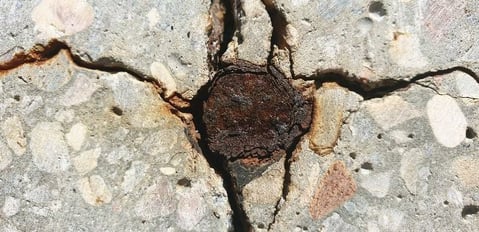 Cross-section of a carbonated structural element. Source: krystalinetechnology
Factors That Contribute to Concrete Carbonation
Moisture Content of Concrete
As we mentioned earlier, moisture is a factor that accelerates carbonation, starting at 50 or 55 % relative humidity is where the optimal conditions for this chemical reaction occur. Surprisingly, starting at the 75 % of moisture relative, the situation is reversed because the pores are gradually blocked by water.
Concrete Permeability
When the concrete mix turns out to be too porous, dcause water to pool in them and promotes carbonation; this is very common in mixtures with an inappropriate water-to-cement ratio, poor compaction, and insufficient vibration, as well as the lack of pozzolans such as fly ash or silica fume, or a inappropriate treatment of concrete.
Coating and Surface Defects
There may be cases where carbonation is severe even though the concrete is fairly impermeable, since poor coating or surface defects such as cracks, drill holes, or cuts, can become direct access points to the reinforcing steel. And this is often one of the most serious factors, and where the effects of carbonation are most quickly visible the integrity of the material.
Preventing Carbonation in Concrete
Carbonation, when it develops at depth and affects the steel, can lead to cause irreparable damage to the concrete element. That is why the ideal approach—and the responsibility of professional engineers and architects—is to prevent this reaction from affecting the concrete, or, failing that, to detect it at an early stage when the effect can still be mitigated.
The preventive measures that can be implemented are aimed at the factors that accelerate the effects of carbonation—which we mentioned earlier—and therefore prevent a drop in pH indoors. The most commonly used preventive treatments are:
-
- Corrosion inhibitors: These are chemicals that are typically added to a corrosive medium in small concentrations; they act on the surface of a metal and inhibit the anodic, cathodic, or both reactions. Some can be added directly to the cementitious mixture.
- Anti-carbonation paints: These paints are capable of sealing the pores in concrete, thereby preventing them from trapping CO2, which would subsequently trigger the carbonation of the concrete.
- Water-repellent treatments: They can be additives for fresh concrete mixes, or they can be paints applied to the concrete surface that offer performance similar to that of paints.
Post-treatment procedures
As we have already mentioned, in very advanced stages of Carbonation is very difficult to reverse the effects on reinforced concrete. When it is already too late to prevent carbonation, and the damage must be repaired in some way, a manual repair of the most affected areas, chipping away at the concrete in specific areas until the rebar is exposed, cleaning it, applying a corrosion inhibitor, and then sealing it again with cementitious mixtures—preferably water-repellent ones.
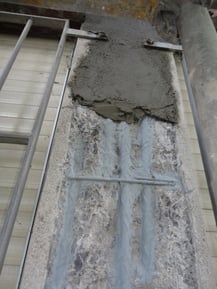
Invasive Treatment of Carbonation in Reinforced Concrete Columns. Source: ObrasInsignia.com
Even so, there is a less intrusive but slightly more complex alternative. The Re-alkalization and chloride removal It is a technique that can be applied to structures that have already undergone carbonation to help reverse the damage caused. It is carried out by applying a current flow so that the structure operates in cathodic mode, with the drawback that it must remain in operation throughout the structure's service life.
Both solutions involve major structural work—and therefore high costs—but they are necessary to ensure the integrity of a reinforced concrete structure affected by carbonation. That is why this chemical reaction must be taken very seriously. before it escalates to a situation that is difficult to resolve or even a complete loss of the structure's integrity.