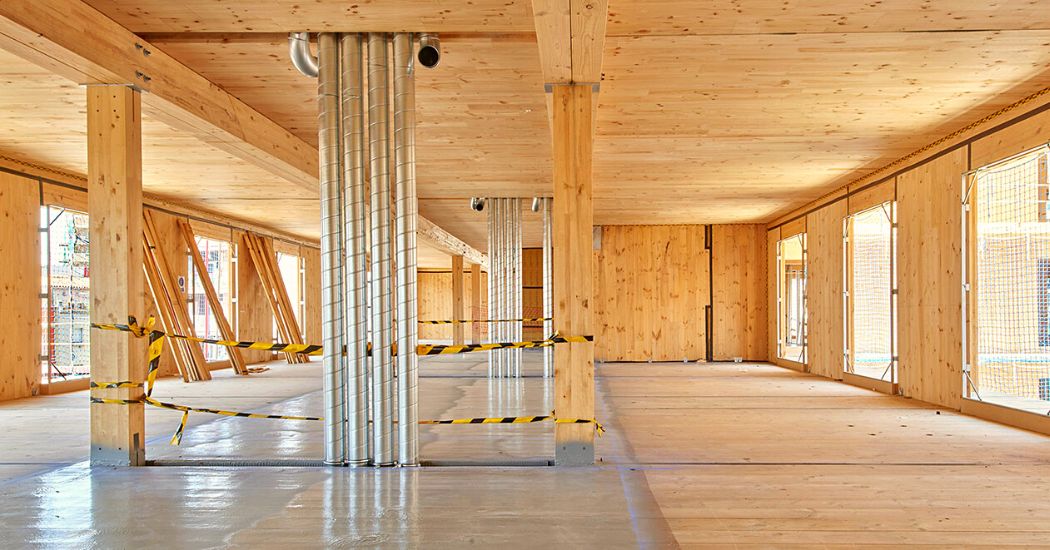
Structural Wood Design: A Trend That Is Gaining Ground Every Day
The use of wood in construction has been discussed since the Neolithic, since it possesses mechanical strength properties (which are inherent to the material itself) and It can be done without the need for very complex tools, it was and remains a very good material for building portal-frame structures. And today, with a good wooden structural design It is possible to achieve performance levels very close to those of other structural materials, and it is also a a very environmentally friendly type of construction, which is a very important issue today and will become increasingly so.
It's no secret that throughout the 20th century reinforced concrete and steel They became the construction and structural materials par excellence, completely relegating wooden structures to a marginal role. But In recent years, structural wood design has regained importance, thanks in part to the mass production of laminated wood beginning in the 1980s, and later to the growing global awareness of its environmental benefits compared to high levels of CO2 and other greenhouse gases produced by reinforced concrete and steel structures.
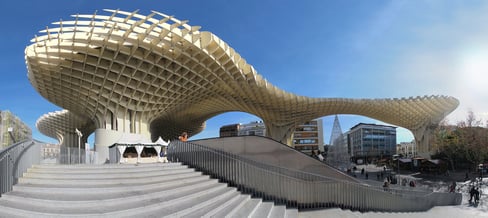 Metrosol-Parasol in Seville, a three-dimensional structure built of wood. Wikipedia
Regulations in Spain for the Structural Design of Wood Structures
Precisely for the reasons outlined above, the regulations governing the structural design of wood have had to be updated; the new structural code (in Spain) It introduces significant changes that represent a major innovation insofar as it eliminates the existing regulatory gap regarding this material. It closely aligns with the approaches established by the Eurocode, implementing proven calculation methods for cross-sections and joints, taking into account solid wood, laminated wood, and other wood-based products that had not previously been addressed in such depth.
Key Aspects of Wood Structural Design
As with other materials, when it comes to structural design with wood, We need to gain an in-depth understanding of how this material behaves. But above all, the external and internal factors that can affect the behavior of the material under the significant stresses to which a building is subjected.
1. Anisotropy
A material that is considered anisotropic is one that, mechanically, It behaves differently depending on the direction in which the force is applied, in terms of wood, this means that the direction of the wood grain determines the material's mechanical behavior. Wood is much stronger in terms of tensile and compressive stresses when its longitudinal axis is parallel to the fibers or grain. (just as a tree naturally supports its own weight).
2. Humidity
Just as steel and concrete expand and contract with temperature changes, wood is affected proportionally in response to humidity; this means that, The higher the temperature, the lower the humidity, and therefore the less moisture the wood releases (in contrast to how steel responds to temperature). Likewise, High levels of moisture and continuous exposure to moisture can drastically affect the integrity of the wood, which is why it should be kept off the ground and protected from standing water
3. Connections or joints
Joints are the critical points of wooden structures, and this is reflected in the weight given to them in the structural safety manual of the technical code. The most effective connections are wood-to-wood joints that are designed to withstand the forces to which they will be subjected. And when it comes to joining wood to other materials such as concrete or steel, Factors such as expansion and contraction must be taken into account of the same, in accordance with the previous point.
4. Types of Wood
Each tree species from which the wood used for structures is sourced, as well as the form in which it is used, is grouped according to “resilient classes”. Therefore, their mechanical strength properties are based on these strength classes so that they can be certified in accordance with international structural design codes.
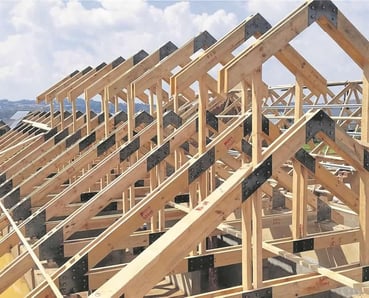 Wooden-frame roof with steel fasteners.
ROOF STRUCTURE: TYPES OF TRUSSES AND THEIR FUNCTIONS; TYPES OF ASSEMBLIES AND JOINTS
Structural design with wood involves a number of factors that are very different from those taken into account when designing structures made of other materials, but also many benefits for the environment, building efficiency, and the construction process. Structuralia offers a master's degree in Structural Analysis for professionals who wish to specialize in the design of structures made from various types of materials.