Recently, news has emerged that a research group at the Autonomous University of Madrid has succeeded in isolating the two-dimensional material “antimonene” in the laboratory—a material similar in structure to graphene but composed of antimony atoms instead of carbon. This discovery opens the door to a wide range of applications, especially in the energy sector. We’ll tell you a little more about this unusual material in this post.
Although its existence was already known thanks to theoretical studies, it was only last week that the antimonene has managed to become isolated in the laboratory thanks to a research team from the Nanomaterials Group at the UAM, in collaboration with the Sensors and Biosensors Group at the same university, as well as a group of electrochemistry experts from Manchester Metropolitan University in the United Kingdom. The discovery has been published in the the scientific journal *Advanced Energy Materials*.
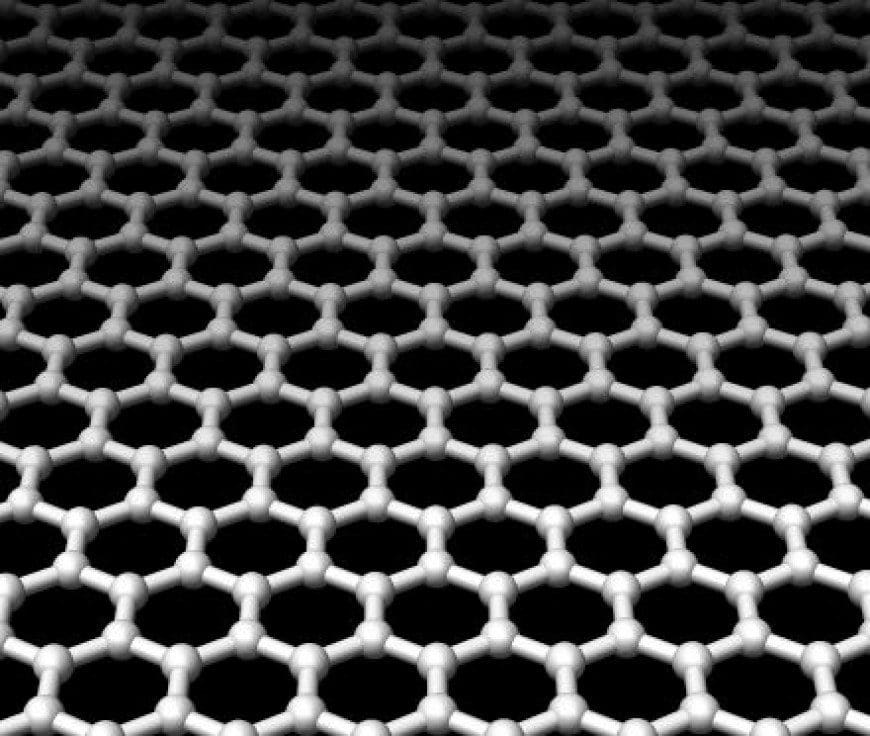
Among other features, the antimonene has a structure shaped like a atomic-thickness layers, similar to those of the graphene but with antimony atoms instead of carbon, joining it on the list of so-called “two-dimensional materials”because of its extraordinarily thin thickness.".
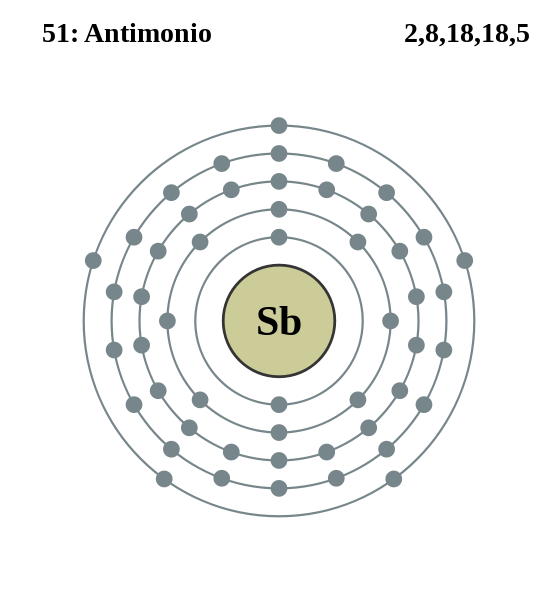
Image: Pumbaa (original artwork by Greg Robson, Wikimedia)
Since the synthesis of graphene more than a decade ago, the applications discovered for the two-dimensional materials have been very diverse and are found in in the midst of development at present.
Among the various applications of antimony, those in the field of energy generation and storage, very favorable for the development of renewable energy, yielding good results when used in the supercapacitor manufacturing (devices capable of storing large amounts of electrical energy in the form of electrostatic charges). Supercapacitors operate by separating electrostatic charges into positive and negative ions thanks to the coating of the antiomonene nanostructure with either anions or cations.
According to the research conducted, Antimonene can store four times as much energy as graphene, and also providing a high stability in the face of cycles of loading and unloading electric power. These properties make it a strong candidate for the development of applications in the energy sector.
Another key characteristic of antimonene is the high surface-to-volume ratio that it has, which facilitates the movement of ions inside it, making it an ideal material for its Applications in supercapacitors. This phenomenon is further exacerbated by the formation of channels and cavities between its layers nanoscale. The use of supercapacitors is becoming increasingly widespread in Replacement of Batteries, as well as in the electric motors in hybrid vehicles and also as emergency generators in the event of power outages in areas such as hospitals or elevators.
In addition, research has begun into applications of this material in components such as long-lasting batteries for electronic devices or in the creation of sodium batteries, which could replace lithium batteries given the scarcity of lithium. Everything indicates that antimony will have a wide range of applications as wide-ranging as graphene, but we'll have to wait a while for research and development into the relevant technology to reveal other applications that we certainly can't even imagine today.
Check out our master's programs