Spanish Highway Code 5.2-IC, issued by the General Directorate of Highways, sets forth the Rational Method for calculating maximum flow rates, which are used to design drainage systems for our highways. The following section analyzes this method for determining flood flow rates for highway design.
The rational method assumes that runoff in a given watershed is generated by precipitation of uniform intensity over time across its entire surface. For this reason, before applying this method, it must be verified that none of the following factors could be relevant to the calculation:
- Inflow of water from other watersheds or transfers to them.
- Presence of sinkholes, or isolated, one-time inflows or discharges.
- Accidents of any kind.
- The presence of lakes, reservoirs, or floodplains that could produce a flood-attenuation effect or divert flows to other watersheds.
- Inputs resulting from snowmelt or other meteorological phenomena.
- Water flows that emerge at points within the watershed as a result of its hydrogeological regime.
In general, these conditions are met in watersheds where the area is less than 50 km2, so its use is recommended in these cases. For all other scenarios, the Instruction cites statistical and hydrological methods as the most appropriate procedures.
Given that, the concentration time (Tc) can be defined as the minimum time required from the start of the downpour for the entire watershed area to begin contributing runoff at the outlet. It is clear that this quantity depends on the length and slope of the selected watershed. This is expressed in the following equation, where the unit is in hours when the other variables are entered in meters:
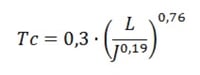
Where:
- L: is the length of the watershed in km.
- J: is the slope of the watershed in m/m.
In those small main watersheds where the travel time of diffuse flow over the land surface is significant relative to the total travel time, the above formula does not apply. Please refer to the Instruction.
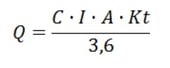
The proposed formula allows you to calculate the flood discharge based on the runoff coefficient (C), the maximum average intensity (I) during the calculation period corresponding to the concentration time Tc, and starting from the watershed area (A) which will affect the value of the uniformity coefficient (Kt), using the expression:
Before beginning to calculate the design flow rate, you must have obtained the maximum daily precipitation of the area where the project is located. If this information is not known, it can be obtained through the estimate by the Ministry of Public Works, consisting of the following steps:
1.) Locate the geographic point of study on the isoline map provided by the Ministry of Public Works (Maximum Daily Rainfall in Peninsular Spain).
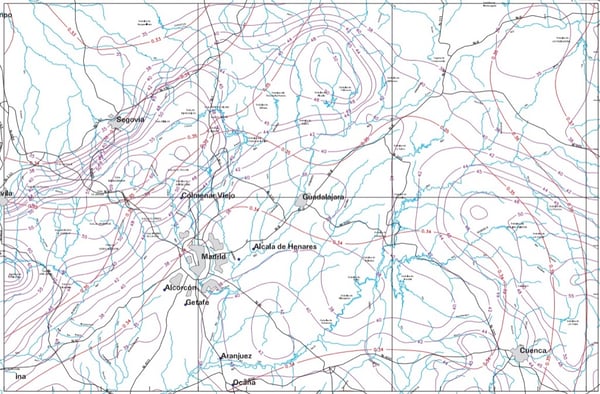
2.) Estimate, using the isolines shown, the coefficient of variation (CV) (lines red with values less than one) and the average value of the maximum daily precipitation annual (lines homes).
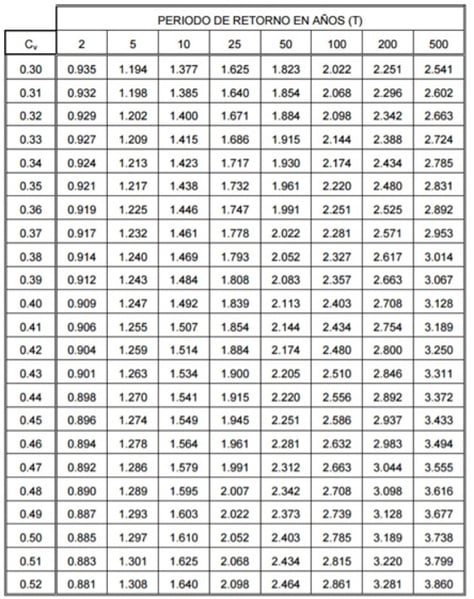
3.) For the return period desired (T) and the Cv value, obtain the amplification factor (KT) using the following table.
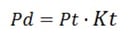
4.) Multiply the amplification factor (KT) by the average annual maximum daily precipitation in millimeters (Pt) to obtain the maximum average daily precipitation for the desired return period (Pd). The data (Pt) can be obtained from various weather stations.
Having established the above, the first The parameter that must be obtained is Rainfall Intensity (It) for the calculated residence time, using the following formula:
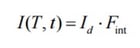
Where:
- I(T,t): is the calculated precipitation intensity.
- Id: is the average daily intensity corresponding to a return period T, in mm/h.
- Fint: This is the intensity factor.
To calculate Id, the daily precipitation Pd calculated earlier will be taken into account; these are related by the following formula:
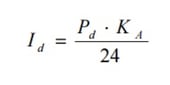
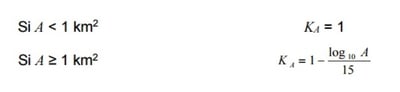
Where KA is the precipitation reduction factor, whose value is obtained using the following expression, substituting the area (A) in km:
When calculating the intensity factor, it is important to note that it depends on the return period (T) and the duration of the downpour in hours (t). Its value will be older of the following two: Fa or Fb.
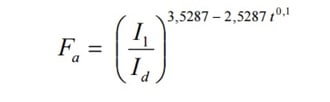
Where:
- t: is the concentration time, which, for this parameter, must be specified as the concentration time value (t=Tc).
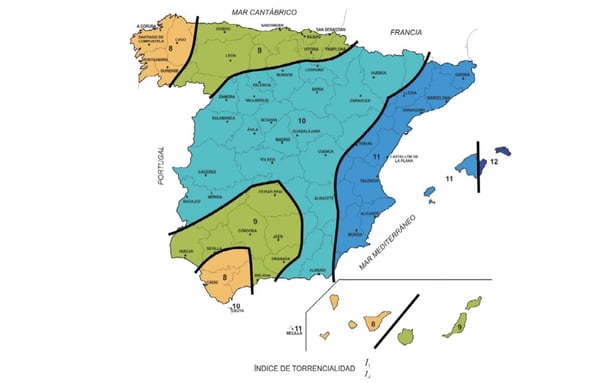
- I1/Id: This is taken from the I1/Id value map for Spain, shown below:
In the case of Facebook, its value is derived from the IDF curves from a nearby rain gauge, using the equation:
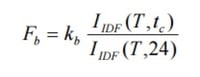
Where:
- Kb: This is a factor that takes into account the ratio of the annual maximum intensity over a 24-hour period to the daily annual maximum intensity. In the absence of a specific calculation, Kb may be taken as 1.13.
- IIDF (T, tc): This is the precipitation intensity corresponding to the return period T and the concentration time tc, obtained from the rain gauge's IDF curves.
- IIDF (T,24): This is the precipitation intensity corresponding to the return period T and a downpour duration of twenty-four hours (t = 24 h), obtained from the following IDF curves.
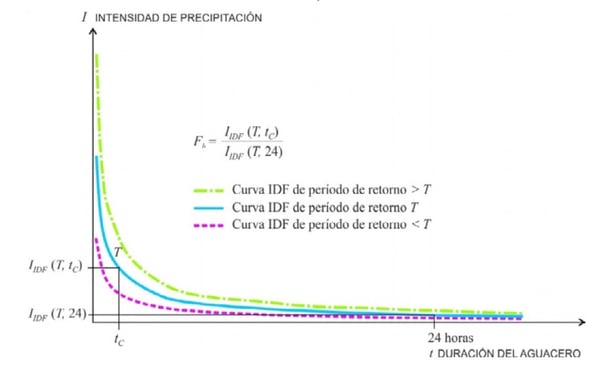
With this, we have now obtained the first parameter of the formula for maximum flow rate.
The second The next step will be to calculate the value of the Runoff Coefficient (C) (the ratio of the portion of precipitation that runs off the surface to total precipitation), using the following expression:
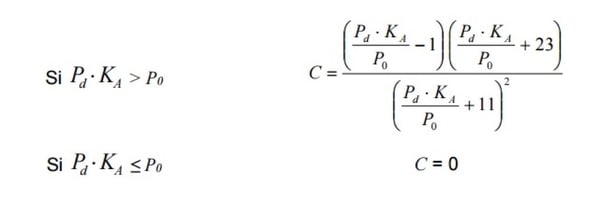
Where:
- C: Runoff coefficient.
- P.S.: Maximum average daily precipitation for the specified return period (mm).
- KA: It is the factor that reduces precipitation.
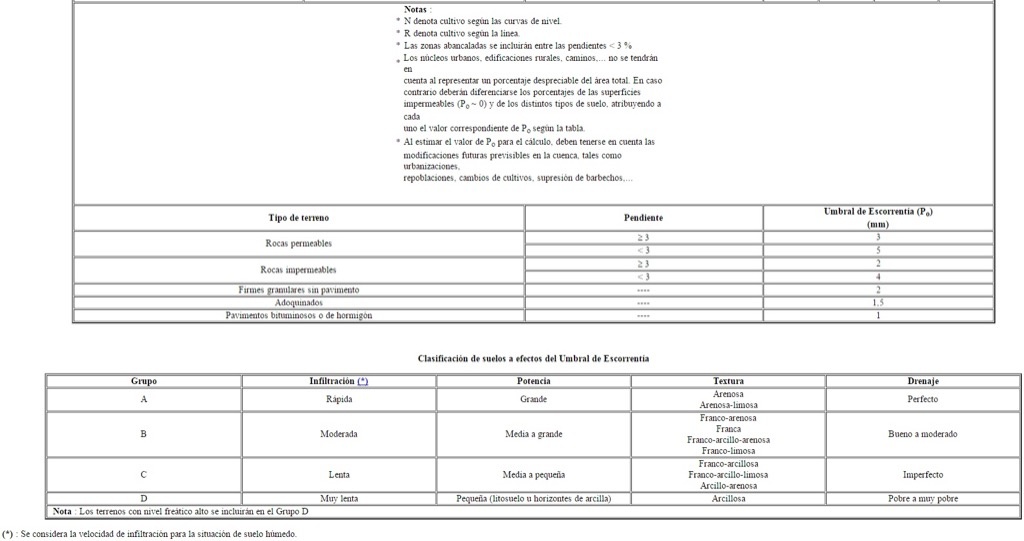
- P0 = corrected runoff threshold in mm. This value is defined as the minimum amount of precipitation that must fall within the watershed for runoff to begin. The initial threshold value can be obtained from the data and maps published by the General Directorate of Highways. Its correction is determined by multiplying the initial value by a coefficient β, whose value is derived from a series of expressions defined in the new standard.
As a sufficiently accurate approximation of this last correction factor, we present the value obtained under the previous Instruction. However, please note that to obtain a more accurate value, you should refer to the new Instruction.
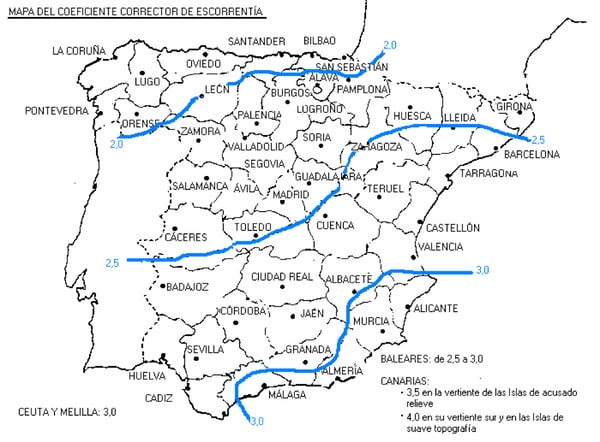
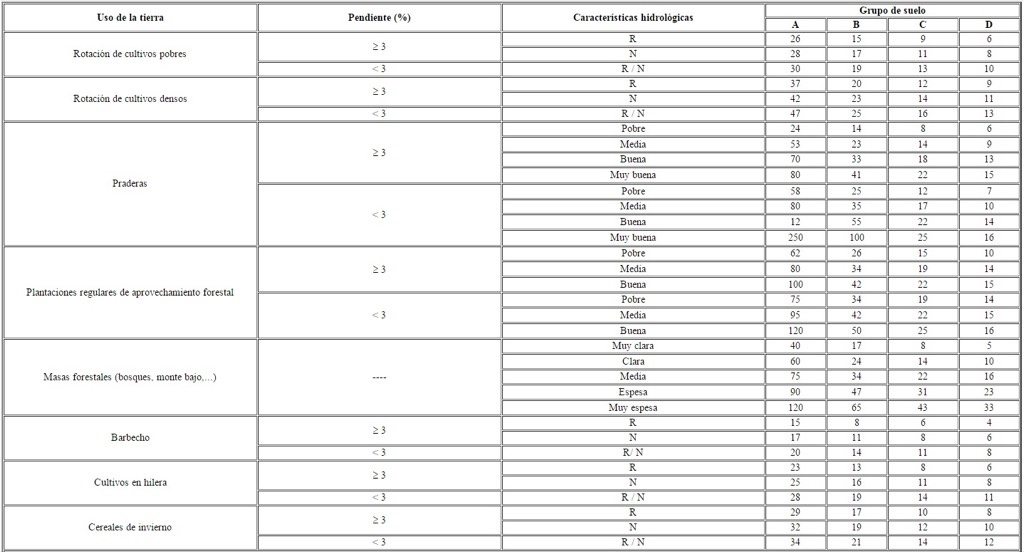
The value of P0 is usually estimated, although the new Instruction includes a method for calculating it, bearing in mind that this value will depend on the type of soil and its vegetation. To this end, there are tables that should be consulted, taking the above into account:
The third The step that must be taken to determine the flood discharge is to calculate the value of the basin area in km (A) that, for the purposes of this regulation, it is defined as the area measured in horizontal projection (plan view) that drains to the outlet that will supply flow to the project under study.
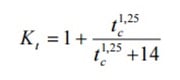
Finally, we still need to know the value of the uniformity factor (K). This is calculated using the following equation, keeping in mind that the concentration time must be entered in hours:
With all of the above, we will have obtained all the values of the various variables on which the maximum flow rate depends, which will allow us to design the drainage systems for our projects—as described at the beginning of this text—using the following formula: