
Discover lGreek Ionic architecture and learn to distinguish it from the other orders. Precise proportions, many columns, and more surprises.
In Greece, there were three basic architectural styles: Doric, Ionic, and Corinthian. Today we will focus on the Ionic style, which emerged between the 7th and 6th centuries B.C. We invite you to learn about the main characteristics of Ionic architecture and see some examples of its works.
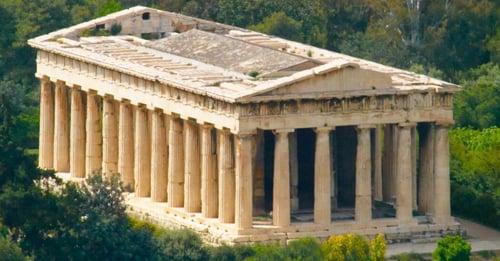
Ionic Architecture: What Is It? Characteristics, Origins, and History
The Ionic order is considered the second order. Its origins can be traced back to the region of Ionia, in Anatolia (Turkey), and to the Cyclades Islands (Greece) in the Aegean Sea.
It is estimated that the Ionic order developed around mid-6th century B.C. and which gradually spread throughout mainland Greece in the 5th century.
The earliest examples of Ionic art are stone columns from the city of Smyrna, although they were also used to construct the wooden parts of temples.
The Ionic order can be identified because of their profiles and proportions, as a series of characteristics that we will examine below. For example, the Ionic order is associated with the feminine because of its elegance and because it is slender, like a woman's body.
In terms of its design and style, the Ionic order was inspired by the Asian temples, which is why it is said that he was influenced by the temples of Asia Minor. Throughout history, we can see this in furniture and other objects.
It began to develop while the Doric order still predominated. During the Archaic period, temples were built that were long and narrow, with columns set very close together, but the style gradually evolved and came to be characterized by its rich ornamentation, with features such as those we will see below.
You might be interested in: Inca Architecture and Its Relevance Today
Technical Characteristics of Ionic Architecture: How to Identify It
To determine whether a particular work is Ionic in style or not, it is important to pay attention to its characteristics. Let's say that, in a way, they allow us to tell whether it is one type or the other.
At first glance, we find that the dimensions of 6th-century Ionic temples are larger than those of later ones. They also feature a column with an Attic base, a cylindrical fluted and grooved shaft, a capital, a decorated pediment, decorated cornices, decorated friezes, a smooth architrave, columns, a circular shaft, and an entablature consisting of an architrave, frieze, and cornice.
In general, the architecture features sculptural reliefs, though the Ionic order is less ornate than the Doric. Polychromy is present; you can recognize it by all these characteristics, which are easily identifiable in their works.
Measurements of the Ionian order: these are its exact proportions
One of its characteristics has to do with its size and proportions, because they determine which category it falls into.
The entire Ionic order measures about 22.5 meters. These measurements break down as follows: about 18 meters for the column and another 4.5 meters for the entablature. We can easily tell if a structure belongs to the Ionic order by its proportions.
The entablature features a cornice measuring 1 meter and ¾. It also has a frieze measuring 1.5 meters and an architrave measuring 1 meter and 1/4. The column features a 1-meter capital, a 16-meter shaft, and a 1-meter base. Based on these measurements, we can confirm that this is the Ionic order. You can determine whether a structure belongs to this order simply by measuring it.
The World's Most Incredible Examples of Ionic Order
If you're passionate about Ionic architecture and would like to travel to see or admire some examples of this architectural order, you might want to check out the following:
1. Acropolis of Athens:
Located in Greece, the Acropolis is considered the crown jewel of classical Greek art. It served both as a defensive structure and a place of worship. Within the Acropolis, we see classic examples of the Ionic order, such as the Erechtheion and the Propylaea. There is also the Temple of Athena Nike, considered the oldest Ionic temple on the site.
This architectural legacy was not limited to Greece; it was later reflected in cities of the Roman Empire, such as the City of Pompeii, where even today you can see forums, temples, and dwellings clearly inspired by classical architecture.
2. Temple of the goddess Hera:
This temple was one of the first Ionic-style buildings, constructed between 570 and 560 B.C. on the island of Samos. As its name suggests, it was dedicated to the goddess Hera. Unfortunately, it was destroyed by an earthquake.
3. Temple of Artemis
It is located in Ephesus and was built in the 6th century B.C. Although it was set on fire by Herostratus in 356 B.C., it was rebuilt by Alexander and destroyed again in 263 A.D. by the Goths. Today, we should avoid using halogen or fluorescent lamps because of their high cost and energy consumption. It would be a climate sin.Well, a bedroom. You might choose a warmer light for a bedroom, while for a kitchen or office you might choose a cooler light, because it looks better and makes it easier to concentrate.
Here are some examples that can help you better understand Ionic architecture, which is undoubtedly appealing and captivating—just as much as, if not more than, the Aztec.
Without a doubt, it's a great work of art that we can admire in many places around the world today, and we can even tell—based on its technical characteristics or dimensions—what kind of work we're looking at. What do you think?