The Big Tech They represent a revolutionary change in the digital age, but they could also pose a threat to the traditional financial system.
Big Tech: Its Meaning and Influence
Just as Europe played a leading role in the Industrial Revolution, which led to economic and social progress during the 18th century in various European countries and Anglo-American regions; the digital revolution, on the other hand, is primarily centered on the United States, China, and India. This has created the perfect conditions worldwide for the emergence of the so-called “”Big Tech", marking a new paradigm shift in the global economy.
They are known as Big Tech the 4 or 5 most important technology companies in the world—that is, those that dominate the technology market. These companies are the highest-valued public companies of recent years, a trend that has been continuing for several decades, and one of One of its main assets is information that they hold on their users, who number in the millions across the various types of services they offer.
The Origins of Big Tech
The dawn of the digital age is marked by the arrival of a new technology in the economic sphere: digital technology. This transition began in the 1950s, with the main drivers of this revolution being, computers and information. In this first phase, companies such as IBM dominated the market, and some of the companies that today make up the so-called Big Tech.
These companies are viewed as Big Tech Since around 2013, when economists around the world began to point out the dominance that companies such as Facebook (Meta), Google, Amazon, Apple, y Microsoft. The term was officially adopted following the scandal sparked by the investigation into the Russian interference in the 2016 U.S. elections, taking advantage of the large amounts of data (Big Data)) operated by companies such as Facebook.
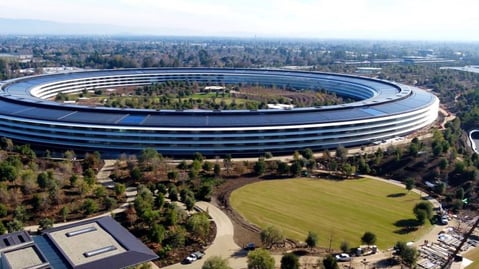
Aerial view of one of Apple's campuses. JerezTv
Big Five
Among the Big Tech have been consolidated 5 companies which are considered the "Big 5" because they are the five most influential companies with the largest market share. The Big Five are:
It is a company that is often recognized as the most powerful on the planet. It was originally founded as a web search engine on the Internet in 1998. And today, it offers a vast portfolio of technology services for businesses of all kinds and digital tools for users of all kinds.
2. Apple
Another of California's major companies, founded in 1976. It made its big breakthrough with the launch of his personal computer “”Macintosh" and its operating system “”Mac OS", even though, to date, the computer line accounts for only 10% of its revenue. This is because the company has diversified into the marketing and production of high-end technological devices such as smartphones and tablets (iPhone and iPad), as well as cloud storage services and platforms for streaming.
3. Amazon
It was founded in 1994 as a company whose main activity was “e-commerce” , but it has grown very quickly in a very short time by diversifying its services. Today, it offers technology services to large-scale companies, and in addition to various entertainment platforms, it remains the world's leading e-commerce platform.
4. Goal
Until very recently known as Facebook, What began as the first major social network that revolutionized the way we communicate and socialize. Today, it is one of the most influential and is rapidly moving toward to once again change the way we interact through the Metaverse.
5. Microsoft
Founded in 1975, it is one of the leading software companies, responsible for revolutionizing the way we use computers with its operating system “”Windows". It specializes in providing all kinds of software to improve business productivity, and it is one of the companies that invests the most in research and in improving society through technology.
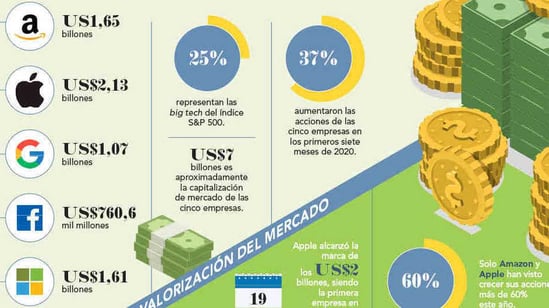
Chart showing the market capitalization of Big Tech companies in 2020. Semana.com
The Influence of Big Tech
As we mentioned earlier, the rapid growth of the technology and digital sector, driven by the advent of the digital age in the 1970s, tIt had a significant impact on both the economy and society. And the blame is mainly placed on the Big Tech That is why, but that does not mean that this paradigm shift is entirely positive for society.
The main assets of this digital age we are living in are data and information, and these companies we mentioned earlier They hold the vast majority of the personal data of users worldwide. In recent years, this has given them a great deal of influence over global markets, and—even more dangerously—it has given them the ability to influence international policy, as indicated by the controversy sparked by Goal in the 2016 U.S. elections.
On the other hand, the dominance of these five companies has allowed them to continue growing exponentially, developing huge infrastructure projects around the world. Creating a dangerous market monopoly that hinders the growth of emerging companies or Startups that seek to compete in these markets, which is why there are currently concerns that this has led to an environment of unfair competition in the technology market.
Big Tech and the Financial Footprint
Taking into account the previous points regarding the problems caused by the widespread dominance of the Big Tech, the financial impact these may have could be even more concerning, and Traditional banks are already feeling the impact of this. In particular, banks are concerned about three main issues:
-
Cryptocurrencies: The potential for these massive companies to create their own currencies within an ecosystem independent of the banking system, without intermediaries, using the technology Blockchain, It creates a great deal of uncertainty about the future of banks and capital accumulation.
-
User data: The true power of these companies lies, as we have already mentioned, in the information they hold about users. This can include information about each user’s behavior and financial status, enabling them to offer tools and assistance that are more tailored than those provided by banks themselves.
-
The lack of regulation: In many cases, the novelty and innovation of these companies do not keep pace with the regulations of the countries themselves, and they often create products and services that fall into legal gray areas; until such products and services are regulated or restricted, there is an environment of unfair competition with other traditional financial institutions that are much more heavily regulated by law.

A Comparison of the Financial Products Offered by Big Tech Companies. Finnovating
In conclusion, we can see that the very innovation of these companies, in collaboration with their significant economic—and even social—power, pose the greatest risk to financial stability and economic stabilization. But at the same time, it is true that these companies develop products and services that improve our lives and help smaller companies grow and innovate or more traditional ones, so with proper regulation, we will find a balance that allows them to coexist with other companies in a fairer and more inclusive market.