The green building It's on the rise. Discover its meaning, its benefits, and the materials used in this type of construction. It's the future.
What is green building, and why is it the future of construction?
In times of sustainability, The way we build is also changing and adapting to the times. Concepts such as green building, a new form of environmentally friendly construction.
Some construction methods are more environmentally friendly than others, and we must remember that we only have one planet. For this reason, more and more architects and clients themselves are becoming aware of this approach to construction, more responsible, eco-friendly, and sustainable with the environment around us.
What is green building, and what are the four concepts on which it is based?
Green building is a type of eco-friendly or sustainable construction. It follows an approach that focuses on reduce the environmental impact of housing, using natural and renewable materials, and minimizing energy consumption and waste generated during construction.
Green building seeks, in a way, to revive that method of construction using natural materials found in nature itself. It is based on these 4 concepts:
Strive to strike a balance between environmental, economic, and social considerations. Therefore, is feasible, fair, and bearable.
Today, although environmentalists, activists, and architects are the ones who have heard the most about this term, the truth is that it’s a form of construction that benefits everyone—not only the environment but also household finances. It can even serve as an investment for the future.
What materials are used in green building?
Green building uses various types of sustainable and eco-friendly materials that come from renewable natural sources and have a low environmental impact (not only during production, but also during transportation and use).
For example, some of the most commonly used materials include:
1. Wood
This material hardly needs any introduction, as it is one of the most popular and widely used materials today. It is a renewable, sustainable, and durable material that provides good insulation and has a low environmental impact. It is also cost-effective compared to other materials.
2. Stone
Like wood, it needs no introduction. Stone is very strong and durable. It provides good insulation and is able to store and gradually release heat, even helping to regulate the temperature.
3. Eco-friendly paints
Another material that is widely used in green building is eco-friendly paint. It is made from natural pigments extracted from plants or minerals, among other sources. The best part is that it contains no substances harmful to the environment and delivers excellent results.
4. Adobe Earth
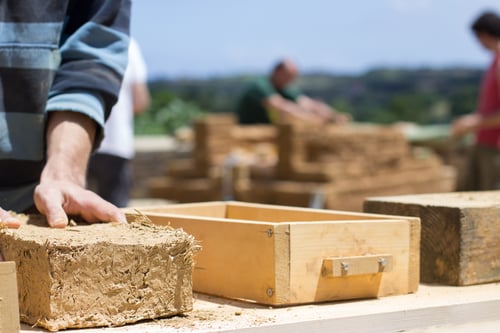
This building material is made from clay, sand, and water. It is simply molded into blocks and then left to dry in the sun. It is environmentally friendly, economical, and thermally efficient. In fact, it is not a new material; it has been used for thousands of years.
5. Cob
Like adobe, it is an inexpensive and efficient building material. It is made by mixing clay, sand, straw, and water, and can be used to build residential structures.
6. Straw
In some ways, straw can be used to make straw bales, which work well as thermal and acoustic insulation. It can be used in combination with adobe or cob to build roofs and walls.
7. PET partitions
These types of partitions look like bricks but are made of PET. As a result, they reduce the use of additives such as cement. They are also highly durable.
8. Recycled steel
Steel is a construction material that can be recycled without losing its properties, which means it can be reused. For this reason, it can be used in green building.
Benefits of Using Green Building Today
Green building is booming because of its benefits for users and the environment. Among its main advantages Highlights:
1. Conservation of resources, water, and electricity
Green building uses technology that helps reduce water consumption or even harnesses rainwater for flushing toilets or irrigation. Efficient systems, such as solar or photovoltaic panels, are also commonly installed to optimize energy consumption and make buildings passive or nearly passive.
2. Using recyclable materials to give them a second life
It is important to foster a culture of reuse—of using resources that are still usable and giving them a second life. This is known as the circular economy, in which recycled and recyclable building materials are chosen.
3. Saving money on bills
Another benefit is financial, because investing in green building allows you to have an eco-friendly and sustainable home that will help you save on your electricity bills. Plus, it’s an investment in the future.
Is there a problem with that?
Not at all. This is the way of building for the present and the future. We are convinced that more and more people will choose this new way of building, such as through passive houses o Passive House.
What do you think about green building? What's your take on it? Do you think it's the future?