Today on our blog, we’ll explain the key factors that define Accident-Prone Sections (TCA) and Sections with High Potential for Improvement (TAPM). Don’t miss a thing!
The definition and procedures for identifying TCA on the State Highway Network (RCE) have been regulated by Service Notes issued by the General Directorate of Highways of the Ministry of Public Works. The first definition dates back to 1993, and currently, in accordance with European Directive 2008/96/EC, the definition set forth in Royal Decree 345/2011 and its guidelines (OC30/2012) is used. In general, there is no consensus on either the name or the definition of TCA (the Autonomous Communities, Island Councils, and Provincial Councils often have definitions that differ from the one used in the RCE), but the concept refers to that a section of the network that poses a significantly higher risk of accidents than the average recorded for sections with similar characteristics over a given period of time. Therefore, the factors to consider when identifying them are:
- Risk exposure (traffic volume).
- Temporal and spatial randomness (representative time periods and distances: 3–6 years and 500–3,000 meters).
- Characteristics of the section (type of road, surroundings, and special sections).
- Statistical distribution (thresholds for identification with a certain level of confidence).
Traditionally, the General Directorate of Highways of the Ministry of Public Works has defined a TCA as a 1-kilometer section in which both the number of accidents with victims over the past 5 years and the average hazard index for that period exceed the respective average for all sections with similar characteristics (equivalent category and lMD), plus the average deviation of those sections:
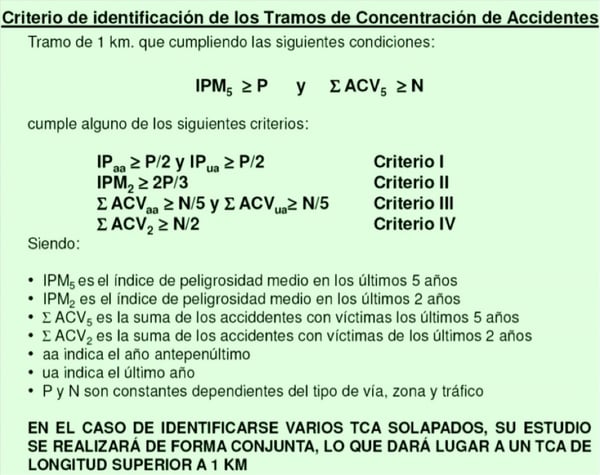
Definition classical TCA, according to the DGC of the Ministry of Public Works.
However, in 2012, Circular Order 30/2012 was issued, approving the guidelines for procedures regarding the safety management of road infrastructure on the national highway network. These guidelines include the following definitions:
- Accident-Prone Section (TCA): is a road segment no longer than 3 km—except in justified cases—that has been in operation for more than three years, where recorded accident statistics indicate that the accident risk level is significantly higher than that of other segments of the network with similar characteristics. This occurs when the hazard index exceeds the threshold for its category, provided that, over the last three years of the period under consideration, more than 5 accidents with victims have been recorded on sections of conventional roads or more than 10 accidents with victims on sections of high-capacity roads.
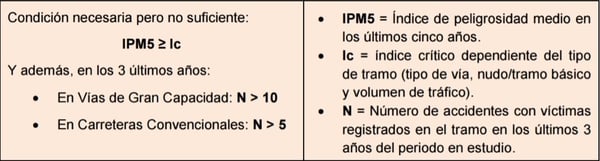
New Methodology for Identifying TCA on the Spanish Highway Network.
- Section with high potential for improvement Traffic Accident Prevention Measure (TAPM): defined as the entire stretch of road with high potential for reducing accident-related costs, where an improvement to the infrastructure is expected to be highly effective, where a complete section is one that is at least 5 km long and lies between two points where changes in traffic conditions or road conditions may occur that affect road safety or traffic management: interchanges, towns, or county boundaries.
Road safety management for roads in service includes the Identification and treatment of accident-prone sections (TCA) and sections with high potential for safety improvement (TAPM) in accordance with the following procedure:
- The identification of TCA and TAPM will be carried out every three years based on an analysis of the number of accidents involving casualties recorded over at least the previous three years in relation to traffic volume.
- Only those sections that have been in service for a certain uniform road safety standards at least during the last three years of the analysis period and Conventional roads and high-capacity roads will be considered separately, and within the latter category, the intercity sections and the rest.
- In the identification of eating disordersWe will distinguish between knots and basic sections both on conventional roads and on high-capacity roads; sections will be considered high-accident-risk (TCA) if the average accident risk during the years analyzed was significantly higher than the average for sections of the network with similar characteristics, and where infrastructure improvements can reasonably be expected to lead to an in accident rates.
- The identification of TAPM will be based on the Classification of the Potential for Improving Network Security, which is a method for grouping together all sections of the road network in operation based on their potential to improve safety and reduce costs resulting from traffic accidents.
- The identified TCA and TAPM will be studied in detail in order to propose measures aimed at eliminating or mitigating any road safety issues detected in them. The technicians responsible for conducting these studies must have specific experience or training in road design, traffic safety engineering, and accident analysis.
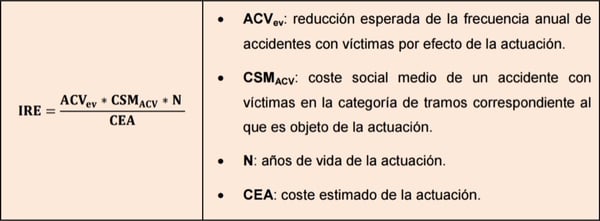
- In infrastructure improvement programs, priority will be given to implementing measures resulting from the TCA and TAPM studies with the greatest Expected Return Index (ERI), which is the ratio of the expected reduction in the social costs of accidents resulting from a road safety improvement measure on TCA or TAPM over its useful life to its estimated cost. To this end, specific programs of road safety improvement measures are established, taking into account available budgetary resources.