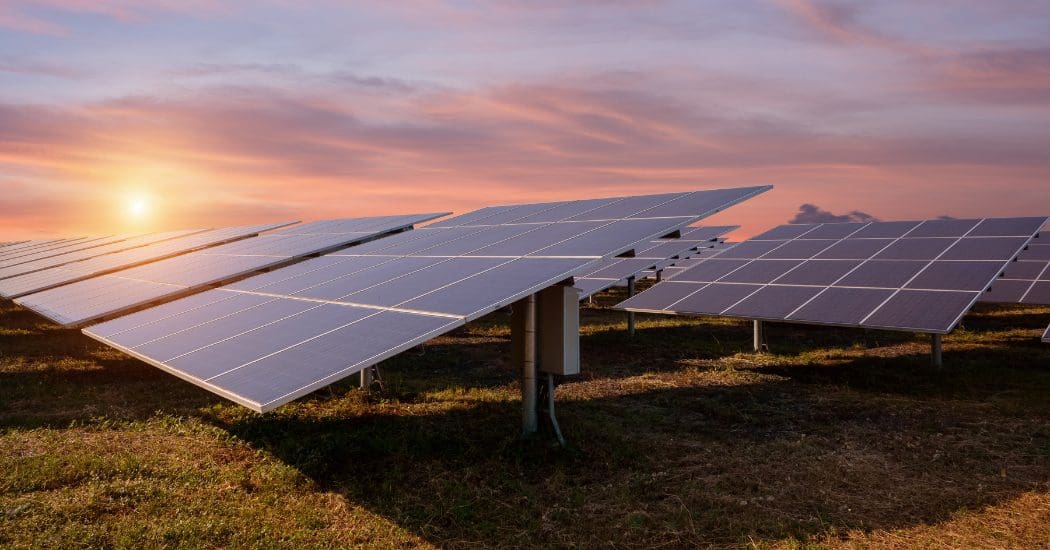
It is called photovoltaic solar energy the electrical energy generated directly in a solar cell from the solar radiation that strikes it. The process of converting light into electricity, known as “photovoltaic effect”, is produced thanks to the invaluable properties of semiconductor materials (primarily silicon and germanium). In these materials, a certain voltage can be generated through the interaction of the energy from incident light particles with the electrons in the receiving material. If an electrical load is connected to the device, electricity is produced.
So, let's take a closer look at the elements necessary for this physical phenomenon to occur.
The Photovoltaic Generator
Although the size and power output of solar panels have increased with recent developments in grid-connected applications—due to construction and transportation limitations—they remain small devices. It should be noted that one of their main advantages is their modularity, which gives them great flexibility when it comes to adapting to a wide variety of applications and locations.
The connection of several panels to produce specific current and voltage conditions (and, therefore, power) is called a photovoltaic generator. In a photovoltaic generator, it may happen that one part is exposed to different radiation conditions than the rest, usually due to shading, dirt, or a cloud in the case of large installations.
The The current generated by a solar cell is proportional to the solar radiation it receives. At the same time, cells and panels connected in series carry the same current—that of the panel that would generate the least current. Some of the causes are impossible to avoid, such as partial shading by clouds, but in other cases, it is possible to try to minimize the losses. Therefore, when configuring a photovoltaic system in series and parallel, you should try to connect in series those panels that will experience similar shading from nearby, known obstacles (chimneys, buildings, trees, mountains, etc.). If a shadow affects a small portion of several panels connected in parallel, all of them will operate at reduced output. It is important to keep in mind that, in some cases, the best solution to excessive shading is to relocate the panels.
Solar trackers
There are various types of solar tracking structures: two-axis, single-axis azimuth (vertical axis), a south-facing tilted axis (polar if the tilt axis equals the latitude), or a horizontal axis (north-south). As a reference, it can be estimated that for latitudes such as those of peninsular Spain, there is an improvement in solar energy yield of between 25 and 40% annually compared to a fixed position with an inclination of about 30° and a south orientation.
Tracking along a horizontal axis, north-south: In this type of tracking, the panels are oriented toward the east in the morning, moving along the north-south axis throughout the day until they reach a westward position at sunset. After sunset, they can return to their initial position in preparation for the following morning. If moderate-to-strong winds are present, they are kept in a horizontal position to reduce mechanical stress; conversely, if snowfall is forecast, they are positioned vertically to prevent snow buildup. Going into more detail, in this type of tracking system in real-world installations, it should be noted that if the panels were in their optimal, almost vertical, the shadow they would cast on other rows of panels would be very elongated, which would either reduce electricity generation in those rows or require the panels to be spaced too far apart, resulting in less efficient use of the land.
In these cases, a compromise must be reached between the two factors (tilt and shading). Thus, in the single-axis tracking panel field at the Toledo-PV photovoltaic plant, which has been in operation since 1994, the tilt is limited to 60° from the horizontal, both in the morning and in the afternoon. This results in an estimated 3% reduction in solar irradiance, which is offset by increased irradiance on the adjacent rows.
Current systems incorporate what is known as "backtracking," which adjusts the position of the panels to reduce shading during the early morning and late afternoon. Among tracking systems, it is one of those that It is simpler, more robust, and less expensive. It is suitable for very large systems, as it maximizes land use because there is almost no shading in the north-south direction, and panels can be placed side by side in long rows.
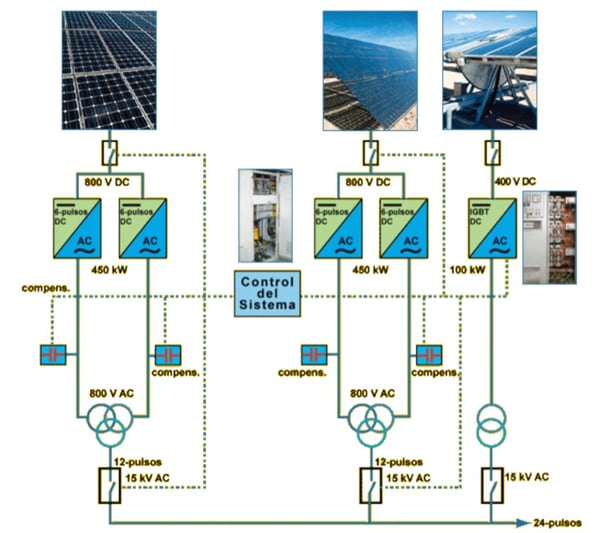
The following is a diagram of the photovoltaic plant.
Tracking along an azimuthal (vertical) axis: in higher latitudes Energy collection is improved through single-axis azimuth tracking. The axis of rotation is vertical, and the panels are tilted at an angle equal to the latitude at all times.
One configuration that combines good solar gain with efficient use of land is tracking with an axis tilted toward the south. When the tilt of this axis is equal to the latitude, it is called polar tracking.
To reduce shading, systems are designed with a smaller tilt angle of the rotation axis—for example, 20°. This allows for a higher concentration of equipment on the available land.
The configuration that maximizes annual solar irradiance for a single, unshaded system is undoubtedly a two-axis tracking system, except in climates with excessive diffuse radiation.
In this type of system, the panels are oriented perpendicular to the sun at all times, resulting in a A gain of more than 40% compared to systems without tracking.
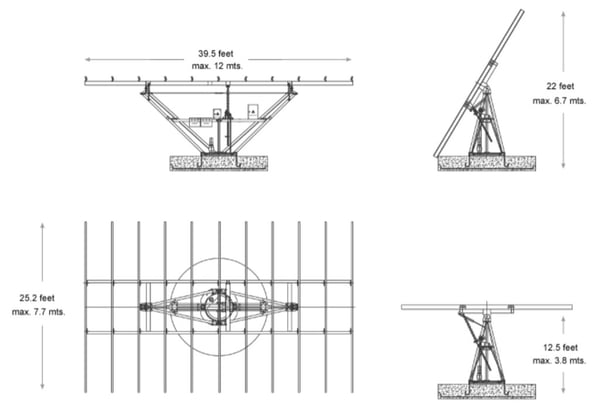
When designing any plant, however, it is important to evaluate not only the increase in radiation resulting from the positioning but also the effects of shading on the other trackers and, of course, the cost of equipment, installation, and maintenance.
Large two-axis trackers cause more shading than the single-axis configurations described above; therefore, in certain situations where space is limited, all options should be considered. There are various two-axis tracker configurations on the market; while they all maintain a perpendicular orientation to the sun, they differ in size, structural design, electrical and mechanical drive systems, cost, and ease of installation.
It is a very new field of development where, for the time being, There is no system standard that is widely accepted as optimal. or more advisable.
The Investor
The photovoltaic generator produces direct current (DC) electricity. Therefore, any grid-connected system must include one or more inverters that are responsible for convert the generated electricity to alternating current, with the voltage and frequency conditions required by the grid.
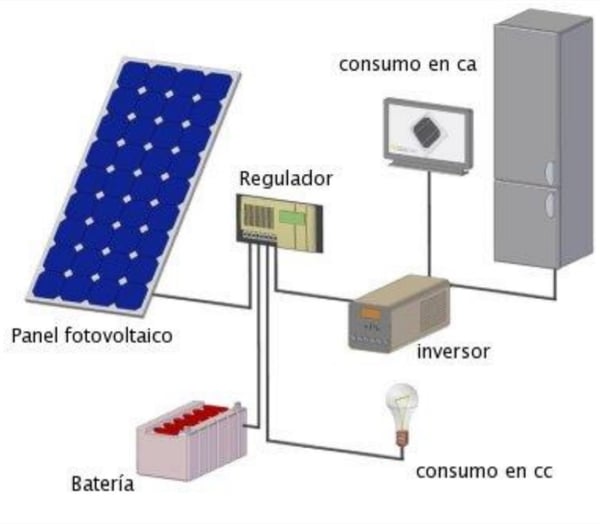
Small-capacity inverters are generally single-phase. In this case, the system behaves as a negative load for the purposes of energy balance.
In larger-scale installations—such as most of those currently being designed in Spain—it is possible to connect either many small single-phase inverters or a smaller number of high-power, three-phase inverters. Both approaches are used in practice.
Support Structures
The most common crystalline silicon solar panels used in grid-connected applications weigh between 12 kg and nearly 50 kg, depending on their size and power output. Their dimensions range from approximately 1 m2 up to more than 2 m2 per unit.
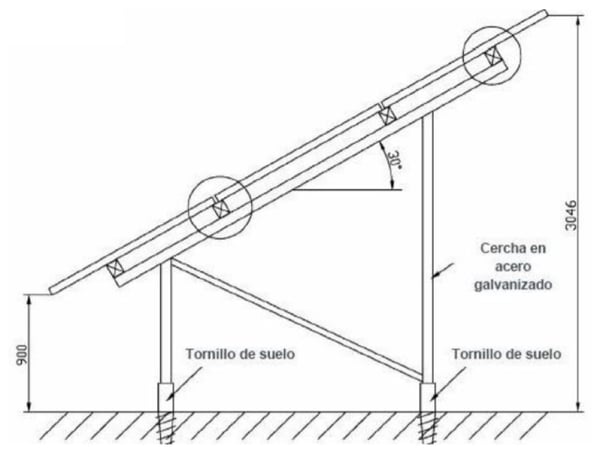
The most common—and simplest—installation method for solar panels is a fixed mounting system, facing south if possible and tilted at approximately 30°. In this type of design, the panels are grouped together and attached to a support structure that ensures the specified orientation and tilt.
It must also ensure that the equipment is securely fastened and facilitate installation and wiring. In open-field installations, the support structure is anchored to the ground with a foundation of varying depth depending on the number of panels on each structure and, therefore, on the weight and wind load it must withstand. These structures are designed for outdoor use and long-term durability. The most common materials are galvanized steel and aluminum. The support structures are designed almost to fit the specific characteristics of the panels, their dimensions, and the number of panels being grouped together.
If you'd like to learn more about photovoltaic power generation, feel free to check out our graduate program:
Master's Degree in Power Generation: Development, Technology, and Operations