It is important to keep in mind the environmental benefits of a geothermal power plant as a sustainable alternative for generating electricity.
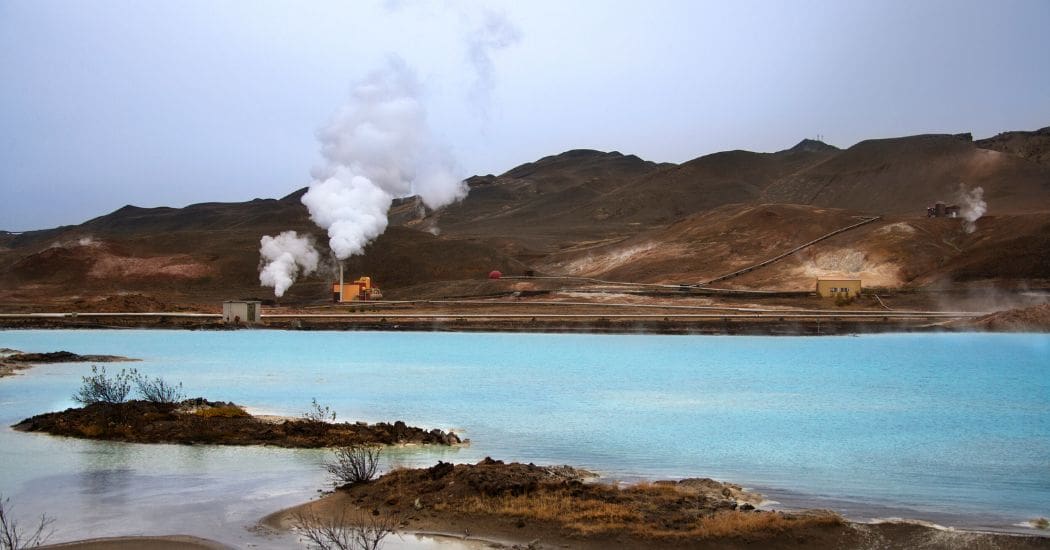
A power plant geothermal It is a system that extracts heat from deep within the earth to generate electricity.
Geothermal power plants can only be found in places where geological activity occurs more powerful, such as the Philippines, Indonesia, Nicaragua, El Salvador, China, and the United States.
But where does the word “geothermal” come from? It is a combination of two Greek words: Geos, which means “earth” and Thermos which is translated as “heat”, that is, its meaning refers entirely to the “heat of the earth.”.
Geothermal Power Plants and Their Types
A geothermal power plant operates using wells from which the earth's internal heat is extracted. As it heats up fluids, These end up becoming steam which drive the turbines connected to generators, producing electricity.
The process restarts once the water enters cooling towers to then be returned to the deep rock and resume extraction from there.
There are three types of geothermal power plants that you'll learn about with us today:
- Dry steam: At these power plants, steam is generated from fractures in the ground, using water that boils at temperatures above 150 degrees Celsius, which drives the turbines and generates electricity.
- Steam flash: This type of power plant uses higher temperatures. The water, which ranges in temperature from 200 degrees Celsius, is pumped down through high-pressure wells and then fed into low-pressure reservoirs.
- The change in pressure causes heat to be released, which is converted into steam that drives the turbines.
- Binary cycle: Unlike the other two types of power plants, this one operates at temperatures below 100 degrees Celsius, which means that nothing is emitted into the atmosphere—not even water vapor.
Aquifer systems originating in the Earth's interior exchange heat with fluids such as isobutane, which has a lower boiling point. This fluid drives the turbines; it then condenses and is reused.
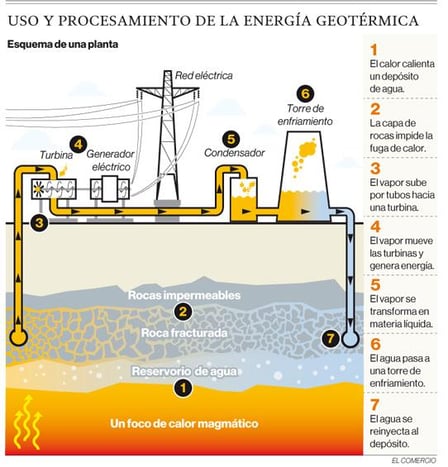 Geometric Energy. Source: elcomercio.com
Advantages vs. Disadvantages of Geothermal Power Plants
All the advantages The challenges associated with a geothermal power plant are related to its nature semi-eco-friendly, which is not comparable to the impact of burning fossil fuels and the pollution they cause. Since it uses only the Earth's heat, geothermal energy is considered a renewable energy source.
It is considered economical and even cost-effective, since the infrastructure required does not involve large-scale construction projects and, furthermore, does not generate noise pollution.
If we're talking about disadvantages, although large tracts of land are not used to generate this type of energy, the chemicals used in the process could damage the landscape or contribute to greenhouse gas emissions, since closed-loop systems are not used to contain the steam or hot water.
On occasion, there have been microseismic events local businesses after the ground cooling, after receiving the injection or inflection of surface water.
Less impact, lower energy efficiency
Many people wonder why power plants aren't more popular if they have so many environmental benefits. The fact is that its energy efficiency is lower than expected or required.
It is estimated that the energy efficiency of geothermal power plants ranges from just 10 to 23%.
As for the heat generated in these processes, it cannot be used locally and more directly; when it is stored and transported, it is lost, leaving few options.
However, in places such as greenhouses or even some facilities capable of effectively supplying heat to buildings and homes, it is possible to feed that heat directly and instantly into the system.
Renewable Energy Initiatives
Although the geothermal energy for electricity generation Although it is considered a relatively clean process, it is undeniable that power plants still constitute a source of SO2, CO2, and hydrogen sulfide (H2S) emissions.
There is currently a research project funded by the European Union, titled GECO which aims to provide clean, safe, and cost-effective geothermal energy that emits no carbon or sulfur in Europe and around the world.
GECO proposes the use of technology for the mineral CO2 capture which enables reliable reduction and uses promising technology for mineral CO2 sequestration, allowing for the reliable, safe, and long-term reduction of all CO2 emissions from its geothermal power plants. But how does it work? Well, it captures gases that are then dissolved in the power plants’ own water. After the water is saturated with gas, it is returned to the deposits and there they continue their process of mineralization.
But in light of the risks, the project has reinforced its strategies, managing to predict any reaction in the subsoil that occurs in response to the induced pressurized water loads.
If you're wondering about the long-term results, they can be summarized as the production of thermal energy through low risk for the environment, in relation to post-power-generation optimization processes.
In conclusion, we can say that a geothermal power plant has a variety of applications and uses. In principle, the agricultural, food, residential, healthcare, and even leisure sectors stand to benefit.
Low costs, sustainability, and minimal environmental impact make this type of energy an innovative option that is becoming increasingly popular among those seeking ways to protect the planet.
Speaking of accidents, or environmental disasters Given the global concerns arising from the burning of fossil fuels, as well as the steady rise in fuel prices due to the war in Ukraine, geothermal energy is emerging as a viable option for the future, which has led various companies to commit to its development and improvement.
If you're interested in learning more about this topic, you can find additional information by visiting our Master's Degree in Sustainable Electricity Generation and Master's Degree in Sustainable Development. 2030 Agenda.