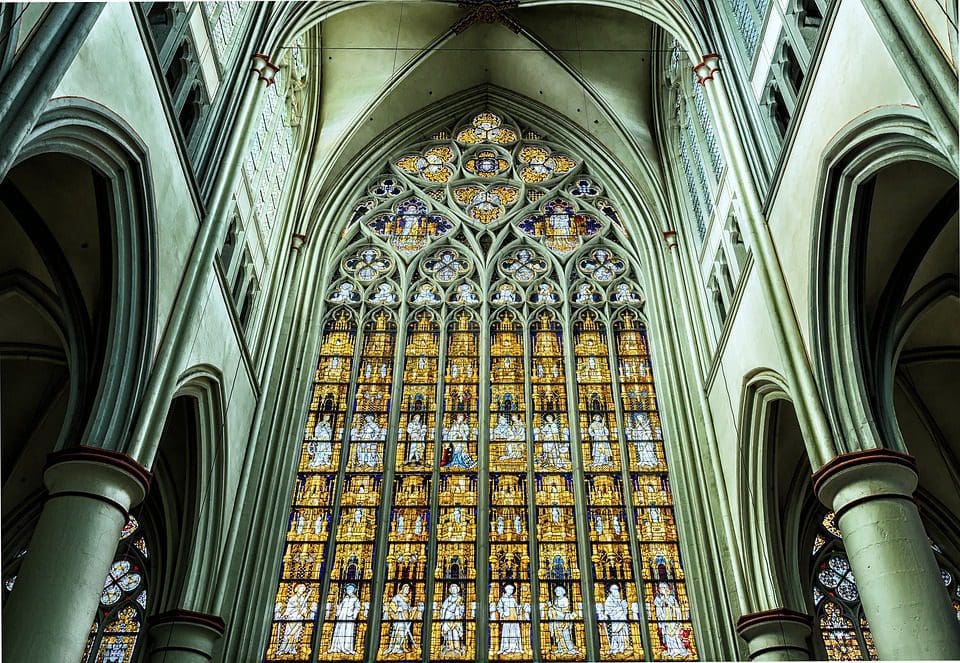
The Gothic architectural style developed in Western Europe during the final centuries of the Middle Ages. It emerged in the first half of the 12th century in northern France—with the Basilica of Saint-Denis considered the first example of this architectural style—and persisted until the dawn of the Renaissance in Italy in the 15th century. However, in some areas of Central Europe, it persisted well into the 16th century.
The main characteristics of Gothic architecture are its soaring heights and the pursuit of light, which emerged in contrast to its predecessor: the Romanesque style. In this post, we’ll introduce you to the the main structural elements characteristic of Gothic architecture.
Without a doubt, the pointed arch, also known as Gothic pointed arch, is one of the main hallmarks of Gothic architecture. A pointed arch It consists of two symmetrical arched sections that end in a central angle at the keystone. Their use is based on the fact that pointed arches provide greater sense of height and verticality than the semicircular arch, characteristic of the Romanesque style.
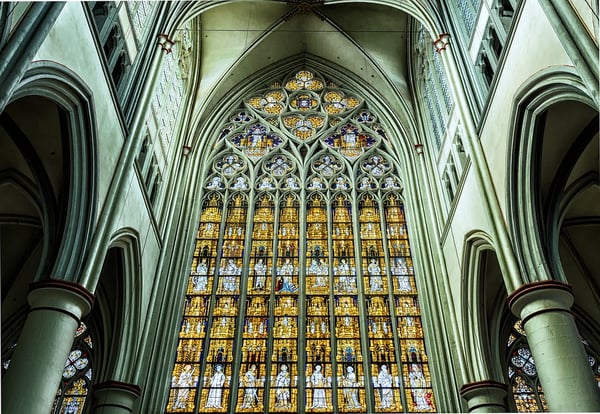
Photo: Tama66 (Pixabay)
Ribbed vault
The ribbed vault It is considered one of the defining structural elements of Gothic architecture. A ribbed vault is formed by the intersection (junction) of two barrel vaults arranged perpendicularly in space, hence their name. Generally, ribbed vaults feature nerves arranged diagonally so that they intersect at the keystone.
The vault consists of two different elements: the arches and the accessories. The former provide the “skeleton,” while the latter fill the space between the arches. The infill is usually made of stone or brick. The ribbed vault allows the thrusts generated by the structure to be transferred to the external buttresses.
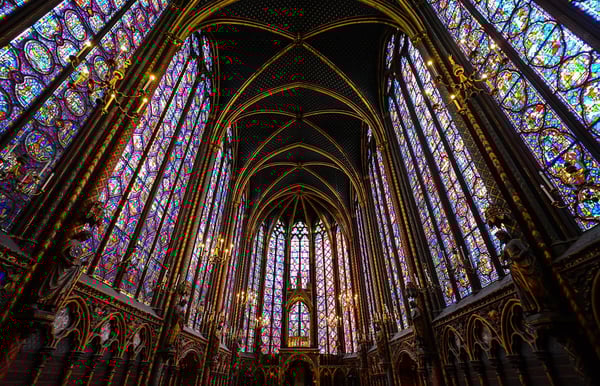
Photo: kirkandmimi (Pixabay)
Buttresses
The Buttresses are vertical reinforcements on the face of a wall, which are usually built outward and serve to to increase its stability and transfer lateral loads to the foundation. The historical origin of buttresses lies in the need to support the horizontal component of the load generated by a vault.
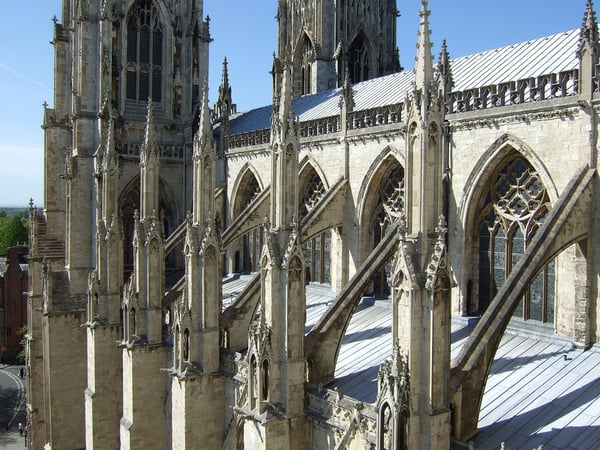
Photo: Rodney Bamford (Pixabay)
Buttresses
The towering in architecture They are half-arch-shaped structural elements located on the exterior of the building, whose function is to transmission of thrust from the vault to the buttress, which in turn will transfer it to the foundation. The bow Gothic spire It is considered one of the defining features of Gothic architecture, along with the ribbed vault and the pointed arches.
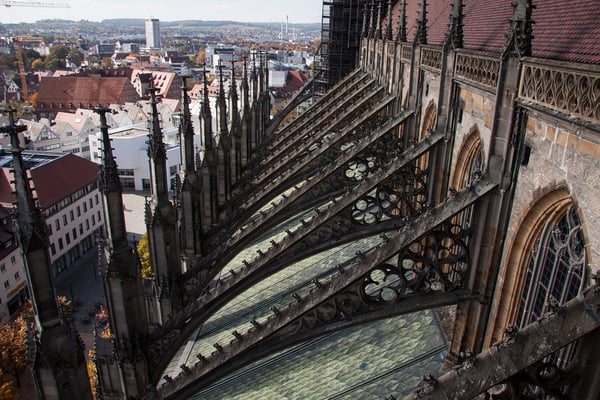
Photo: stux (Pixabay)
Pinnacles
The last of the structural elements characteristic One of the characteristics of Gothic architecture is the pinnacle, a conical or pyramidal finial that crowns the buttress, fulfilling a double function: ornamental and structural, since its weight stabilizes the oblique forces coming from the flying buttresses, concentrating the vertical force on the buttresses and counteracting the lateral thrusts. Its use also gives the building a visual sense of height, as it tapers to a point.
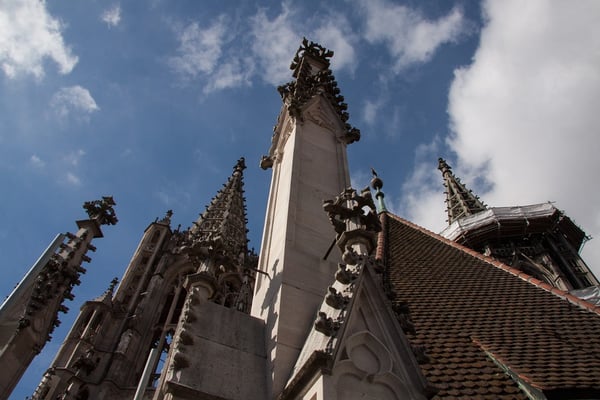
Photo: stux (Pixabay)