Pneumatics and hydraulics have played a major role in the evolution of industry over the past few decades, but they have been around since the the earliest forges of Ancient Greece. Today, they are an everyday part of production lines and machinery in nearly every industry worldwide.
And the mechanical component that has made it possible to fully harness the energy of fluids, in a simple and efficient way, has been the hydraulic cylinder. It is simply a cylindrical component capable of converting the pressure exerted by a liquid into mechanical energy in an axial direction; in other words, it is used to generate linear motion. And they are called single-acting cylinders those that exert force in only one direction.
How do they work?
Single-acting hydraulic cylinders operate on a fairly simple principle: A pump injects fluid—usually oil—into a hollow cylinder containing a moving part, which is driven by the fluid filling the entire interior of the cylinder. The force and speed of the movement depend, on the one hand, on the internal volume of the cylinder, and on the other, on the hydraulic pump’s capacity to deliver the fluid under pressure.
To convert fluid pressure into mechanical energy, a single-acting cylinder requires a series of components that ensure all of the above functions are carried out as efficiently as possible.
Parts of a single-acting hydraulic cylinder
The main components generally found in a single-acting hydraulic cylinder are:
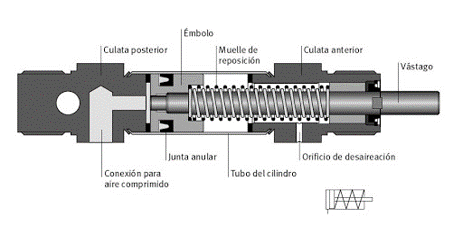
- The rear stock: A solid component designed to channel and direct the fluid entering the cylinder
- Connection: Fluid inlet from the pump to the cylinder
- Piston: A moving part with the same diameter as the inside of the cylinder, which moves due to fluid pressure
- O-ring: These are parts that help ensure the piston is airtight
- Replacement spring: This is the part that allows the piston to return to its resting position, if necessary.
- Front stock: the part that seals the opposite end of the cylindrical component and holds all the parts together.
- Deaeration hole: Drain any liquid that may have passed through the piston.
Stem: A metal rod that converts the force of the oil into mechanical energy by producing axial displacement.
Single-acting cylinders: types
Single-effect
They return due to an external force—that is, from the component or element that receives the axial movement of the rod—which is why they are generally arranged vertically (to take advantage of gravity).
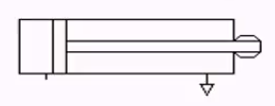
Single-acting spring-return actuator
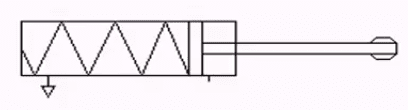
It consists of a spring that retracts when oil fills the cylinder chamber, pushing the piston toward the end of the cylinder and causing the rod to retract; thus, when the chamber empties, the cylinder can return to its original position without relying on any external force.
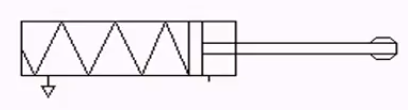
Single-acting spring-loaded valve
In this case, in the rest position—that is, when there is no oil in the cylinder chamber—the spring fully retracts the piston rod, and it is when the oil is injected that the piston rod is pushed out of the cylinder.
How to Determine What Type of Single-Acting Cylinder Is Needed
The single-acting cylinders They are used in any mechanical system that needs to apply or generate a force in a single direction, or in both directions in the case of double-acting cylinders. This involves moving a load, raising a platform, applying force (a press), releasing a load, closing a gate, and so on—the applications are limited only by the imagination.
In order to Select the most suitable hydraulic cylinder For our purposes, it is very helpful to know the parameters that manufacturers use to produce the different types of cylinders, and these parameters are:
- Force capacity of a cylinder: This is calculated by multiplying the effective area of the cylinder's internal chamber in square centimeters (cm2), based on the pump's pressure in bars.
- Cylinder oil capacity: It is calculated by multiplying the cylinder's area in square centimeters (cm2), by the stroke of the rod, that is, the linear displacement of the rod in centimeters (cm)
- Tank capacity for multiple cylinders: This is calculated by multiplying the oil capacity of each cylinder by the number of cylinders to be used.