
The efficient design of the database architecture is the key to successful information management.
How to Design a Scalable and Efficient Database Architecture
In a world where the amount of information As the volume of data generated and stored grows exponentially, it is essential to have a good database architecture to ensure a proper management.
It is also important to explore current trends in this field, such as database management in the cloud or the implementation of technologies for Big Data.
In addition, examining database architecture allows us to analyze how it link different components, such as servers, networks, and applications, to ensure proper operation and secure data management. To understand how data is organized and managed today and how it can be improve these processes in the future.

Database architecture. Source: cognodata.com
What Is a Database Architecture, and What Types Exist?
Database architecture refers to the overall design of a database and its underlying structure, which allows information to be stored, organized, and retrieved in a efficient and safe.
There are several types of database architectures, each designed to meet different needs and objectives of an organization. Some of the most common types of database architecture are:
1. Layered Database Architecture
This architecture divides the database into several layers, each with a specific function. The layers include the presentation layer, the application layer, the business layer, and the data layer. This approach improves the database's scalability, performance, and security.
2. Client-server architecture
In this architecture, the database is divided into two parts: the database server and the client that accesses the database. The database server manages the storage and data recovery, while the customer interact with the database to run queries and make updates.
3. Cloud-based architecture
This architecture uses cloud technology to host and manage the database. The database is stored and accessed through Internet, which enables easy scalability and greater availability.
4. Object-Oriented Architecture
This architecture uses an object model to represent data in the database. The objects are stored in the database and can be accessed and manipulated through a language object-oriented programming.
5. Distributed Architecture
In this architecture, the database is divided into several parts that are stored in different servers. The servers are connected to each other and can communicate to share data and provide greater scalability and availability.
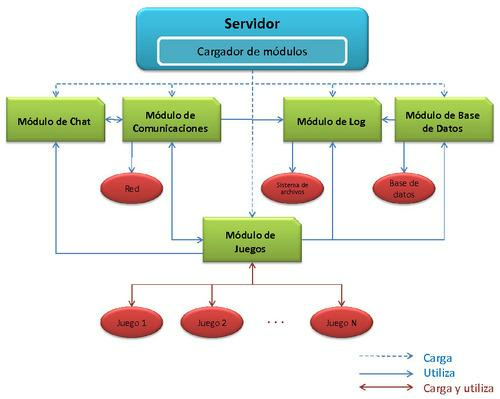
Subsystems on the server. Source: portaljuegos.wikidot.com
Each type of database architecture has its own advantages and disadvantages, and it should be chosen based on an organization's specific needs and objectives.
How Database Architecture Works
Database architecture refers to the structure physics y logic of the database, which consists of multiple layers and components that work together to ensure the availability, reliability, and security of the data.
Its main components are described below:
-
Physical Layer: This is the lowest layer and refers to the physical storage of data on a hard drive or other storage devices. The information is organized into files, records, and fields.
-
Logical layer: This is the layer that provides an abstract and structured view of the data. The information is organized into tables, relationships, and constraints.
-
Database engine: This is the software that manages the database and handles user requests. It performs data validation, ensures data integrity, optimizes queries, and manages storage.
-
Concurrency Control: It is the mechanism that ensures data consistency when multiple users access the database simultaneously.
-
Security and Authorization: This refers to the set of security measures that protect the database against unauthorized access and ensure that only authorized users have access to the data.
-
Database Access Tools: These are applications that allow users to interact with the database. They include query languages such as SQL, graphical user interfaces, and client-server applications.
How Database Architecture Can Be Applied to Different Scenarios
The implementation of the database architecture may vary depending on the scenario. Here are some examples:
1. Companies
Companies often use databases to store and process information about its customers, suppliers, products, and services. Database architecture can be used to design a system that enables proper information management, such as performing queries and data analysis, generating reports, and controlling access to data.
2. Industry
In industry, database architecture can be used to control and manage production processes, product quality, and the resource management. For example, a company that manufactures machinery parts can use a database to record product specifications, production processes, and supplier information.
3. Education
In the field of educational, database architecture can be applied to manage student registration, their grades, scores, and other relevant information. In addition, it can be used to create library management systems and to manage online educational resources.
4. Health
In the healthcare field, database architecture can be used to manage patient medical records, medical histories, test results, treatments, and medications. This enables better patient management, disease prevention, and more effective medical care.

5. Government
In the government sector, database architecture can be applied to the management of public records and information on services, statistics, and economic data. This enables better resource management, more effective decision-making, and greater transparency in public administration.
As can be seen, database architecture can be applied in a wide variety of scenarios to enable efficient information management. Its application will depend on the specific needs of each case and the objectives to be achieved.
Database Architecture Security
Database architecture security is a critical aspect for any organization that handles confidential or sensitive information. Below are some best practices for ensuring that security:
1. Secure physical access to the server
It is important to ensure that the database server is located in a secure place, protected from unauthorized access.
2. Implement authentication and authorization
User credentials must be verified and authorized before access to the database is granted.
3. Use encryption
All information stored in the database must be encrypted to prevent unauthorized access.
4. Keep the database software up to date
Software updates often contain important security patches, which is why you should keep your software up to date.
5. Establish password policies
Robust password policies must be established to ensure that users use secure passwords and change them regularly.
6. Perform regular backups
It is important to perform regular backups of the database to ensure that, in the event of a system failure, the information can be recovered.
7. Restrict access to the database
Only users who need access to the database should be granted permission, and appropriate roles and authorizations must be established.
8. Monitor database activity
Its importance lies in the need to monitor activity in order to detect and prevent unauthorized access attempts or suspicious activity.
On the Structuralia website, you can find more information about courses and master's degrees that will help you develop your skills and stay at the forefront of this field, if you found this article interesting and want to learn more about database architecture.