There are many questions surrounding How the pyramids of Egypt were built. Discover the latest theories from scientists.
How were the pyramids built? Do you know their history?
Egyptian history is fascinating, and there are many artifacts whose origins we still wonder about today. For example: ¿How the Pyramids Were Built? Here's what we know so far.
The Truth About How the Pyramids Were Built
It has always been believed that slave labor was used to build the pyramids, with the slaves carrying the large blocks of limestone for their construction.
However, there are studies that claim the opposite. For example, the archaeologist Mark Lehner and Egypt's former Minister of Antiquities, Zahi Hawass, they claim that The pyramids were not built by slaves. What they really believe is that they were built by artisans.
And you might wonder, how did they recently come to this conclusion? They believe this based on the discovery of the graves of some builders, where they found evidence that the workers were actually well-fed (including remains of bakeries and even animal bones), confirming that they were well-cared-for artisans, not slaves.
These discoveries allowed us to confirm that they were skilled Egyptian workers who lived in a temporary settlement near the pyramids. The excavations also revealed that the settlement was rich in resources and was likely supported by a central authority. In other words, it is likely that in some way it was a kind of national project to showcase its wealth.
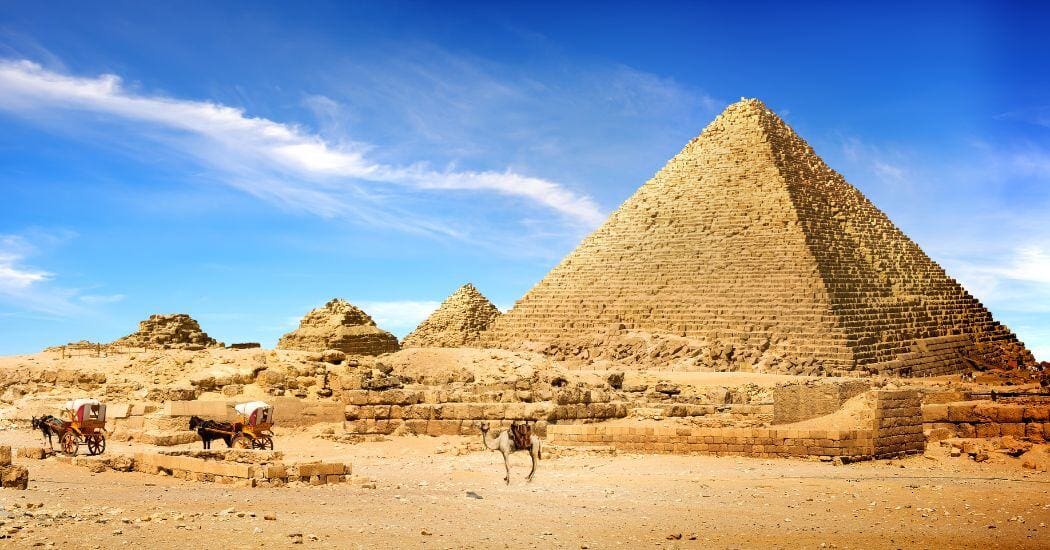
To understand how the pyramids were built, it's also important to appreciate the end result. It's truly incredible! That shows they were built with ingenuity, not just hard work, which confirms all these theories supported by the experts.
But many questions continue to linger in the minds of historians and enthusiasts of Egyptian history and culture.
How could they carry the stone forests across the desert, given how heavy they were?
Physicists from the University of Amsterdam and the FOM believe they've figured out how. They claim that the Egyptians would wet the sand with water so they could slide a sled along it to transport the trees.
To test this, they built a sort of Egyptian sled in the lab and tried moving it across the sand. They observed that the force required decreased as the wet sand became firmer. This allowed them to move more blocks as the ground became wetter.
The key is to add just the right amount of sand, so that it's strong and sturdy enough for the sled to glide easily.
And not only that, but even They found visual evidence to support his theory. For example, in Djehutihotep's tomb, there is a trace of a person pouring water onto the sand at the front of the sled. This would help explain how the pyramids were built with very few resources.
What other theories are out there about the construction of the pyramids?
Much like the water-powered sleds used on sand, some scientists claim that the Egyptians transported stone blocks to higher ground using ramps and a system of sleds with ropes, rollers, and levers.
Some theories suggest that the ramps spiraled around the pyramids, but they also claim that the pyramids may have had internal ramps.
Will we ever uncover all of its secrets?
We don't know. But it's believed that these secrets might lie beneath the surface and could be revealed at any moment. In fact, technology may play a major role in this.
This is one of the great advantages of ongoing technological advances, because even AI could help us shed light on all these events and understand how these heavy stone blocks could have been built and placed so high up.
Today, significant progress continues to be made in this field to uncover all the secrets hidden within the pyramids of Giza. One example of this is the ScanPyramids project, where an international team has been working since 2015 under the auspices of the Egyptian Ministry of Antiquities.
This project uses modern technology to learn everything there is to know about the pyramids without having to go inside. Technology has even allowed researchers to discover spaces that have been hidden for more than 4,500 years—spaces that may have been used to distribute the weight and stress of the structures. Without a doubt, they have stood the test of time. And the large number of daily visitors confirms this.
What can I study if I'm passionate about architecture?
If you're passionate about architecture, we invite you to take a look at the Structuralia Master's Programs. You can explore our website and discover the best training programs.
We also recommend that you travel to see the pyramids, because they're definitely worth it. You can see them from the outside or go inside, although some can be really narrow and even claustrophobic. But if you're passionate about Egyptian history and the pyramids, you can't miss this.
Were you surprised by this information about how the pyramids were built? Did you expect them to be built that way?