
The concrete consistency It is one of the factors that most influences the mechanical properties of concrete. How can we measure it?
Concrete is perhaps the most widely used material in the construction industry, but it is also a highly variable material. This means that for each application, each project, or each shape, we can produce different types of concrete. When specifying concrete, the following format is used: T-R/C/TM/A (Type-Resistance/Concrete Consistency/Aggregate Size/Environment Designation).
This format for describing concrete types is set forth in the Article 39.2 of the EHE-08, and as such, it must be reflected in both the drawings and the project's specific technical specifications. In this instance, we will focus on the variation that exists in the consistency of concrete.
What does "concrete consistency" refer to?
The consistency of concrete can be defined as the resistance of fresh concrete to deformation, is an indicator of workability and is highly sensitive to variations in the water content of the mix. To be usable on the job site, concrete must not only have the proper consistency but also be able to to fill the gaps in the formwork and properly wrap the rebar, to ensure good adhesion by removing air bubbles from the dough.
In conclusion, the consistency of concrete is closely related to its mix design, since the cohesion of its various components—especially the amount of water in the mix—depends on it. Therefore, we can say that the consistency will determine the density, mechanical strength, water resistance, and even the surface finish of concrete.
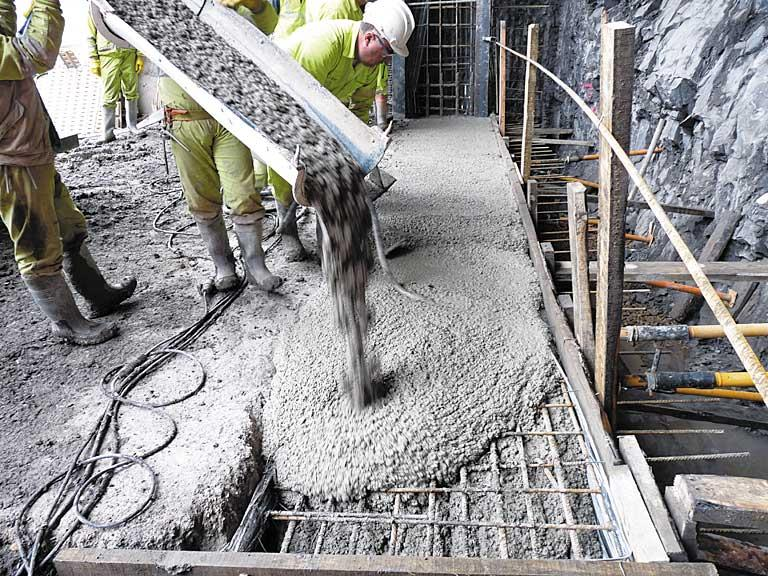 On-site concrete pouring. Source: Victor Yepes
How is the consistency of concrete measured?
The primary method for measuring concrete consistency—and the one endorsed by the EHE (Structural Concrete Guidelines)—is by measuring its slump. using the Abrams cone (slump test). This test is performed by placing a standard-sized conical mold on a horizontal support plate filled with the mixture to be tested; the mold is then removed vertically, allowing the mixture to fall and spread out on the concrete plate.
The spread of the mixture on the steel plate is what allows us to measure the consistency of the concrete; this process is called settlement measurement. The measurement is taken in centimeters from the central axis occupied by the mold in its original position to the perimeter of the circle formed by the expansion of the mixture. Subsequently The measurement is compared with those defined by the EHE To determine the consistency of the mixture:
- 0 to 2 cm, consistency dry
- 2 to 6 cm, consistency plastic
- 5 to 8 cm, consistency soft
- 10 to 14 cm, consistency fluid
- 17 to 22 cm, consistency liquid
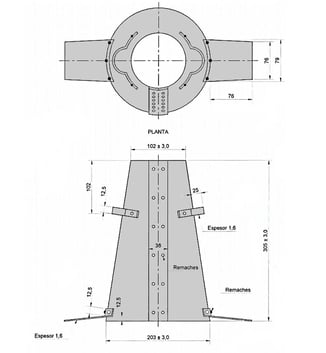 Dimensions of an Abrams cone. IDC
In addition to the Abrams cone, there are other methods for quantifying the consistency of concrete, such as: Kelly's sphere, the compaction factor test, the vebe test and the mortar flow test. These allow architects and engineers to know the exact characteristics of the type of concrete they will use in the construction of a structure.