Originally published on April 7, 2016; updated on September 12, 2025.
Natural gas has established itself as one of the most widely used energy resources in the world, and its safe and efficient transportation depends on critical infrastructure: the gas pipelines. These pipelines, often invisible to the average person, form networks that span entire countries and ensure a continuous energy supply to industries, homes, and power plants.
But what exactly is a natural gas pipeline, and how has this technology evolved to address today’s challenges in efficiency, safety, and sustainability? In this article, we’ll explore its definition, fundamentals, recent advancements, and future prospects.
What is a natural gas pipeline?
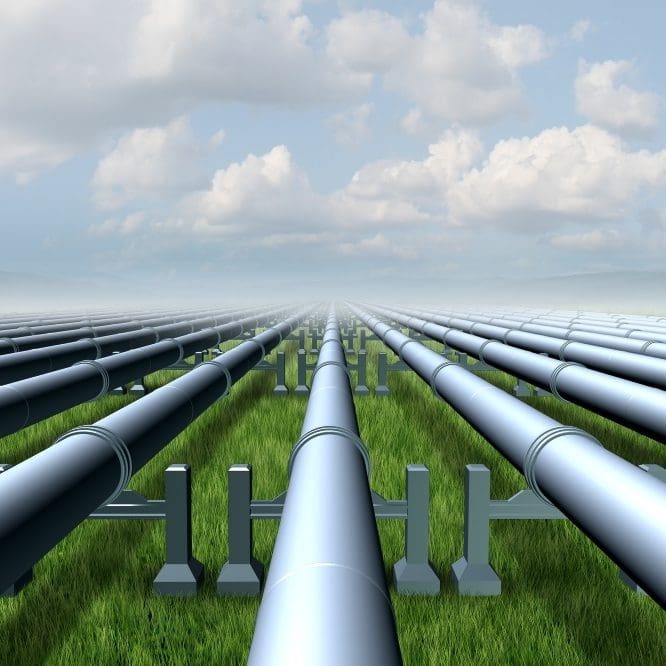
A gas pipeline It is a large-diameter pipeline, made primarily of high-strength carbon steel or high-density polyethylene (HDPE), designed to transport natural gas or other combustible gases over medium and long distances.
Its basic operation is based on:
- Compression stations that maintain the proper pressure throughout the entire route.
- Shut-off valves that allow sections to be isolated in the event of maintenance or an emergency.
- Control and Monitoring Systems (SCADA) that monitor pressure, flow, and potential leaks in real time.
To illustrate this with an analogy, a gas pipeline is like a “underground highway” in the natural gas sector, where compression stations are equivalent to gas stations: energy refueling points that maintain a constant flow.
How does a natural gas pipeline work?
The design, construction, and operation of a natural gas pipeline involve complex engineering processes:
- Layout and Work Area: The site is prepared according to the defined layout by removing the topsoil and establishing access points.
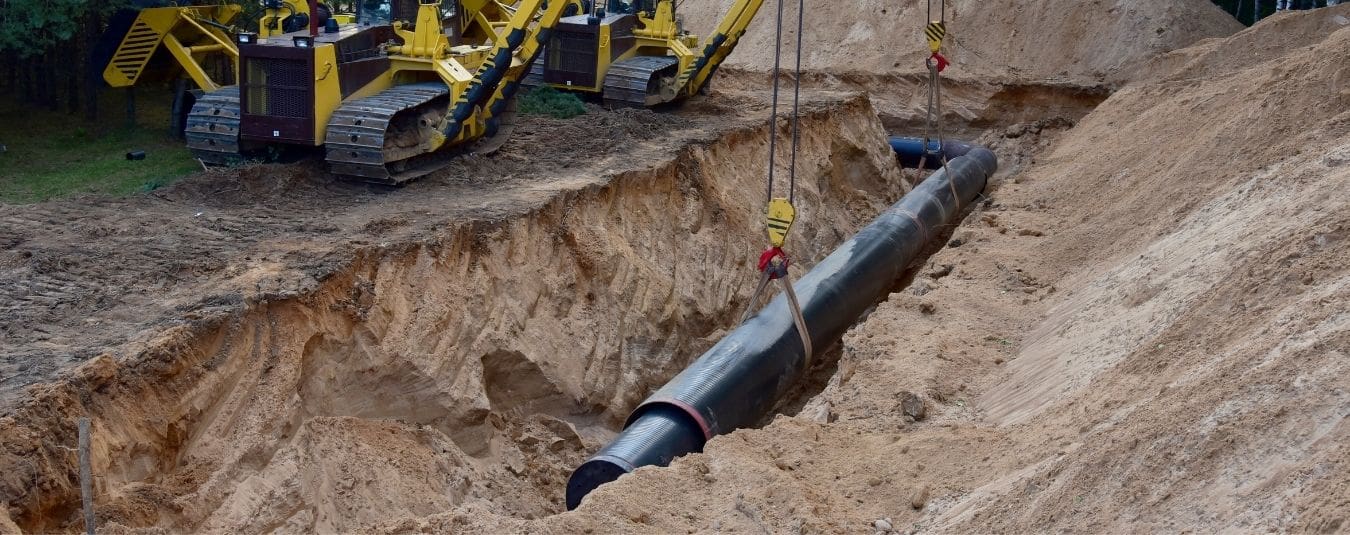
- Trench Excavation: performed using excavators or trenching machines, depending on the type of terrain.
- Alignment and Bending: The pipe sections (typically 12 m long) are adapted to the topography. Bending radii and ovality are monitored to maintain structural integrity.
- Welding and essays: They can be manual or automatic. Each connection is validated by non-destructive testing (ultrasound, X-ray) to ensure strength.
- Coating: Protects the piping from corrosion. Polyethylene tape or heat-shrinkable sleeves are used.
- Placing in a trench and covering: The pipe is laid using sidebooms on a support bed that prevents damage to the lining, and is covered with approved material.
- Pre-commissioned: Includes hydraulic leak and strength tests prior to commissioning.
- Auxiliary facilities: Valves, regulation and metering stations, remote control systems, and cathodic protection systems round out the infrastructure.
This process ensures that the gas pipeline operates safely, minimizing environmental and structural risks.
Types of Gas Pipelines and Their Regulation
Not all gas pipelines are the same. Depending on their function and location, gas pipelines are classified into different categories that ensure gas is delivered safely and efficiently from the fields to the end user. Let’s take a look at the main types of gas pipelines:
- Primary Gas Transmission Pipeline: the giants of the system. They transport large volumes of fluid over long distances at high pressure, equal to or greater than 60 bar.
- Primary Gas Distribution Pipeline: They connect transportation systems to urban and industrial networks, operating at medium pressures ranging from 60 to 16 bar.
- Secondary Gas Distribution Pipeline: These are the pipes that supply homes and small businesses; the pressure is very low (16 bar).
Now, what ensures that this entire system operates in accordance with safety and sustainability standards? The answer lies in regulation.
In Spain and the European Union, the transmission and distribution of natural gas is regulated by the Law No. 34/1998 on the Hydrocarbons Sector, supplemented by technical standards such as UNE-EN 1594 (for high-pressure piping) and European directives on industrial and environmental safety.
In Latin America, each country has its own legal framework:
- Mexico: Hydrocarbons Act (2014), supervised by the CRE.
- Colombia: CREG Resolution No. 071 of 1999.
- Argentina: Law 24,076, under the supervision of ENARGAS.
And on the international stage, standards such as the ASME B31.8 or the guides for the American Petroleum Institute (API), which set the standard for gas pipeline design and operation.