The use of kinetic energy from deep-sea currents to generate electricity has been under development for some time. In fact, there are already several examples of devices designed specifically for this purpose, as well as pilot projects involving experimental installations in countries such as Canada and the Netherlands. However, the installation and maintenance of these mechanisms on the seafloor require significant investments, making them uncompetitive—a situation that could change substantially thanks to new research conducted by the UPM.
A research and technological development project carried out by the Marine Renewable Energy Technology Research Group (GITERM) at the Polytechnic University of Madrid (UPM) has developed new alternatives in the design of the devices for harnessing tidal energy in shallow waters, also known as first-generation energy. Furthermore, this research has led to the creation of new procedures with whom save costs, in order to convert the tidal energy in a practice session competitive and widespread worldwide.
GITERM has developed a cost analysis procedure of a first-generation power generation facility throughout its entire life cycle, which can be used from the start of installation. Given the growth of offshore wind energy over the past decade, it is no surprise that experts agree that the next milestone is harnessing energy from tidal movements.
It is estimated that 80% of the kinetic energy from ocean currents is located at depths greater than 40 meters, thus opening up a wide range of design possibilities for electric generators capable of operating at these depths, which offer the advantage of being much more easily accessible than the seafloor, both for installation and maintenance operations. Therefore, the successful development of this technology could lead to high energy efficiency at viable and competitive costs.
Photo: Free-Photos (Pixabay)
It is precisely in this area that GITERM has been working, by designing the prototype of the GESMEY device, which has been the the world's first design capable of operating fully submerged. In addition, GITERM has conducted a comprehensive cost analysis of the various project alternatives using a tool that it also developed entirely in-house, thereby optimized the processes energy production and facility maintenance from the perspective of economic, environmental, and technical.
These new devices, which are suitable for installation at depths greater than 40 meters, are referred to as “second-generation devices””, due to their similarity to the first-generation models and because they contain a the simplest and most robust mooring system These, whose base can be anchored or fixed. They are secured to the seabed by means of a cabling network.
The prototype of the GESMEY device consists of a structure consisting of a a central body to which three peripheral stainless steel bodies are attached using arms, inside which are located the generator, multiplier, and instrumentation system. According to GITERM, the initial design of the GESMEY device featured a single outer rotor similar to that of conventional wind turbines; this design has evolved as a result of the research conducted, resulting in a device with several rotors, a fact that has contributed to the a 30% reduction in the cost of energy produced.
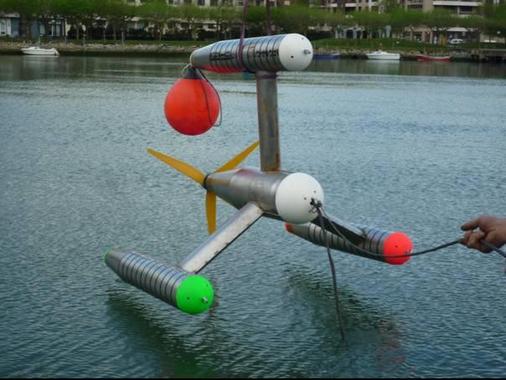
Prototype tested by GITERM / Source: UPM
Although the prototype will continue to undergo technical improvements for some time, there is no doubt that it will have a significant impact in the future on the energy mix of coastal countries, in which Tidal energy is a source with great potential. Furthermore, as José Andrés Somolinos, one of the researchers at GITERM, points out, “tidal energy is a renewable source that has a added value Compared to other sources, thanks to its high level of predictability. Tidal energy technologies are characterized by an energy CO2-free and represent a major contribution to economic growth and to the job creation in areas coastal ”and remote areas.".