The exponential growth of online commerce has led to a restructuring of the supply chain, the cross-docking In logistics, it has established itself as a key strategy for streamlining processes, reducing costs, and improving operational efficiency. But what does the docking? This method replaces traditional warehousing by allowing goods to move directly from the receiving area to the shipping area, thereby optimizing time and resources.
In this article, we'll explore how it works, what types of cross-docking they exist, their impact on order fulfillment and load management, and how a good management system can make all the difference.
What is cross-docking, and how does it work?
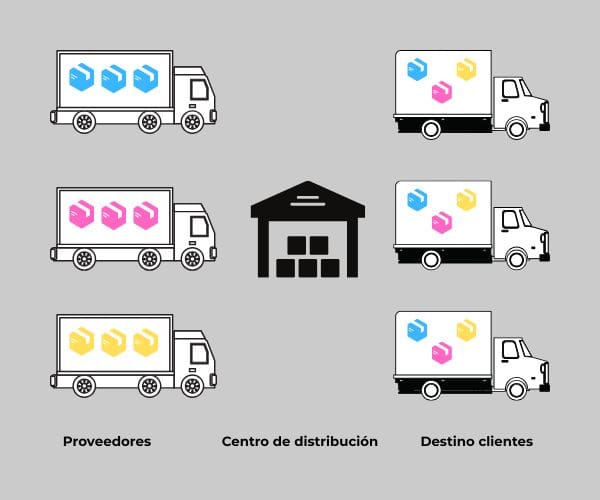
The cross-docking It is an operational strategy that allows products to be transferred directly from the receiving area to the shipping area, without the need to store them. This approach aims to eliminate intermediate processes, which not only increases efficiency in order fulfillment but also contributes to more sustainable logistics by significantly reducing the energy consumption associated with storage and handling.
This methodology synchronizes the receipt and shipment of goods through a dynamic system for assigning loading docks and routes, where the cargo units (such as pallets or containers) are tracked in near real time. The term «docking», refers to the operations carried out at loading and unloading docks, which in this model become the epicenter of the logistics operation, minimizing downtime and the space required for storage.
Implementing this strategy leads to a significant reduction in resource consumption, such as electricity usage, warehouse climate control, the physical space required for temporary storage, and the use of material-handling equipment. In addition, by minimizing unnecessary logistics movements, emissions associated with transportation and internal handling are also reduced. All of this translates into lower carbon footprint, positioning the cross-docking as a strategy aligned with the goals of sustainability, strategic efficiency, and green logistics that an increasing number of companies in the sector are adopting in their operations.
If you'd like to learn more about sustainability, strategic efficiency, and corporate responsibility as they apply to logistics, we recommend taking the Master's Degree in Sustainability and Social Responsibility.
Main Phases of the Cross-Docking System
The phases of the cross-docking system focus on transporting products from the supplier to the end customer with little or no need for storage. The stages of the process are described below:
- Reception: Products are shipped from one or more suppliers to the distribution center or cross-docking facility. This is where quality control and document verification take place.
- Ranking: Products are identified, labeled (if necessary), and sorted according to their final destination.
- Consolidation: Products are grouped by order or destination. At this stage, products from different sources may be combined for a single customer.
- Transfer: The merchandise is moved directly from the receiving area to the shipping area, without going through the warehouse.
- Shipping: Consolidated orders are shipped to their final delivery locations.
Types of Cross-Docking
There are three main types of cross-docking that exists:
- Direct (or pre-distributed) cross-docking: The products arrive at the logistics center already labeled and ready for final shipment.
- Indirect (or consolidated) cross-docking: Products from different sources are grouped together to form full truckloads bound for the same destination. This is useful when multiple suppliers ship products to the same store; the products are consolidated at the distribution center and shipped together.
- Hybrid cross-docking: Combines previously stocked products with newly arrived merchandise to fulfill orders. New products are received and combined with existing inventory to assemble a complete order.
6 Benefits of Cross-Docking in Logistics
Companies that have implemented this logistics strategy have managed to eliminate or minimize intermediate storage, by allowing products to go directly from the supplier to the customer or point of sale, with much more streamlined management.
The following are listed below Six of the main benefits from the cross-docking in logistics:
- Reduction in Operating Costs: By avoiding prolonged storage, the costs associated with the inventory management, warehouse maintenance, and product handling.
- Shorter delivery times: The flow of products is more direct and faster, which allows for respond more quickly to customer demand, improving the shopping experience.
- Warehouse Space Optimization: With fewer products in stock, space is freed up in the distribution center, allowing for better organization and the ability to handle a higher volume without the need for physical expansion.
- Lower risk of obsolescence or deterioration:By reducing the time products spend in storage—especially in sectors with high turnover or perishable goods—it reduces the risk of expiration, damage, or loss.
- Improved traceability and control of the supply chain: the systems of cross-docking require a high level of coordination, which promotes the use of advanced technologies for real-time tracking and monitoring of goods.
- Greater sustainability: less storage, less energy consumption, less unnecessary transportation. The model of cross-docking may reduce the carbon footprint in well-structured logistics operations.
CONCLUSION
The cross-docking It's not just a trend, but a an efficient and sustainable response to today's logistical challenges. In a business environment where immediacy, cost efficiency, and environmental responsibility are key, this strategy enables companies to adapt quickly. From improving delivery times to optimizing resources and reducing emissions, implementing a system cross-docking When managed well, it can make a big difference in any organization's positioning.
Adopting this logistics model means moving toward a ca smarter, more connected, and more environmentally friendly supply chain with the environment. If your goal is to innovate in logistics management, reduce your carbon footprint, and strategically position yourself in the market, the cross-docking It is, without a doubt, the way forward