For the flat roofs n...wouldn't make sense if we couldn't drain them properly, which is why we need to pay close attention to this.
Flat Roofs and the Importance of Drainage
Since the earliest examples of human architecture, the roof, along with the walls, has been the fundamental basis of what we conceive of as a construction. At first, it is understandable that the roof was built by default using one or two sloped planes; this way, one can drain water or snow that may fall on it can be easily removed, and it also facilitates construction. But after many years of technical evolution, we have found uses for the flat roofs and drainage solutions.
Specifically, a flat roof is defined as any roof—whether it is accessible or not—that does not have a slope greater than 5% on either side. In other words, it has a slope that is walkable and can be used if necessary, but is steep enough to direct the flow of rainwater or meltwater from snow, toward the drains and the drainage system.
Types of Flat Roofs
Depending on the function performed on a flat roof, they are technically classified into three types, which may occur separately or in combination:
Walkable Roofs
As the name suggests, these are surfaces that make it easy to carry out various types of activities on them, You can walk and move around freely on them, and they are usually finished with Catalan tiles or some type of floating flooring.
Roofs Not Accessible to Pedestrians
Unlike the previous types, these roofs are not built to support the weight of one or more people moving freely on them. They usually have a gravel surface to facilitate drainage, since the surface does not need to be perfectly flat, but it does must allow for the passage of a maintenance worker since they often house all kinds of facilities.
Green roofs
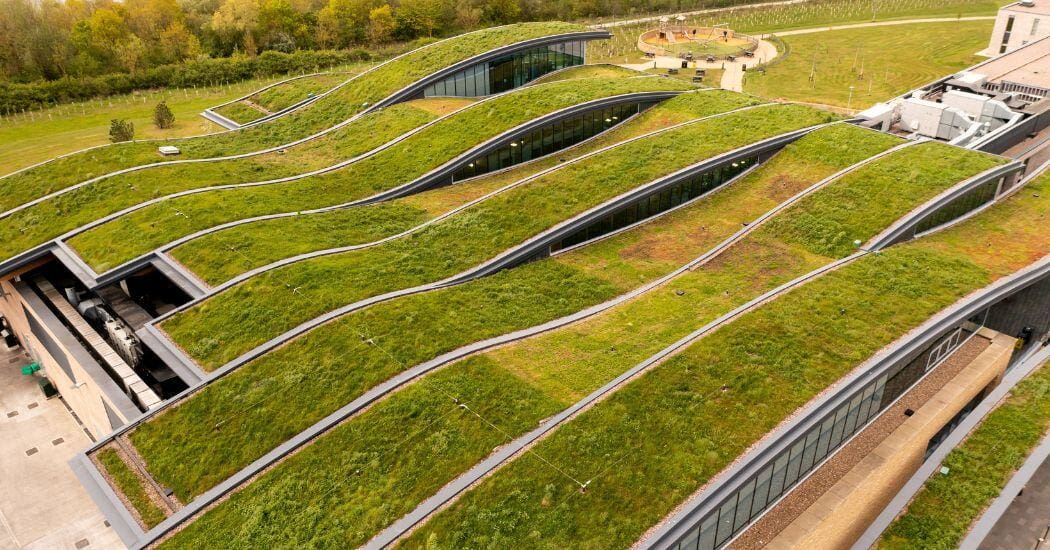
These are containers that have layers designed to hold plants. Drainage is very important in these, Different types of layers, permeable geogrids, and riprap should be installed to allow water to pass through and prevent it from affecting the structural layer of the slab.. They are not usually passable, but they do allow access for maintenance.
Drainage of a flat roof
Water accumulation on a roof is usually one of the the most serious issues that may arise, not only It may increase the weight load on the deck, but rather that water always finds a way to seep through the waterproofing when it accumulates, and creates moisture problems in building components on which the roof rests. This is why it is so important that the slope and the drainage system function properly, preventing water from accumulating on the roof at all costs.
A flat roof is drained so that water flows from the highest point of the roof to the lowest, where there are drains connected to pipes that carry the collected water into the ground, the public sewer system, or even a system for storing and reusing rainwater. To determine what type of drain and pipe diameter we need, we must calculate the amount of water which the drain must be able to handle in the worst-case scenario.
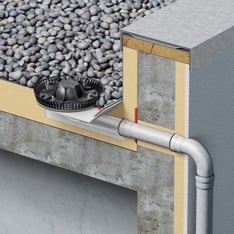 Drainage system for a non-trafficable flat roof. ACO
Calculation of drainage pits on flat roofs:
For flat roofs, it is very important to include a slight slope that allows water to run off or drain easily toward the drains; this slope is usually regulated in accordance with the building codes in effect in each country or region; as an example, here is a table that specifies the slope for flat roofs in the Spanish Technical Code. Furthermore, under the same premise, it is stipulated that the area draining into each storm drain does not exceed 150 m2 and the length of the section does not exceed 15 m, but it is essential to take into account the rainfall zones defined in each country's building codes.
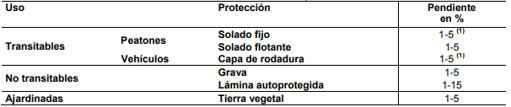
DBHS Spanish Technical Code. CTE
Flat Roofs as Building Coverings It is only feasible to the extent that we are able to drain the water, since otherwise it would be counterproductive to allow water and snow to accumulate on a flat surface. But if they can be properly drained, they become a usable and practical space, whether as a terrace, a garden, or to house part of the building's facilities and maintain them easily. In the Master's degrees focused on construction At Structuralia, you can specialize in many other aspects of construction like this one.