
Learn about the Differences Between Architecture and Civil Engineering and the various professional specialization options.
The Differences Between Architecture and Civil Engineering, and Specialization Options
Throughout the 19th and 20th centuries, it was very common to view architecture and civil engineering as two sides of the same coin, likely because the skills they share in the field of construction and civil engineering. But the reality is that these are separate professional fields—with some overlap, but each with its own clear limitations. To address the boundaries that separate these two professions and help clear up some uncertainties about the possible specializations within each, we’ll explain the Differences Between Architecture and Civil Engineering.
Historical Background
It is undeniable that the an almost age-old conflict over each figure's sphere of influence professional, so much so that in 1977, France enacted the first law aimed at defining each of these concepts and, at the same time, reconciling them. This public code It promoted a more universal vision and called on both professional groups to set aside their competition for a monopoly in the construction sector, in order to seek collaboration and dialogue that would improve the quality of buildings and projects.
As a result of that 1977 technical code, today we can give you (in a very brief summary) an idea of the skills and competencies of each of the two professional roles in question, since it would be very difficult to cover any of them in full. Emphasizing the concise nature of the following definitions, and inviting those interested to explore the skills and technical aspects of each profession in greater depth, these are the main ones Differences between architecture and civil engineering:
Civil Engineering
Civil engineers receive specialized training in the relevant areas of knowledge calculus, fluid mechanics, and physics, by applying theory and practice to acquire the skills and advanced logical thinking necessary to design, build, and manage infrastructure, as well as its integration into the surrounding environment. Examples include: roads, railroads, bridges, canals, dams, airports, ports, and breakwaters.
 Road Infrastructure Project. TECH Spain
Because of the skills he acquired in those areas of scientific and technical knowledge, civil engineers have the following options for professional specialization:
Architecture
Furthermore, the architect's professional training is structured with a view to historical, social, and even artistic criteria, in order to plan, design, and fit out any type of living space, including buildings, public spaces, interior spaces, and even spaces virtual. Likewise, architects must be familiar with construction techniques in order to bring the ideas reflected in the project to life (which is where their field overlaps with civil engineering); however, architects’ capabilities are limited when it comes to the construction of large-scale infrastructure projects.
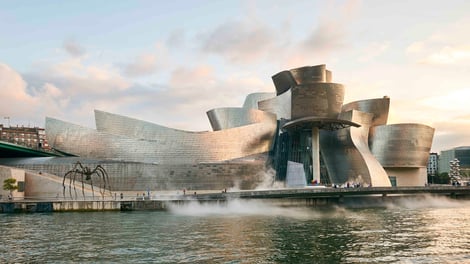 The Guggenheim Museum in Bilbao, an iconic museum. Guggenheim Bilbao
It is often a profession associated with more creative aspects, which add aesthetic value to buildings, but at the same time contribute ingenious solutions to technical problems and for optimizing resources. For these reasons, architects can pursue the following professional specializations:
Degree Programs and Degrees
In this case, we will focus exclusively on the higher education system in Spain, since the names and credits awarded for each degree program may vary depending on each country’s system. In the case of the architects, they must earn a Bachelor's Degree in Fundamentals of Architecture (worth 330 ECTS credits and lasting 5 years), but in order to sign off on a project, they must complete the Master's Degree in Architecture (60 ECTS credits and lasting one year).
The Bachelor's Degree in Civil Engineering or Civil and Land-Use Engineering, which is worth 240 ECTS credits and lasts 4 years, is the program that students must complete civil engineers In order to practice as a Technical Engineer, and by adding the qualifying Master’s degree in Civil Engineering (120 ECTS), you will gain more comprehensive skills.
In addition, in Spain there are degree programs in Building Engineering, Building Science and Technology, and Technical Architecture, which, once the graduate has been admitted to the professional association, allow them to practice freely as Quantity Surveyor or Technical Architect. A professional who drafts technical plans, oversees the physical execution of construction projects, and assesses health and safety at construction sites.
In conclusion, We can identify fairly distinct boundaries in professional skills, as well as in the range of technical specializations available to both roles. Even so, it can be said that Both share a commitment to achieving the highest possible quality in built environments, constant innovation, and maximum efficiency in project execution. Whether you're an engineer or an architect, Structuralia offers a wide range of specializations so you can continue to grow and develop professionally.