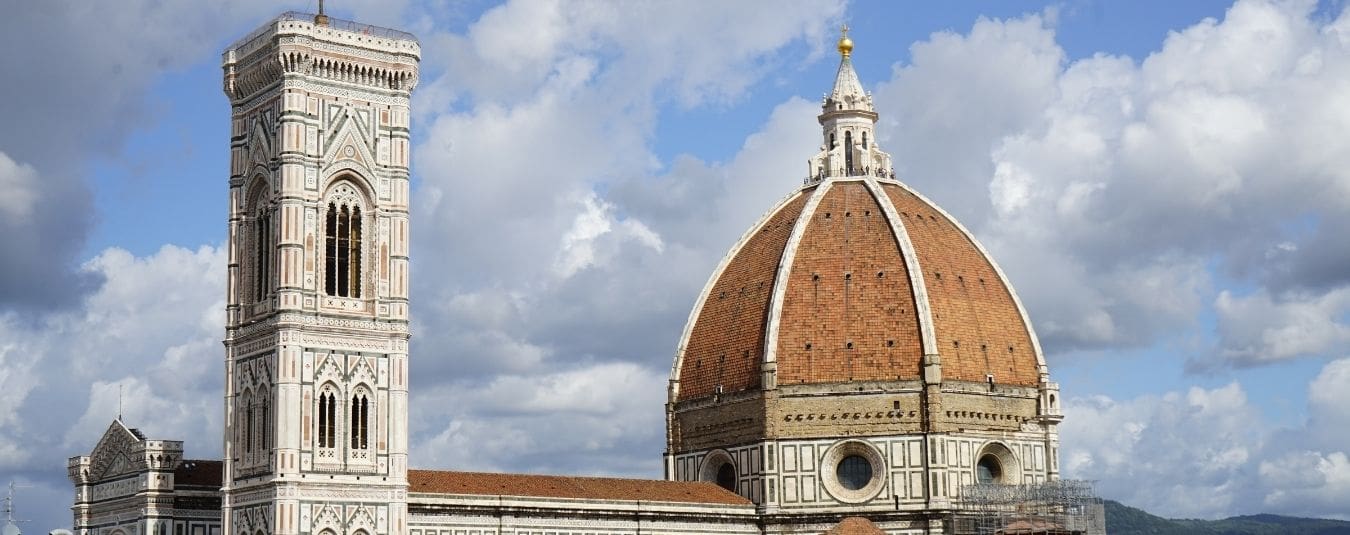
The Cathedral of Santa Maria del Fiore in Florence is one of Italy’s top tourist attractions. It is a Gothic-style building designed by Arnolfo di Cambio, but construction was not completed until 1436, when the colossal dome that crowns it was finished—a dome that not only stands out against the rest of the church but also serves as a visual landmark throughout the city of Florence. If you want to learn all the details about this structure, don’t miss this post.
The construction of the current building of the Cathedral of Santa Maria del Fiore It began in 1294 with the aim of replacing the old Church of Santa Reparata, and it was completed more than a century later, when between 1418 and 1436 the construction of the the majestic dome that crowns it.
The dimensions of the architectural complex are monumental, especially with regard to the aforementioned dome. The Its highest point is 116 meters above the ground, the equivalent of a a 38-meter-tall building, and its base at 55 meters. But what makes this structure truly admirable is its 42.5-meter inner diameter, which turned her into a a landmark achievement in its time, upon being crowned the the second-largest in the world, surpassed only by another Italian dome: that of the Agrippa's Pantheon, which has a diameter of 43.4 meters.
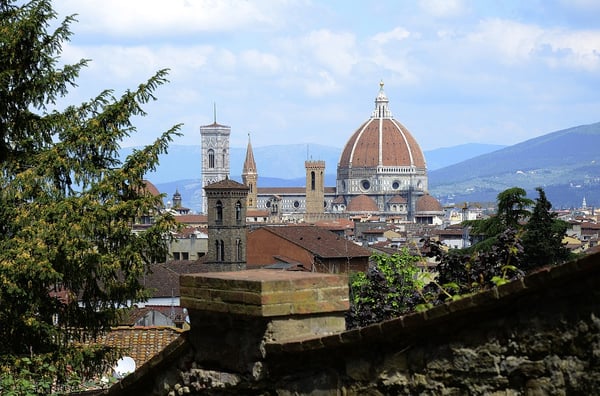
Photo: Jack78 (Pixabay)
Although the technological development and construction materials during the subsequent centuries have led to larger-scale constructions, such as the dome of the Leipzig market hall, in Germany (65.8 meters in diameter, made of reinforced concrete), or the dome of the Belgrade Fair building, in Serbia (109 meters in diameter, made of prestressed concrete); the dome of the cathedral in Santa Maria del Fiore still holds the title of “the world’s largest masonry dome.”.
Given that it was built in the early 15th century, it is no surprise that its construction was a historic milestone at the time. The architect behind its design was Filippo Brunelleschi, also known for developing the conical perspective, which made use of completely innovative construction methods and procedures for the time being. Since no plans or sketches of the construction methods used were left behind, many of the secrets of how this dome was built using the means and resources available at the time remain a a mystery today.
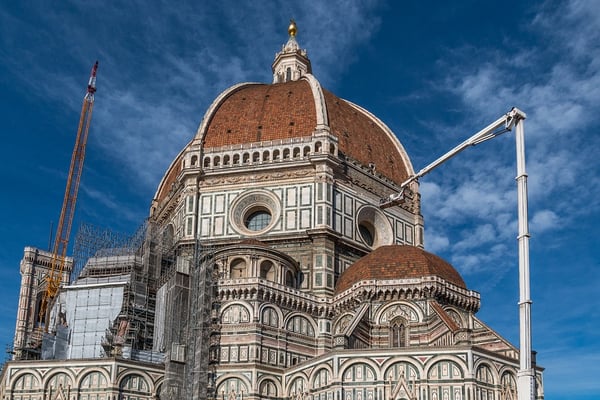
Photo: the3cats (Pixabay)
To understand how a dome with such characteristics came to be built, we'll need to take a brief mental journey to the the prevailing mindset in the development of architectural works from the 12th and 13th centuries. Unlike today, where, in any construction project We work on a drawing, Knowing in advance what the final result of a building would be—its structure and, above all, how the loads would be supported—at the start of construction of the Cathedral of Santa Maria del Fiore, the prevailing approach to cathedral construction was the starting construction without a fully defined plan, since these would be completed several centuries later, so it was assumed that technology would advance enough to bring them to a successful conclusion during that period.
It is no surprise, then, that as construction of Santa Maria del Fiore progressed, this began to worry the leading figures of the time, when the The building reached such a height that the dome which will be used to close it It couldn't be hemispherical, due to structural problems derived from the clearing system of pushes. Also, let's remember that it was the dome of a completely disproportionate diameter for the buildings of that time. That is why the cathedral remained more than two decades with a huge hole on the roof, which they didn't know how to close using the construction materials available at the time.
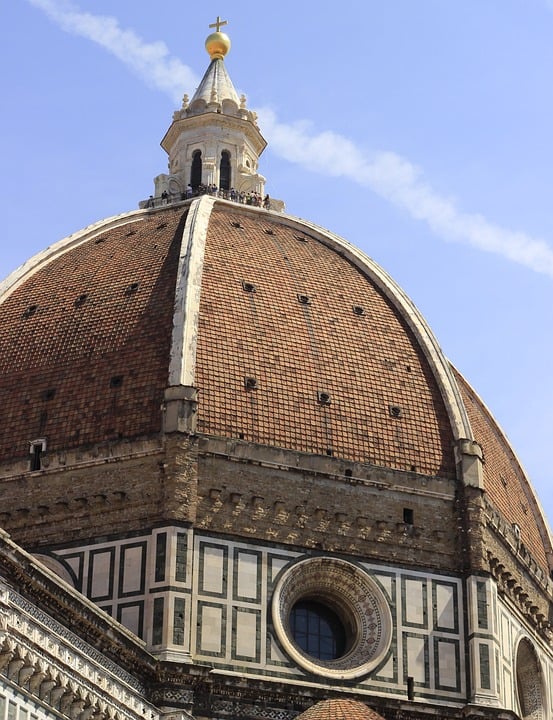
Photo: alfcermed (Pixabay)
It's quite interesting that it was Filippo Brunelleschi, a young man without any training in architecture or structural engineering, the person in charge of overseeing its construction. Perhaps the grandeur of his ideas gave him a unique opportunity to go down in history by completing the construction of a building that is now known throughout the world.
The solution Brunelleschi implemented was the enclosed by a dome with an octagonal base, whose main framework consisted of the overlapping of two barrel vaults brick walls divided into “sections.” This architectural innovation allowed for a a distribution of efforts that worked together perfectly to the previously developed cathedral structure.
The leadership consists of on a factory-made polygonal drum covered with marble, in which a series of round glasses that provide lighting inside the cathedral. To build it, Brunelleschi had to invent a three-speed winch with a complex system of gears and pulleys which was powered by a special rope made of It was 180 meters long and weighed more than 400 kilos, because it did not exist until now no lifting system capable of lifting and maneuvering more than 50 meters high on the ground, materials as heavy as those used to build the dome.
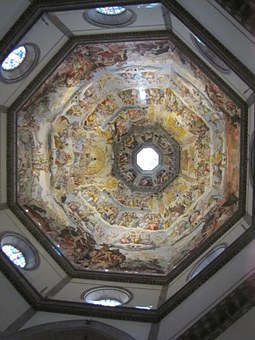
Photo: 21150 (Pixabay)
Today, the size of the dome of Santa Maria del Fiore places it among the a prominent feature of the Florence skyline, which is recognizable because of it.