The circular economy It is not a new concept, although it has gained momentum in recent years. It has its roots in traditional models of resource use, where waste was not viewed as trash but as raw materials for new processes. In contrast to the linear economic model of “extract, produce, dispose,” the circular economy aims to close the life cycle of products, materials, and resources, extending their usefulness for as long as possible.
This approach involves rethinking how we design, produce, and manage our goods. Instead of focusing solely on consumption, the emphasis is placed on regeneration, reuse, recycling, and efficiency. The goal is clear: minimize the environmental impact, optimize resources and promote economic and social sustainability.
Application of the Circular Economy in Construction
The construction It is one of the sectors with the highest consumption of raw materials and waste generation. For this reason, it is also one of the sectors with the greatest potential for applying the principles of the circular economy. The way we design and build our infrastructure must change to adapt to a world in which resources are limited.
From the design, it is possible to incorporate solutions that allow for disassembly and reuse materials at the end of the building's useful life. This prevents building materials from ending up in landfills. It therefore promotes a “reversible” architecture”, which allows each component to be separated and recovered. This approach not only minimizes waste but also reduces the demand for virgin raw materials and the carbon footprint associated with their extraction and processing.
In addition, progress is being made toward the use of recycled or recyclable materials. Some examples include recycled concrete, certified wood, or composite materials made from industrial waste, such as insulation panels made from recovered textile fibers or high-strength recycled plastics. These materials not only meet sustainability criteria but can also offer superior performance in terms of durability, thermal efficiency, and ease of maintenance.
In this context, the following take on special significance: smart materials, capable of adapting, self-repairing, or responding to environmental stimuli. Their application in architecture not only enhances the efficiency and functionality of buildings but also reinforces the principles of the circular economy by extending the useful life of components and reducing the need for replacement.
👉 If you'd like to see specific examples and learn how they're being integrated into real-world projects, we invite you to read our article: Smart Materials: Sustainable Innovation in Architecture
It also promotes the inclusion of technologies that reduce energy consumption, such as the efficient insulation or the passive climate control systems. Bioclimatic design, the use of green roofs, natural ventilation systems, and the use of sunlight are increasingly common strategies in circular projects. All of these contribute to reducing emissions during the building’s operational phase, which accounts for a significant percentage of its total environmental impact.
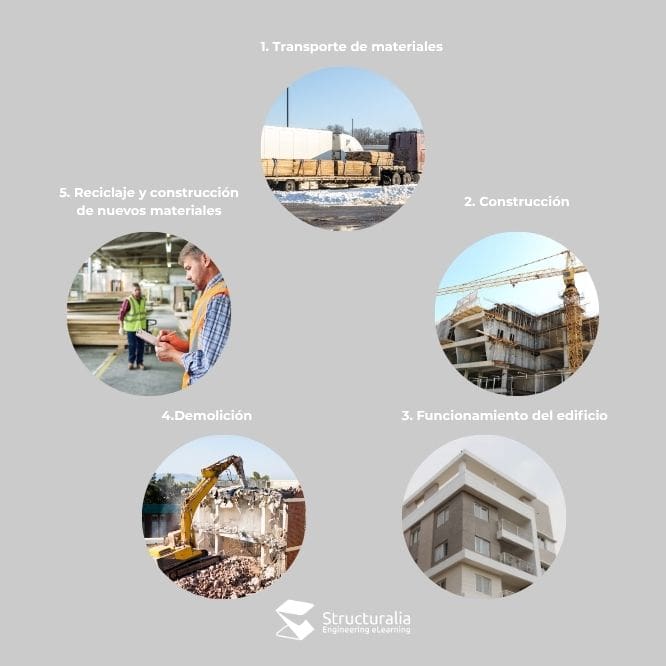
Another key aspect is the life cycle analysis of buildings. This tool allows for the assessment of environmental impact from the extraction of materials through the end of their useful life, helping to make more sustainable decisions. It is a way to quantify a project’s circularity and compare different construction solutions. In fact, an increasing number of sustainability standards and certifications—such as LEED, BREEAM, and VERDFE—now include LCA as a mandatory criterion for achieving the highest certification levels.
Circular Economy and Industry
In the industrial sector, the circular economy translates to more efficient and responsible production models. This may involve, for example, adopting strategies such as eco-design, servitization (shifting from selling products to offering services), predictive maintenance, or the reuse of byproducts and waste.
Some companies are developing “industrial ecosystems” where waste from one factory becomes raw material for another. These kinds of synergies help reduce costs, emissions, and dependence on virgin resources.
Likewise, digitization is a key pillar. Technologies such as the Internet of Things or the Big Data They enable real-time monitoring of processes, facilitating a more efficient use of materials and energy. This increases efficiency and minimizes waste.
Conclusions
The circular economy represents a profound shift in the way we think about industrial and construction development. It is not just about recycling, but about redesigning the entire production system to make it more sustainable, resilient, and environmentally friendly.
In both industry and construction, applying these principles presents an opportunity to innovate, reduce costs, and create economic, environmental, and social value. The transition to this model is not only possible but necessary.
If you're interested in learning more about this field, we recommend exploring our Master's Degree in Economic Engineering, where you'll learn how to lead the sector's sustainable transformation.