
There are several Examples of hybrid clouds that offer a good balance between public and private clouds.
Some examples of hybrid clouds for improving operational efficiency
In the fast-paced world of technology, cloud computing has become a cornerstone for organizations seeking agility, scalability, and efficiency. Among the different types of clouds, Hybrid clouds have emerged as a powerful solution that combines the best of both worlds: the flexibility of public clouds and the control of private clouds. In this article, we'll explore some Examples of hybrid clouds to learn about its main features.
There are different Types of Cloud Computing with benefits such as cost reduction, scalability based on demand, and the availability of services anytime, anywhere. However, some companies face challenges because they believe they can only fully migrate their workloads to a public cloud or rely entirely on a private cloud. This is where hybrid clouds come into play, allowing organizations to take advantage of the best of both worlds and build customized and highly efficient IT environments.
For that reason, we will take a closer look at Examples of hybrid clouds, exploring how various companies offer this solution for maximize operational efficiency. From integrating public cloud services with existing private infrastructure to combining specific applications across different environments, we will examine how hybrid clouds enable organizations to adapt and grow in an agile and efficient manner. These examples will demonstrate The Value That Hybrid Clouds Bring to Businesses, providing greater flexibility, security, and control over your IT resources.
What are hybrid clouds?
Hybrid Clouds are cloud computing environments that combine public and private cloud infrastructures, allowing organizations to take advantage of the best of both worlds. In a hybrid environment, companies can keep certain workloads and sensitive data in its own private infrastructure, while taking advantage of the scalability and flexibility of thethe public cloud for other applications and services. This provides them with a greater control over the security and management of critical data, while allowing them to take advantage of the benefits of the public cloud, such as the access to unlimited resources and the ability to scale according to the complaint.
From a professional standpoint, hybrid clouds offer a number of significant advantages. For one thing, enable companies to migrate their workloads gradually and strategically, without compromising the security or availability of critical data. At the same time, organizations They can choose which applications and services run in the public cloud and which ones remain on their own infrastructure, based on their specific needs and requirements. This provides greater flexibility and adaptability, especially for companies with sensitive or regulated workloads that require greater control.
In addition, hybrid clouds promote interoperability between different environments and platforms. Companies can seamlessly integrate their existing systems with public cloud services, allowing them to take advantage of the additional capabilities without having to completely rebuild their IT infrastructure. This facilitates the migration of applications and data between environments and promotes collaboration and information sharing in a more flexible and scalable environment. In short, hybrid clouds offer a balanced solution which allows organizations to take advantage of both the public and private cloud simultaneously, optimizing the efficiency and adaptability of their business operations.
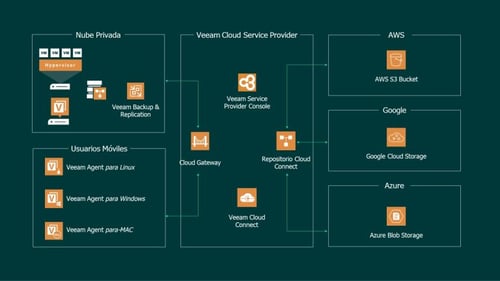 Diagram illustrating how hybrid clouds work.veeam.com
Examples of the most significant hybrid clouds on the market
There are several Featured Suppliers in the hybrid cloud market, each with its own unique features and approaches. Below, we’ll take a look at some of the leading providers and their distinctive features:
1. Amazon Web Services (AWS)
AWS offers a hybrid solution called AWS Outposts, which allows organizations to extend their cloud infrastructure to on-premises environments. Outposts provides AWS services—such as storage, databases, and analytics—in the customer's data center, delivering a consistent experience across the public and private clouds. In addition, AWS offers a wide range of public cloud services that integrate seamlessly with hybrid environments, allowing organizations to leverage their existing infrastructure and scale as needed.
2. Microsoft Azure
Azure offers Azure Stack, a hybrid solution that enables companies to Create and deploy applications consistently in the Azure public cloud and on-premises environments. Azure Stack provides cloud services, such as computing, storage, and analysis, at the customer's data center, enabling seamless integration between public and private environments. Microsoft also offers additional services, such as Azure Arc, which extends Azure's management and services to infrastructure and environments multicloud, providing organizations with greater control and flexibility.
3. Google Cloud Platform (GCP)
GCP offers Anthos, a hybrid and multicloud platform that enables companies to run applications on Google's public cloud and in on-premises environments. Anthos provides management and orchestration tools for managing workloads across different locations, which allows for greater portability and flexibility. In addition, GCP offers sAdvanced storage, data processing, and machine learning services that can be used in both hybrid environments and Google's public cloud.
4. IBM Cloud
IBM offers IBM Cloud Satellite, a hybrid solution that enables organizations to deploy and run IBM services Cloud in any location, whether in the IBM public cloud or in on-premises environments. Cloud Satellite enables companies to extend their cloud services to remote locations, while maintaining consistency and security. IBM also offers infrastructure services and applications specifically designed for hybrid environments, such as IBM Cloud Pack for Integration, which facilitates the integration of applications in hybrid environments and multicloud.

IBM's physical infrastructure for providing hybrid services to organizations and businesses. IBM
These are some of the most robust and relevant hybrid cloud solutions on the market that provide organizations with services for take advantage of the benefits of both the public and private clouds at the same time. Each provider has its own strengths and approaches, so it's important, as data engineer or a professional in the industry, carefully assess the organization's specific needs and requirements before choosing the most appropriate solution. The choice of a hybrid cloud provider will depend on factors such as integration with existing infrastructure, scalability, security, and manageability.
If you're interested in this world of cloud computing, and you want to get a head start and take a a privileged position as a professional in this industry As we continue to grow, we invite you to learn more about the range of master's programs and courses offered by Structuralia for engineers in the Technology and Digital Transformation.