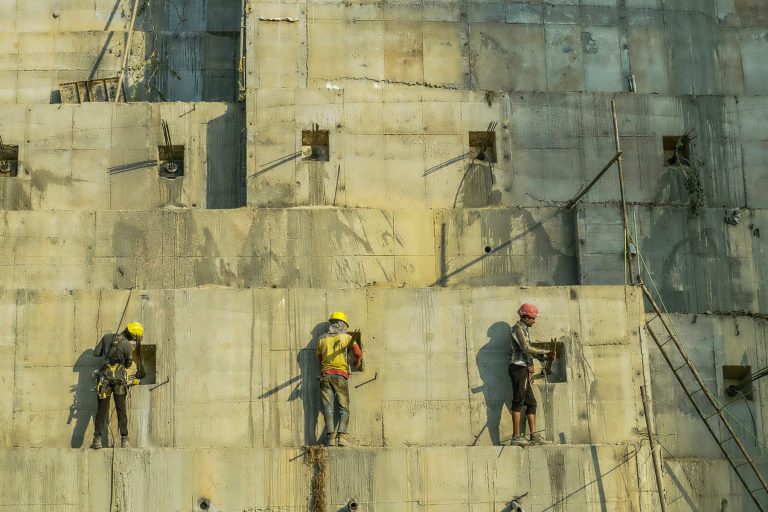
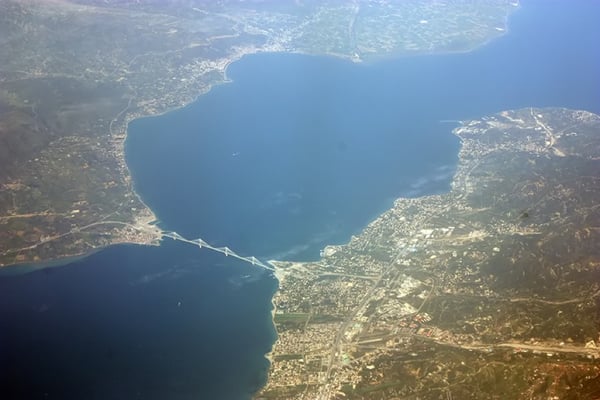
The Rion-Antirion cable-stayed bridge is a structure located in the Strait of Corinth, connecting the cities of Rio and Antirio in Greece, and is considered one of the greatest marvels of modern engineering in Europe. Its construction overcame numerous natural obstacles to ensure the project’s success.
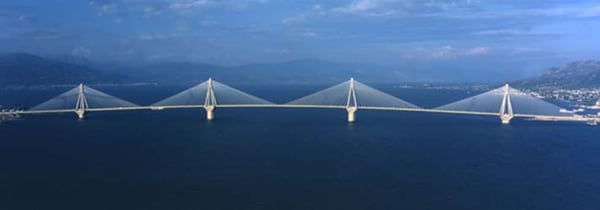
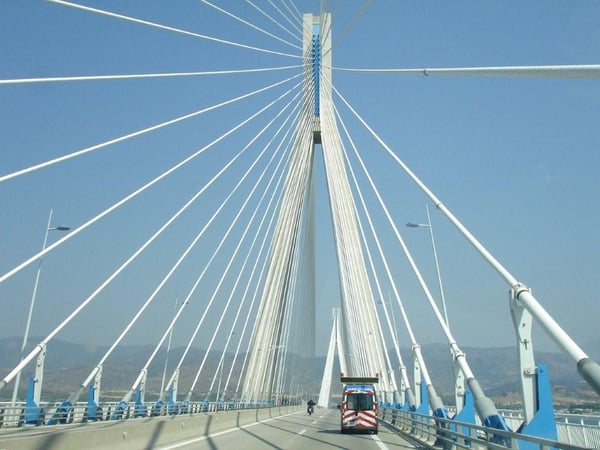
It consists of 5 spans with a total length of nearly 2.9 kilometers and features three central spans, each measuring 560 meters. It has a total of 6 lanes spread across a width of 28 meters: 2 in each direction and 2 emergency lanes. It also has a separate lane for pedestrians and bicycles. The bridge rests on four piers from which all its stay cables originate.
It is located in a seismic zone, which made its construction very difficult. But it wasn’t just this challenge; it also had to overcome the area’s fast-moving currents, and since it is situated at a depth of about 65 meters, it also had to be stabilized on unstable ground consisting mostly of mud and sand. And as if that weren’t enough, the structure is founded on two different tectonic plates, one at each end of the bridge.
To address the issue of poor soil consistency, the engineers in charge of the project decided to embed hundreds of steel pipes 30 meters long and 2 in diameter on the seabed, arranged vertically beneath each of the four piers. Subsequently, with the help of a barge, a platform was constructed to be placed on the reinforced seabed, and once in position, it was covered with a 3-meter-thick layer of gravel on which each of the piers rests.
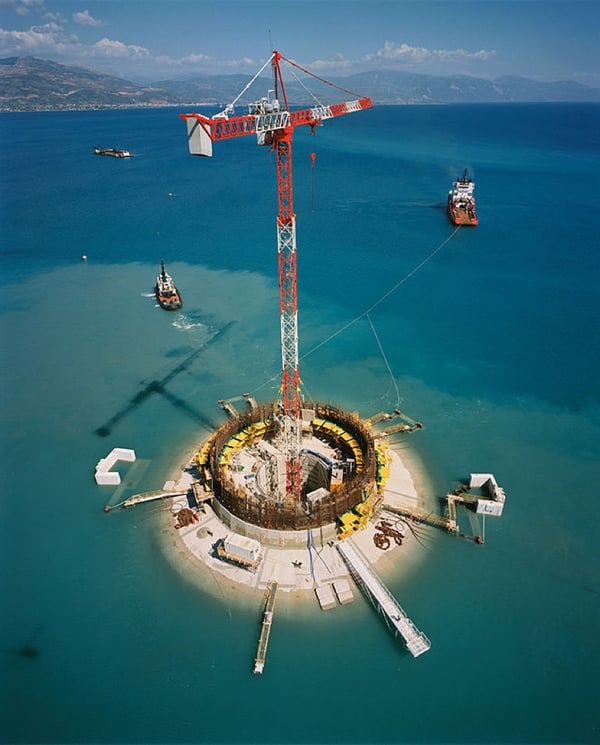
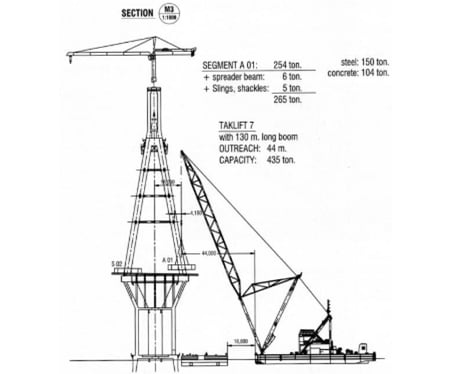
The materials most commonly used in the construction of the bridge were steel and concrete, as they were found to perform best in the event of an earthquake and are also widely used in the construction of this type of bridge. Ultimately, the construction of the Rion-Antirion Bridge required 88,800 metric tons of steel—3,800 metric tons of which are in its cables—and approximately 280,000 cubic meters of concrete.
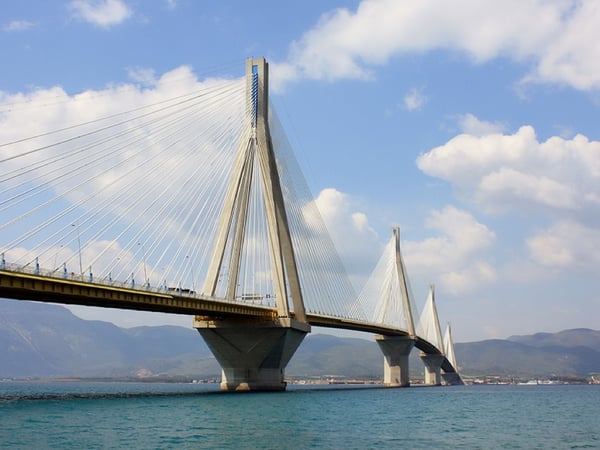
The current bridge is capable of withstanding the impact of a 180,000-metric-ton oil tanker sailing at 18 knots, from withstand wind gusts of up to 250 kilometers per hour, provided it does not collapse during an earthquake measuring 7 on the Richter scale and absorb up to 2 meters of movement between its piles. It's no wonder that its construction has received numerous awards and accolades.
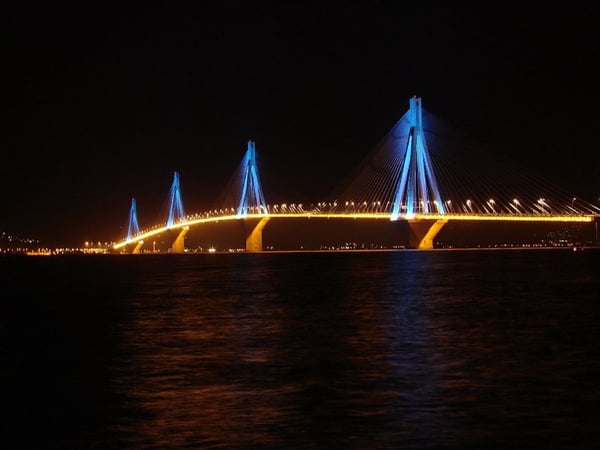
The need for a road connecting the two towns was first considered in 1880, but the project presented too many challenges. As a result, it did not open to traffic until August 2004, although construction had begun in 1998. The total cost of the bridge, also known as Charilaos Trikoupis Bridge, came close to the 803 million euros.