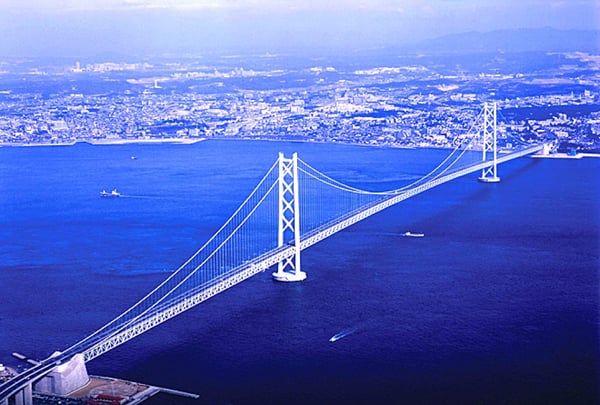
It is a suspension bridge that connects the town of Honshu with Awaji Island, which are separated by the Akashi Strait in Japan. It is considered to have the strongest and heaviest cables in the world. The cost of its construction was 5,000 million dollars.
Before it was built, people had to take a ferry to get from one area to another—an option that proved very dangerous during heavy rains and led to the sinking of two of these boats in 1955. The media coverage was so extensive that the importance of building this type of structure was recognized.
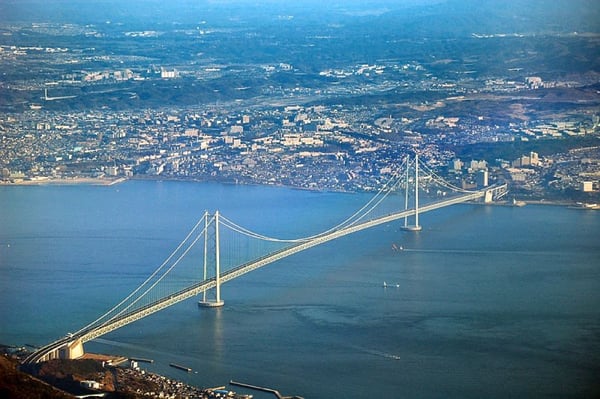
It has a total length of 3,911 meters divided into three sections: the main span, which is the longest in the world One span is 1,991 meters long, and the other two are 960 meters long; the deck is 35.5 meters wide. The bridge features two cables, each 1,122 millimeters in diameter and consisting of 290 strands. The primary materials used are steel and concrete, and approximately 2,000 workers were involved in the construction.
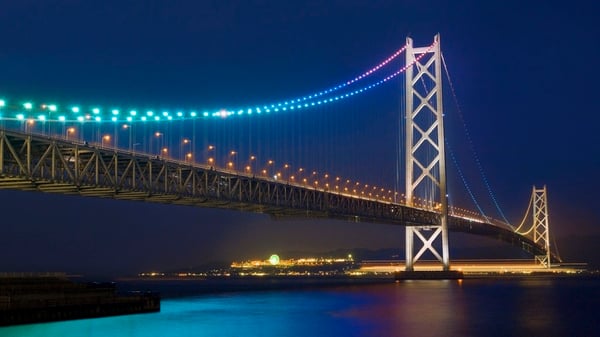
Construction of this bridge began in 1988 and lasted 10 years. The first proposal called for a much shorter main span, but in subsequent proposals, its length increased steadily until it reached its current size. At one point, it was also planned to be a mixed-use bridge for both rail and road traffic, but in 1985 it was decided that only a highway would be built.
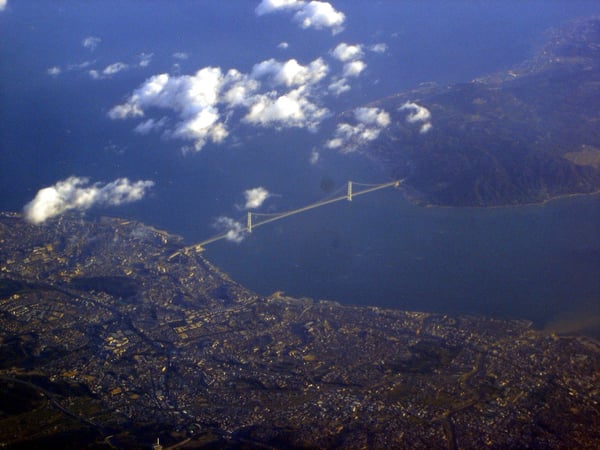
Its design and construction always took into account that it is located in an area prone to typhoons and earthquakes; therefore, the structure is engineered to withstand earthquakes exceeding the maximum on the Richter scale. The risk of any of these natural disasters occurring posed a constant challenge to the project’s completion. In fact, in 1995, when the bridge was not yet finished, a strong earthquake struck the island of Honshu, but the bridge did not sustain significant damage.