Originally published on May 18, 2018, updated on August 14, 2024.
The concrete recycling It is a process that can reduce the environmental footprint caused by the widespread use of this material.
May 17 is the World Recycling Day, an opportunity we cannot let pass us by to discuss one of the quintessential construction materials—and one that has one of the greatest impacts on the environment: concrete. Concrete Recycling It can bring significant environmental benefits around the world and help mitigate the large environmental footprint left by the construction sector across the globe.
Why is concrete recycling important?
Concrete recycling is done using recycled aggregates and materials obtained from crushing concrete waste from other infrastructure projects. Concrete recycling poses a significant challenge for the sustainable construction, since the second most widely used material in the world, after water. Recent analyses suggest a production figure of 25,000 million metric tons per year, which is equivalent to about 6 billion truckloads of concrete per day.
It is estimated that global concrete production generates 1.6 trillion metric tons of CO2 per year, approximately the 5% of the total carbon dioxide load in the atmosphere. Such figures are not surprising, considering that this is a material used in all types of infrastructure -energy, transportation, construction, technology, etc.—across the entire planet.
 A concrete dam. Build a New World
Despite the durability and longevity of concrete structures, infrastructure built with this material often does not exceed a design life of 30 years due to changes in the population’s estimated demands or needs over time.
How is concrete recycled?
For recycling purposes, concrete debris is transported to a recycling plant, where it is crush. Concrete recycling machines require concrete debris are not contaminated by other types of materials, such as wood or brick, to perform its work properly. In the video accompanying this post, you can see a concrete recycling crusher in action.
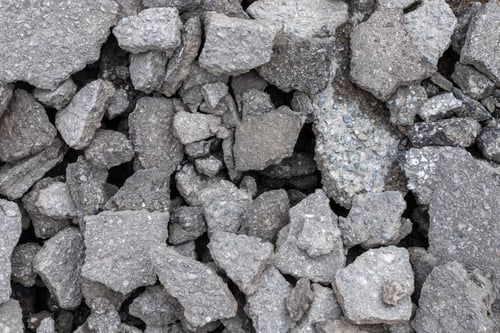 An example of crushed debris such as that used for concrete recycling.
After crushing, the aggregate fragments derived from concrete waste are sorted by size to facilitate its subsequent use. The recycled aggregate from the original concrete, after the crushing process, consists of a A mixture of coarse and fine particles. Aggregates from concrete have heterogeneity in their properties due to the Properties of Concrete, to the crushing systems employees involved in recycling and the presence of impurities.
Applications for Recycled Concrete
Generally, the quality of recycled aggregate is much higher in coarse fractions than in fine fractions, and it is precisely the coarse fractions that are most commonly used in subsequent applications.
Currently, it is common to use aggregates derived from recycled concrete in the road subbase or in the manufacture of rigid retaining walls, as well as its inclusion as added to new concrete mixes, especially the coarse fraction, since this one has the best properties.

Retaining walls that can be made from recycled concrete.
Benefits of Concrete Recycling
The percentage of the Coarse aggregate ranges from 70 to 90% of the total mass of the original concrete, with the coarse fraction having a particle size distribution that makes it suitable for use in virtually any type of project, as well as for the production of new types of concrete. The surface texture The surface of the aggregates is rough due to the presence of cement mortar adhering to them. The density of recycled aggregate is similar to that of the original concrete and slightly lower than that of a first-use aggregate (5–10% lower).
The main advantages of concrete recycling include the savings on transportation costs, the savings from landfill sites and the reduction in the environmental footprint by reducing the pollution caused by the demolition waste, in addition to the decline in the demand for new aggregate extraction from quarries. This and other factors make recycled concrete a sustainable material that can be used in construction.