The natural gas transportation It begins at the fields and extends as far as needed through a complex network of pipelines, compressors, and control stations.
Natural gas is a major source of energy which is used worldwide for electricity generation, heating, cooking, and transportation.
In order for natural gas to be used, it must first be transported from the fields to the places where it is needed. Natural Gas Transportation It is carried out through a complex network of pipes, compressors, and control stations.
The transport of natural gas between countries “producers”and the “consumer” countries" is carried out via gas pipelines stretching for kilometers and with the involvement of large LNG carriers. In this article, we’ll take a closer look to learn a little more about this complex process.
How Is Natural Gas Transported?
1. Via gas pipelines
As we mentioned earlier, natural gas is transported through infrastructure known as gas pipelines, which consist of pipes that carry the gas to the over long distances.
In the gas pipelines, the gas flows at very high pressures (between 36 and 70 atmospheres). The pipelines are subject to very rigorous inspections to prevent leaks and the risk of explosions. Some of the gas pipelines are tens of kilometers long, and They even link continents, such as those connecting Africa and Europe.

Natural gas value chain. Source: asugasperu.wordpress.com
These pipes are made of steel with a “high” carbon content (around 0.25%), which exhibits high hardness and a high yield strength elastic.
To prevent corrosion, a coating of polymers (passive protection) and cathodic protection (with an applied current).
As for the diameters of these types of pipelines, they tend to vary depending on the flow rate they are designed to handle; however, in general, gas pipelines range from 20” (508 mm) to 48” (1219 mm).
The pressure at which the gas flows through this pipeline reaches 72 bar (7.2 MPa) for the international travel, whereas for local distribution systems, the pressure is reduced to 16 bar (1.6 MPa).
Conveyor speeds range from 10 to 20 meters per second, in order to ensure the continuity of supply and prevent problems at the facilities.
 Mojave Desert Gas Pipeline. Source: newtral.es
As a point of interest, it is worth noting that the world’s longest natural gas pipeline, which connects Horgos (Kazakhstan) with Hong Kong (China), is 8,704 kilometers long and can transport 30,000 million cubic meters per year.
It is common for the pipeline network to encounter large bodies of water along its route. There are two main solutions for overcoming them: the implementation of subsea gas pipelines, such as the well-known Nord Stream; or the transport of gas by LNG carriers.
2. Using LNG carriers
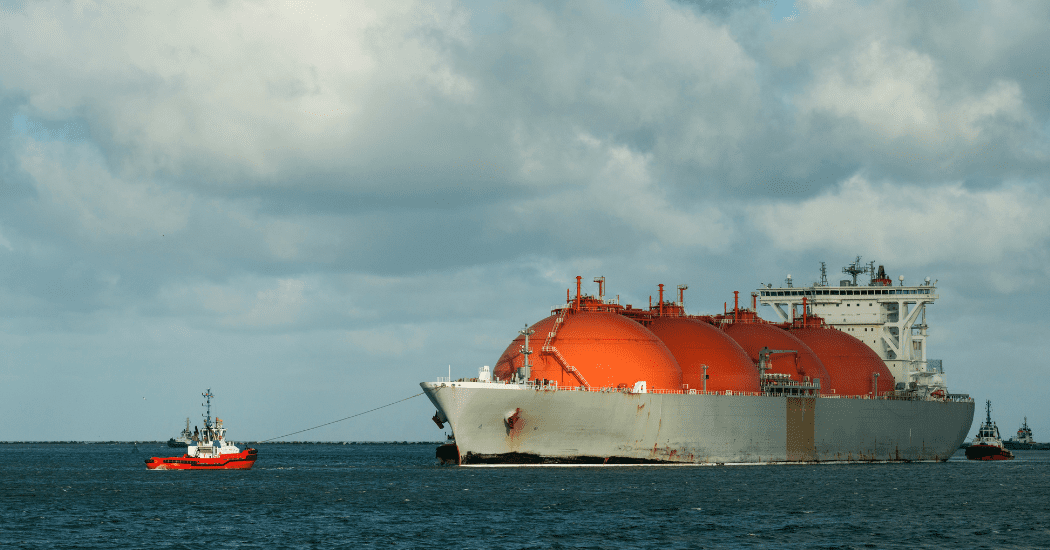
On the other hand, the methane tankers They transport natural gas in liquid form after cooling it to very low temperatures, since it liquefies at -160°C. As a result, the gas occupies about 600 times less space than in its gaseous state, making more convenient transportation. Upon arrival at the port, the liquefied natural gas is stored in enormous tanks, awaiting regasification and injection into the distribution network when demand requires it.
The first option involves a significant investment in infrastructure, so maritime transport is often used to solve the problem, with the added advantage that distribution can be branched out from there.
One drawback of shipping is that, in order to transfer cargo from one mode of transportation to another, it is necessary to to liquefy the raw material. This process takes place at liquefaction plants.
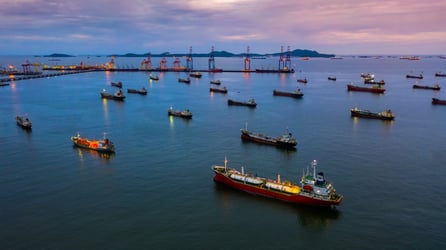
Once liquefied, LNG (Liquefied Natural Gas) is transported in the large tanks on LNG carriers. This avoids the geographical challenges posed by seas and oceans when constructing gas pipelines.
The vessel with the largest LNG carrying capacity is the “Mozah” of the Q-Max class, which, with its 43,400 kW (58,200 Cv) of power, can transport up to 266,000 cubic meters in a single voyage.
Natural Gas Flow Process
To give you an idea, this is the process and the path that natural gas follows until it reaches your home.
1. Production
Once the natural gas is extracted from the field It must be processed so that it can be transported and sold.
For example, methyl mercaptan is added to detect leaks and prevent spontaneous combustion; impurities are filtered out; and gases that hinder the cooling of the gas are removed. The water content is also reduced, and gases such as nitrogen, mercury, and CO₂ are removed.
Gas transported through pipelines travels at high pressures, but always in a gaseous state. The conversion process required to transport it in tanks or cisterns will turn it into the liquefied natural gas (LNG), that is, in a liquid state.
2. Storage
From an economic and technical standpoint, it is the underground storage is the most cost-effective. However, in Spain we have a large volume of LNG imports, so the proportion of storage in tanks at regasification plants In our country, it is much higher than in other countries.
3. Transportation and Distribution
Natural gas is typically transported through gas pipelines from the site to the destination. If there are no pipelines connecting the two points, transportation is carried out with LNG carriers (or cryogenic).
In summary, natural gas transportation is a complex process that involves a series of critical steps to ensure the safety and efficiency of its supply. The infrastructure of pipelines, compressors, and control stations is essential to ensuring that natural gas is reliably delivered to the communities and businesses that depend on it.
If you'd like to learn more about transportation and other topics related to natural gas, feel free to check out our courses and master's degrees offered by Structuralia.