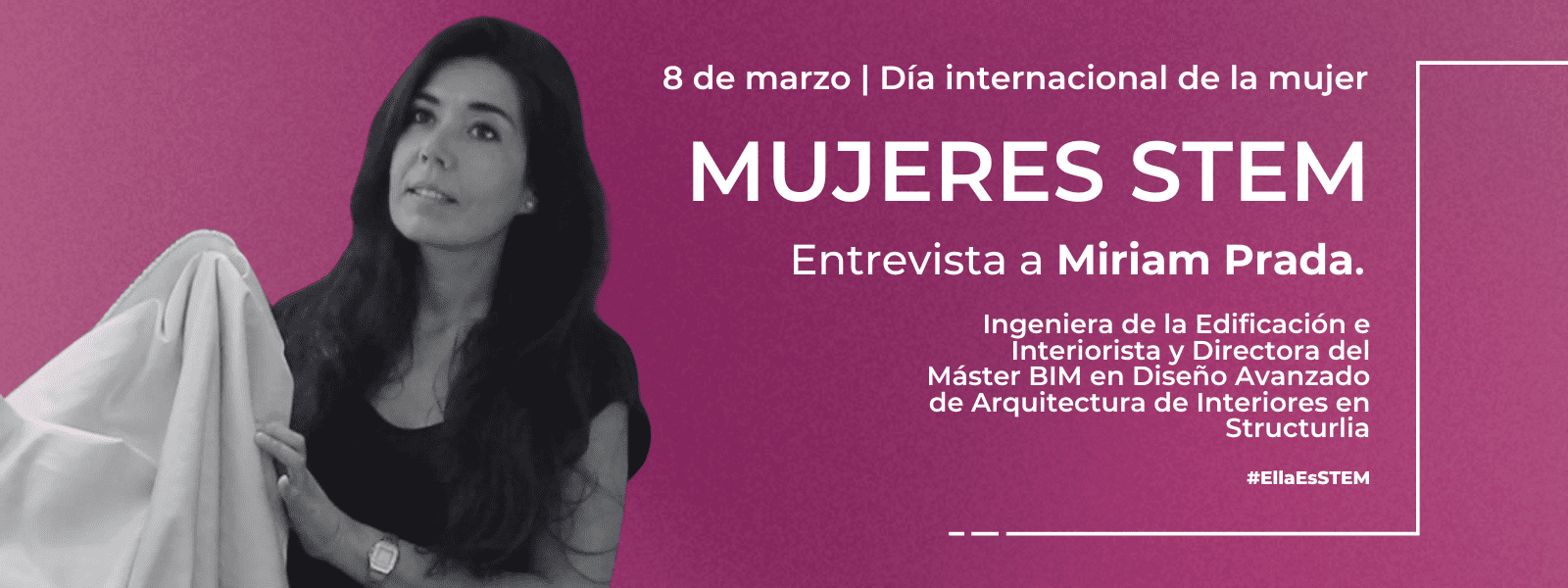
#EllaHaceSTEM: Interview with Miriam Prada on Interior Design, Innovation, and the Role of Women in STEM
The The design and architecture sector is constantly evolving, And today more than ever, technology and STEM education play a key role in transforming spaces. However, women in these fields continue to face challenges, ranging from a lack of role models to the need for greater inclusion in the professional world.
As part of the International Women's Day, Structuralia Launches the #EllaHaceSTEM Campaign, an initiative to highlight women who have made their mark in the STEM field. Through a series of interviews, we feature alumnae and influential faculty members who are leading change and serving as an inspiration to new generations.
This time, we spoke with Miriam Prada, Building Engineer and Interior Designer with more than 15 years of experience in the design industry. Based in London, he has worked on prime and super-prime residential projects in seven countries and has collaborated with clients from more than 15 countries. One of the most notable milestones in his career was his role as Head of Interiors on a project in which the penthouse broke historical records as the most expensive one-bedroom apartment in Westminster's history.
Miriam currently runs her own studio, Lar da Nai, a design firm that seeks to transform spaces with purpose, as well as heading the interior design department at Tenorite Interiors and coordinate the Master's Degree in BIM for Advanced Interior Architecture Design on Structuralia. She also shares her experience through her podcast, where he addresses various topics related to the sector.
In this interview, Miriam talks to us about her career, the challenges of STEM education, the importance of female role models, and how we can build a more inclusive future in the design industry.
What was your experience with STEM training like?
«My experience with STEM education has been and continues to be extremely enriching and challenging. I've had the opportunity to contribute my perspective as an engineer and interior designer, combining creativity with a technical and structured approach. In my role as director of the Master's Program in Interior DesignI aim to make a real impact in education by offering practical training that is aligned with the needs of the job market, »In the talks I've given, this is my favorite part. In a more personal way, I try to share as many real-life experiences from the industry as possible, with the goal of motivating the audience. It's a demanding profession, but it's also wonderful."
What aspects of education do you think could be improved so that more women would choose this path?
«In the short term It is essential to foster a more inclusive environment starting at an early age. Many women do not consider STEM careers because they do not see role models or feel that it is a male-dominated field. We should share more stories of women's success and offer support during the transition from education to the workforce.
In the long term, adapt and revise educational systems so that they keep in mind that not all of us are “wired the same way” and that a lack of success does not necessarily mean a lack of ability.
»In the very long term, the same as above, but in the context of work environments, hiring processes, and support throughout one's professional life."
What strategies can help spark an interest in science and technology from an early age?
«The key lies in visibility and experimentation. Programs, mentoring, and hands-on experiences in technology, science, and design can make a difference. It’s also important to change the narrative in the classroom, »showing that STEM is a broad field where creativity and innovation are essential. Encouraging others to listen."
How important is access to role models and mentors in professional development in STEM?
«The Access to role models and mentors is key to building confidence and fostering professional development for women in STEM. »Seeing other women in leadership positions helps break down psychological barriers and shows that success is within reach. For my part, whenever I can, I strive to be approachable and to foster support networks within my field."
What are the main challenges young women face when they begin their training in these fields?
«A lack of representation, stereotypes, and, in some cases, a lack of support in academic and work settings can hinder their development. Furthermore, The gender gap in access to opportunities and leadership remains an obstacle »that we must work to eliminate. These are still seen as success stories, but they should be the norm."
What educational initiatives have been effective in increasing the number of women in the sector?
«The Scholarships specifically for women in STEM, mentoring programs and networking events have had a positive impact. Initiatives such as design and technology workshops focused on girls and adolescents have also proven effective in sparking an interest in these fields at an early age. Travel, Comparing what we have with other cultures is very helpful; we're not at the top, but we're not at the bottom either, and Seeing how others do it is very inspiring.»
Do you think STEM education is adapting to current changes and needs?
«There is still much room for improvement, but significant progress has been made. The integration of technology into teaching, the focus on multidisciplinary skills, and the personalization of learning are transforming STEM education. However, We need more flexibility and updates »in academic programs to align them with the demands of today's market; I believe success will come when we can tailor them as much as possible."
How can universities and training centers promote more inclusive environments?
«Build a Community, create networking opportunities, and ensure that academic programs are accessible and diverse. Protocols must also be established to prevent gender bias and promote women's leadership »And, of course, it is essential to promote equity policies, offer scholarships to women, and celebrate success stories."
What impact has technology had on the way STEM is taught today?
«Technology has revolutionized STEM education. From digital tools and online learning platforms to augmented reality and interactive simulations, teaching methods have evolved to make learning more dynamic and accessible. In addition, lArtificial intelligence is opening up new opportunities for personalized education.«
What advice would you give to someone who wants to start learning about this field?
«I would tell him that Trust in YOUR ABILITY y surround herself with a community that supports her, There are people who are like lead (who drag you down) and people who are like corks, who keep you afloat. In any field where there are challenges, it’s absolutely essential to find the corks… And Trust in all the wonderful things that come with being a woman (Although this isn't strictly gender-specific), being sensitive, emotional, or protective is sometimes seen as a disadvantage in the workplace, and STEM isn't just about numbers and code; it's about creativity, problem-solving, and transformation. She should seek out mentors, stay curious, and not be afraid to take up space. The world needs more women in STEM, and each one has something unique to contribute.»
The path of Miriam Prada in interior design and STEM education is a reflection of the impact that training can have, innovation, and a commitment to the sector. Through her experience, she shows us the importance of women’s visibility, the need to adapt education to new realities, and the value of building supportive communities.
At Structuralia, we remain committed to giving a voice to female leaders in STEM through the campaign #EllaDoesSTEM, inspiring more women to pursue careers in science, technology, engineering, and mathematics. Because talent has no gender, and the future of the industry depends on diversity and the leadership of outstanding professionals like Miriam.