Like all materials, the mineral fibers have their pros and its cons, but here we'll explain why they're so widely used.
Mineral Fibers in Construction: Advantages and Disadvantages
In the world of construction, there are countless materials and additives, and although as professionals it is almost impossible to gain in-depth knowledge of them all, it is important to understand the possibilities they offer so that we can find Appropriate and efficient construction solutions. In some cases, these materials are shared with other sectors—such as, for example, the subject of this post, mineral fibers, which in some cases overlap with the fashion textile industry.
What are mineral fibers?
They are fibers (elongated particles) produced by humans from inorganic materials, and they have Excellent thermal and acoustic insulation properties, in addition to being able to be used as additive in concrete mixtures, In fact, they are the most widely produced and consumed fibers worldwide. They are also known as FMA (synthetic mineral fibers) They are primarily made of silicates and inorganic oxides in varying amounts. There are three types of FMA:
1. Continuous filaments:
These are semi-straight fibers, thicker than wool, generally ranging from 3.5 to 25.0 μm. They have been produced since the early 20th century, since are used to reinforce materials within the insulation, electronics, and construction industries.
2. Mineral Wool:
They consist of masses of intertwined, randomly arranged fibers of varying diameters and are divided into three classic subcategories: Rock Wool, Glass Wool, and Slag Wool. These are the ones that have been in production the longest (since the mid-20th century), and since then they have become indispensable for Thermal and acoustic insulation in buildings.
3. Refractory ceramic fibers
They are formed from a mixture of aluminum, silica, and other oxides, and consist of fibers ranging from 1.2 to 3.5 μm in diameter and of varying lengths. These are the newest members of the FMA, since they have been manufactured since 1960, and are used for Insulation for extreme temperatures in industrial applications.
Properties of Mineral Fibers
As we have already noted, these types of products are widely used in construction and in the industrial sector as insulation material. This is because they have a number of physical properties that make them ideal for these sectors. These properties are:
-
They have very low thermal conductivity (between 0.030 and 0.040 W/mK) and low density, which makes them work very well as thermal insulation.
- They create resistance to airflow and absorb sound very effectively.
- Despite their low density, they are rigid enough to be quite easy to handle, making it possible to create rolls or sheets that are easy to use and install; they can also be cut easily. on site and are manufactured in a wide variety of thicknesses.
- They are a “non-flammable” product with good fire resistance.
- It is permeable enough to allow water vapor to pass through it without causing moisture or condensation to build up inside.
-
They can be manufactured with a high percentage of recycled materials, such as glass, which lowers their price and makes them more environmentally friendly.
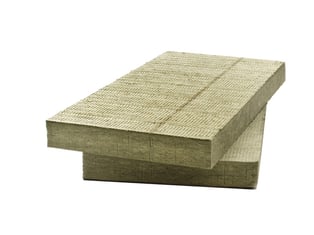
Close-up of a rock wool panel. Dycten
Disadvantages of Mineral Fibers
Because they are made up of such small fibers, when they are cut and handled, there is a possibility that particles may be released andaffect the respiratory system of the workers, and some of these fibers, such as refractory ceramics, are considered to be possibly carcinogenic by the International Agency for Research on Cancer (IARC). It should be noted that the vast majority of mineral fibers pose no risk, but since asbestos (corrugated asbestos cement) was recognized as a carcinogen, concerns about mineral fibers have increased.
On the other hand, FMAs are materials that During their manufacturing process, they emit significant amounts of CO2 into the atmosphere, so they are not considered entirely eco-friendly. Even so, some experts believe that their thermal insulation properties help save a significant amount of energy in heating and cooling buildings; thus, their environmental impact would be offset in this regard—and even more so when they are manufactured from recycled raw materials.
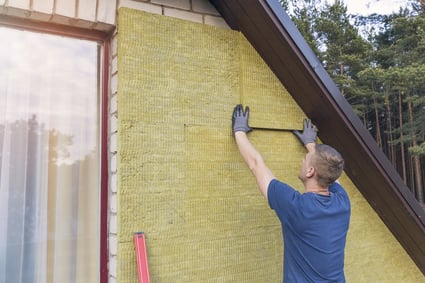
Exterior insulation with mineral fibers. Insulation in Zaragoza
In conclusion, mineral fibers have been a major discovery of the last century that has earned its place in the industry due to its significant thermal and acoustic insulation properties, today it is one of the most widely used materials in construction as thermal insulation for walls and roofs. Despite its environmental impact due to the origin of its raw materials and the energy required to manufacture them, It is a highly efficient material for saving energy in buildings.