
The future of STEM careers is very promising because these fields not only meet the needs of today's society but also those of the future.
The advent of globalization, new technologies, and digitization has led to radical changes in our daily lives and in companies’ production processes, with the fields of education and employment best reflecting these transformations.
In order for today's technological era to replace outdated industrial processes, there is a need to train the next generation in professions based on scientific and/or technical knowledge.
That is why the fields of science, technology, engineering, and mathematics (STEM, (acronym) are the most lawsuits filed by companies at present, and it is expected that this will also be the case in the future.
If you'd like to learn more about the STEM career prospects, keep reading this article—you might decide to study some of these in the end promising academic disciplines.
Data from Studies on the Future of STEM Careers
A report from the United Nations (UN), argues that by 2050 the 75% Some of the jobs will be related to STEM fields.
The data above show the importance These STEM majors are key to addressing the future of a society that is becoming increasingly technological; they also underscore the need to open more college majors to meet these high labor demands.
To supplement this information, the Organization for Economic Cooperation and Development ((OECD) predicts that a 80% of the jobs currently in highest demand will disappear in 2030 and will be replaced, directly or indirectly, by STEM majors.
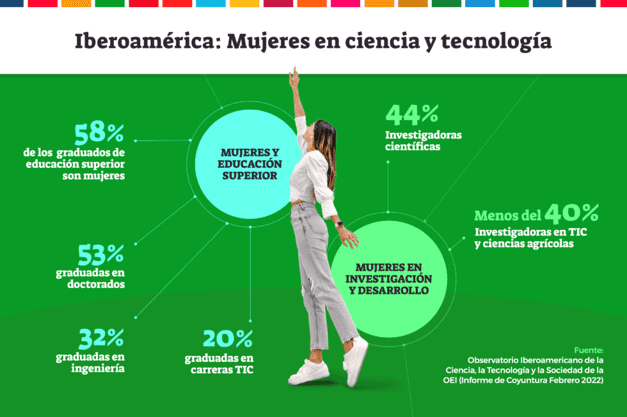
However, despite the rise of these professions, it is worth noting the concern expressed by the United Nations Educational, Scientific, and Cultural Organization (UNESCO), with regard to the data presented on women's participation in STEM fields.
According to UNESCO, only the Women's 35% Worldwide, students are pursuing higher education in STEM fields and less than 30% participate as female researchers, with the exception of Latin America and the Caribbean, where they account for 44%.
In order to improve this situation, various international organizations have made proposals to encourage girls at an early age, using tools that help spark their interest vocation, and thereby reduce the gender gap that is emerging in these types of degree programs.
Fields of Application for STEM Careers
There is a extensive wide range of professions Although there are many disciplines within this field, in this article we will mention only the most popular ones:
1. Science
These are the degree programs responsible for solve real-world problems through scientific theories, concepts, and experiments. Critical thinking, research skills, and analytical abilities are required to to reach conclusions. This group includes biology, biotechnology, physics, and medicine.
2. Technology
These are the professions that develop new systems and programs or improve existing software. Scientific reasoning and data analysis They enable us to find solutions to various problems. Some examples include systems analysis, web development, programming, and robotics.
3. Engineering
These are the careers that require the creativity and skills techniques for solving a wide variety of real-world problems. The most in-demand fields are environmental engineering, electric, mechanics, and chemistry.
Mathematics
In these professions, the reasoning, deductive reasoning, and problem-solving skills, through data analysis, modeling, and pattern identification to propose solutions. Some of the professions in high demand in this field include accounting, economics, statistics, and mathematics.
Driven by the technological boom of recent years, the following have emerged: new professions such as cybersecurity, virtual reality, and food science.
Why Study a STEM Major?
The reasons for pursuing a STEM degree are not based solely on the economic, but also the social.Without a doubt, professionals in STEM fields have a high likelihood of achieving job stability, excellent salaries, and unstoppable career growth, because they are the degrees most in demand by companies, not only today, but also in the future.
Furthermore, these are dynamic professions that are constantly evolving, and they offer the opportunity to help improve the quality of life for all of humanity.
How to Encourage Interest in STEM
Even though technology has has evolved steadily and rapidly, there is little student participation in STEM programs.
The UN and UNESCO, among other organizations, are conducting studies to provide tools that motivate young people to pursue careers in these fields. Among the findings, the following stand out:
- Raise Awareness the paper the crucial role they play the teachers to inspire motivation in their students, who generally feel respect and admiration for them.
- Guide young people regarding their career opportunities, thereby changing their perception that STEM subjects are very difficult. This needs to be done even at a very young age.
- Apply tools that will transform the way students are taught science and technology subjects, with the goal of increasing their interest in and passion for the sciences.
- Awaken the vocations STEM for children through video games, books, experiments, contests, etc.
- Eradicating Stereotypes gender equality so that more women can pursue careers in STEM. To this end, we must ensure better access to education, prevent discrimination in the labor market, and increase the visibility of women in STEM careers.

In Structuralia there is a Master's program in STEM fields, allowing professionals to specialize in their various areas of expertise.
The future of STEM careers is very promising because these majors are part of the a country's socioeconomic progress.
STEM Careers transform reality, because they are innovative, creative, and analytical. Thanks to them, we can see how people have been replaced by robots in manufacturing processes, how e-commerce is booming, and how digital printing continues to expand into more and more areas—just to name a few advances.
All of these current changes—and those yet to come—require technical professionals trained in robotics, telecommunications, statistics, logistics, digital marketing, and other fields within the STEM disciplines to fill the shortage of professionals the current situation and the one that is on the horizon.