We're talking about the geothermal energy, what it is and how energy is actually generated by today's geothermal power plants.
Geothermal Energy: What It Is and How Geothermal Power Plants Work
It seems that there are more and more renewable energy options available on the market, and it is not yet clear whether in the future, Our energy consumption will be supplied by a single source or by several sources. In any case, geothermal energySolar energy is a widely available, increasingly utilized, and more efficient source of renewable energy.
Geothermal energy is a form of renewable energy derived from the heat within the Earth, and it can be used directly as thermal energy, or transformed into electricity. Geothermal energy is obtained by extracting steam and hot water from underground, which is used to power turbines and generate electricity.
Development of Energy Production geothermal
The use of geothermal energy has a long history dating back to ancient times, when it is believed that The Romans used hot springs to heat their public baths and homes in places such as Bath, in the United Kingdom, and the city of Pompeii, in Italy.
However, the true history of geothermal energy production began in 1904 in Larderello, Italy, where a plant was built the world's first commercial geothermal power plant. The power plant used natural steam rising from the ground to generate electricity and supply power to the local power grid.

The Larderello geothermal power plant, in the early 20th century. Enelgreenpower
During the 1920s, geothermal power generation expanded to other parts of Europe, such as Germany and France, and in 1930, the first geothermal power plant in the United States was built in the National Park of Yellowstone. However, The real expansion of geothermal energy did not begin until the 1950s and 1960s, when the first commercial geothermal power plants were built in the United States.
Geothermal energy production has become an increasingly attractive alternative to fossil fuels, as it is a renewable and clean energy source that does not emit carbon dioxide or other pollutants into the atmosphere. In addition, technology has advanced significantly in recent decades, leading to reduced costs and increased efficiency to the point that, in 2019, global installed geothermal capacity reached 15.4 GW, with an annual production capacity of more than 82 TWh.
Geothermal Power Plants
There are several types of geothermal power plants, but the most common type is the steam cycle, where steam is used at the plant to drive a turbine and generate electricity. Another type of geothermal power plant is the binary cycle, which uses an intermediate fluid to transfer heat from hot water or steam to the working fluid, which is then used to generate electricity.
In general, geothermal power plants They are an efficient and sustainable way to generate electricity, since they do not emit greenhouse gases or other pollutants into the atmosphere. These, They have evolved significantly since the early 20th century and improved their efficiency, although some of them—such as the one in Larderello—are still in operation and rank among the most important in the world.
How Geothermal Power Plants Work Today
Geothermal power plants operate by harnessing the natural heat from the Earth's interior to generate electricity. The process of geothermal power generation can be divided into three main stages: exploration and drilling, steam extraction, and electricity generation.
In the first stage, a suitable geothermal area is identified for the construction of a geothermal power plant. A geological survey , very similar to the geotechnical studies, to determine the temperature, pressure, and permeability of the underground rock. If an area with suitable characteristics is found, the next step is to to drill a geothermal well.
In the second stage, Steam or hot water is extracted from the geothermal well and is sent to the geothermal power plant. If hot water is extracted, it undergoes an evaporation process to turn it into steam; if the well produces steam directly, it is sent to the geothermal power plant through pipes.
In the third stage, electricity is generated from this steam. It is directed to a turbine, where its kinetic energy is converted into electrical energy. The steam is then cooled and turns into water, which is returned to the subsoil through an injection well.
Geothermal Power Plants Around the World
There are numerous geothermal power plants around the world that are fully operational. Below, we present some of the world’s most significant geothermal power plants:
-
The Cerro Prieto Geothermal Power Plant in Mexico: This power plant is located in the city of Mexicali, in the state of Baja California. It is one of the largest geothermal power plants in the world, with an installed capacity of 720 MW. It was built in the 1970s and has been in operation ever since.
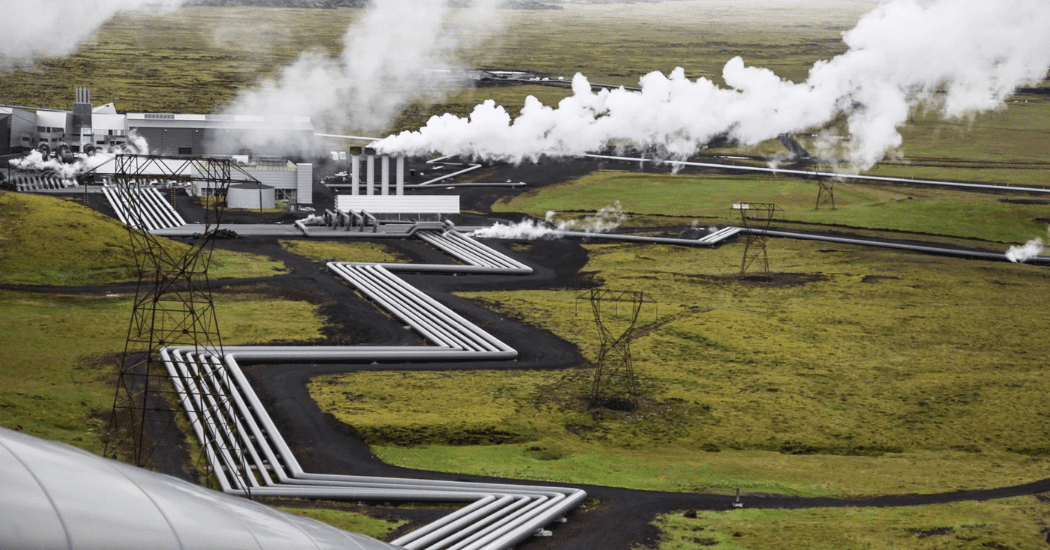
- The Hellisheidi Geothermal Power Plant, Iceland: This power plant is located near the Icelandic capital, Reykjavik. It has an installed capacity of 303 MW and is supplied with steam and hot water from the Hellisheidi geothermal field. The plant has been in operation since 2006 and is one of the largest in Europe.
- The geothermal power plant in Larderello, Italy: This power plant is located in the Tuscany region of Italy. It was built in 1913 and is one of the oldest geothermal power plants in the world. It has an installed capacity of 769 MW and supplies power to a large part of the region.
- The Geysers Geothermal Power Plant, United States: This power plant is located in Lake County, California. It is the largest geothermal power plant in North America, with an installed capacity of 1,517 MW. The plant has been in operation since the 1960s and supplies electricity to more than 22 million people.
-
The Yangbajing Geothermal Power Plant, China: This power plant is located in the Tibet region of China. It has an installed capacity of 25 MW and is supplied with steam and hot water from the Yangbajing geothermal field. The plant has been in operation since 1985 and is one of the largest in China.

Facilities at the Hellisheidi geothermal power plant in Iceland. Piensageotermia.com
Without a doubt, geothermal energy is increasingly becoming a more efficient option for producing energy in an environmentally friendly way that is accessible to everyone, thanks to the The Development and Evolution of Geothermal Power Plants around the world. As engineers in the energy sector, it is essential to stay informed about the wide range of sustainable energy production options, particularly geothermal energy.
Structuralia is one of the training platforms for engineers that places the greatest emphasis on the sustainable development of energy production. If you're interested in specializing in this such an interesting and promising field, feel free to check out their extensive catalog Master's degree programs for engineers.