
Innovation Management: Everything You Need to Know
The current socioeconomic landscape, characterized primarily by the fierce market competition, has caused innovation management become an essential part of businesses, especially if they are looking to improve the product, service, or process they provide.
In this regard, and contrary to popular belief, innovation management It does not involve only the research and use of sophisticated technologies, but rather It can be done using simple techniques and easy to implement. For this reason, they are suitable for both small and medium-sized businesses and large companies.
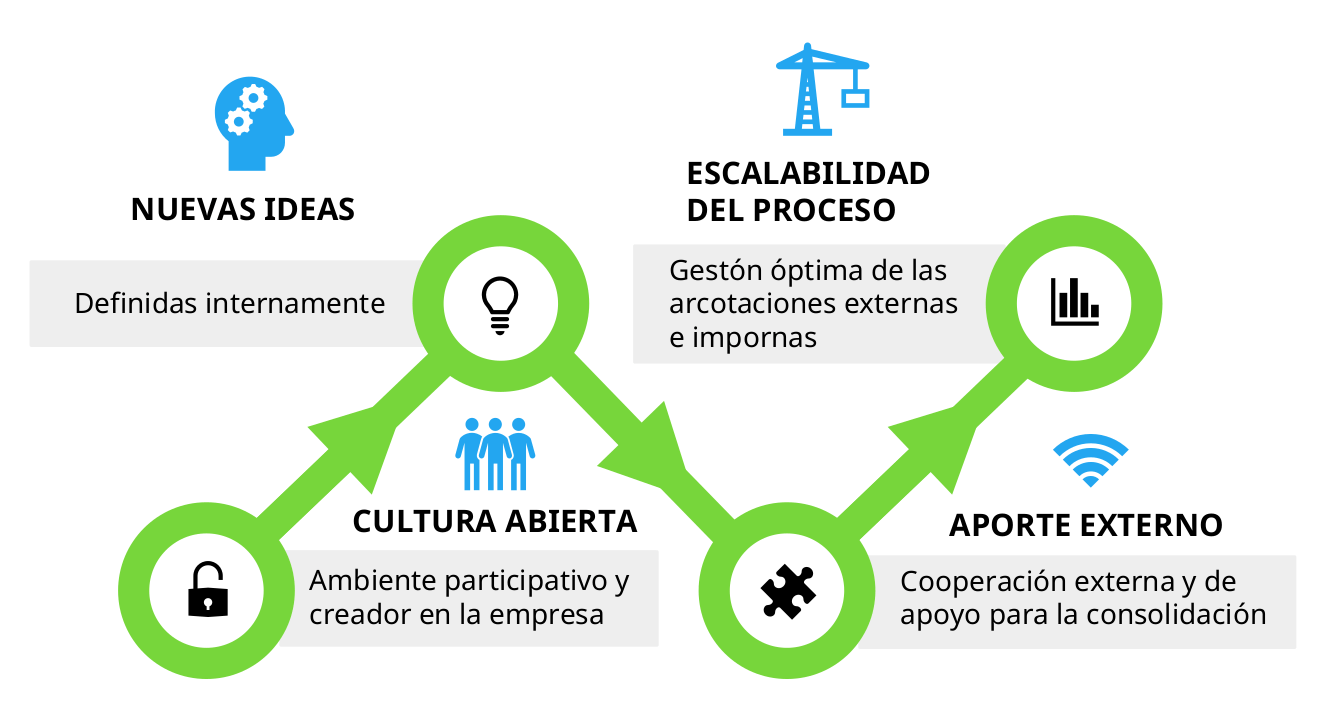
Diagram of the Keys to Successful Innovation Management Within a Company. Viima.com
What is innovation management?
We define innovation management as the process that encompasses from the conception of an innovative idea to its full implementation within the company, through the design and evaluation phases.
To ensure its success, It is essential that the company and its leaders be involved in these processes, and also facilitate and encourage employee participation. This also ensures that the ideas generated align with the company objectives at all levels.
Finally, without going into too much detail, innovation management methods can be divided into:
-
Revolutionary: It is closely linked to technological advances, which can provide a competitive advantage over competitors.
-
Disruptive: one who presents cutting-edge ideas that have the potential to significantly transform the market once implemented.
Concepts for Managing New Technologies
The following concepts are essential in the field of innovation management, and they help break down such a complex topic. We can also think of them as tools that will serve as a starting point if we decide to get involved in the world of innovation management.
1. Innovation Management as a Process
There is no product and/or service without a process, and managing that process is key to an organization staying at the forefront of new technologies. Therefore, it is important to learn how to manage the innovation processes. With the goal of providing them with a greater adaptability and, above all, to give them the opportunity to anticipate and bring about disruptions that will allow these processes to renew their competitive advantages at the right time.
2. Process-Based Management
When working with a process-based approach, it is important to recognize that Not all of them have the same objectives or the same importance.a. In this context, there is the well-known “Process Map” used to distinguish between different types of processes:
-
-
Key processes: These are the operational procedures that involve direct contact with the customer.
-
Strategic Processes: They are responsible for analyzing the needs and constraints of market society and shareholders.
-
Support processes: are those that promote the organization of all necessary resources, including personnel, machinery, and raw materials.
-
3. The Metrics of Innovation
Furthermore, to determine whether the innovation goals have been met They need to be measured in order to make decisions. That's what the Innovation indicators at the company level based on their function (economic, intensity, efficiency, and cultural) and their position in the process (input, intermediate, and output).
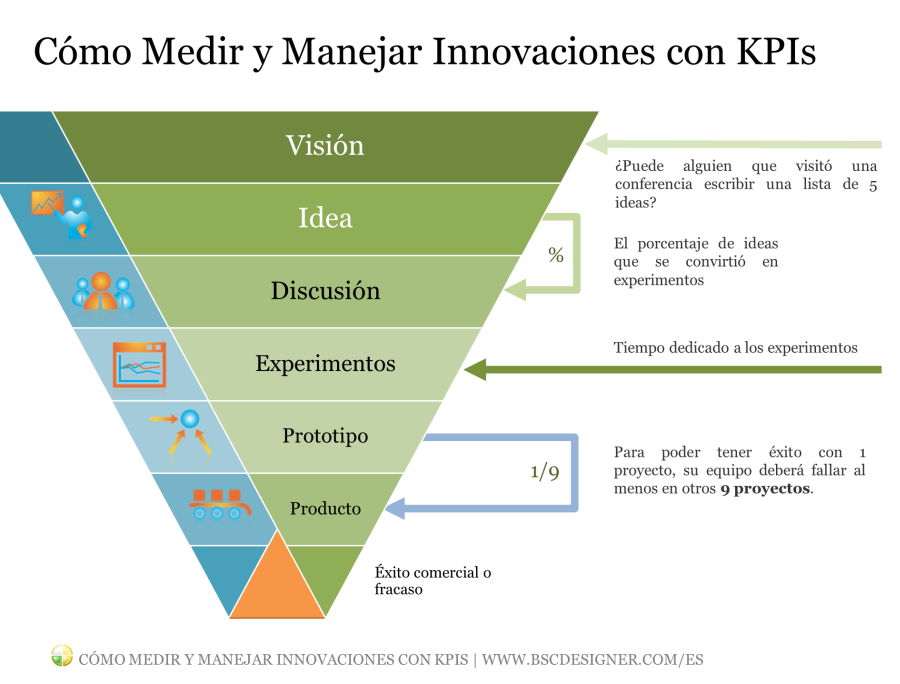
A practical example of the metrics used to evaluate innovation management. BSC Designer
4. Innovation Management Systems
An Innovation Management System comprises various phases and activities, as well as the interrelationships among them. This concept is governed by the standard UNE 166.002 as a benchmark in Spain and Europe.
5. Implementation of the innovation management system
It begins with a review of the standard and a self-assessment exercise. Next comes the comprehensive project planning phase, followed by the establishment of minimum requirements and the management of uncertainty.
Innovation Management Tools
Innovation Management Tools (IMTs) are the methodologies and techniques used in the various phases of the process to achieve greater efficiency. There are a wide variety of them, each with different characteristics, methods, and stages of implementation.
Some of the best-known and most widely used methods that can be applied in more than one area are:
1. Benchmarking
Developed by Rank Xerox in 1979, it consists of a process of improvement through the continuous identification, understanding, and adaptation of best practices and processes found both within and outside a company.
2. Process Reengineering
A thorough reevaluation and redesign of business processes to achieve significant improvements in the most relevant performance metrics (cost, quality, service, or response time). This approach can be applied to any type of company, provided there is strong commitment from management and an adequate technological infrastructure.
3. Technology Audit
Used to identify a company’s main needs, weaknesses, and strengths through a brief visit and interview. Through this process, the auditor learns management’s perspective, examines the environment, and assesses what the company truly needs. The significant psychological factor involved in this methodology can pose an obstacle to its success.
4. Value Analysis
It is carried out through a systematic review of product design, comparing it with customer demands in order to meet those demands at a lower cost. It is a complex method consisting of various techniques that evaluate the components of the products and their associated costs.
5. SWOT Analysis
This allows the company to understand current and future opportunities and threats and, therefore, identify its strengths and weaknesses in relation to them. It consists of two phases: an external analysis, which examines the company’s threats and opportunities, and an internal analysis—focused on human resources, production, customer service, etc.—that assesses its strengths and weaknesses.
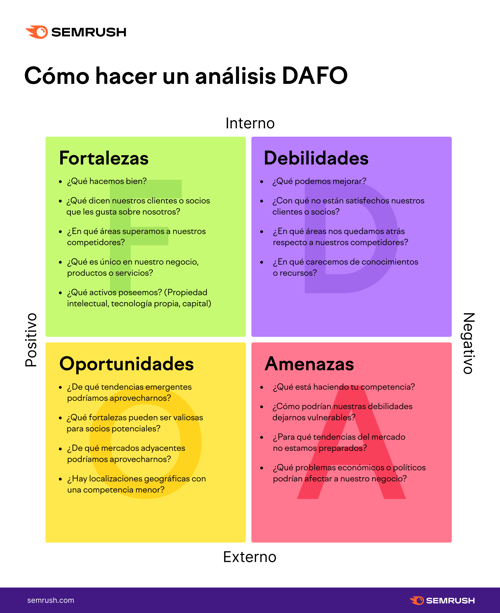 Illustration explaining how to conduct a SWOT analysis for innovation management. Semrush.com
Innovation Management It has become a cornerstone of business success and survival today. In a world marked by rapid technological advances, constant shifts in consumer preferences, and increasingly intense global competition, The ability to innovate stands out as a key differentiator. From the creation of disruptive products and services to the optimization of internal processes, innovation management not only boosts efficiency and productivity, but also promotes a culture of creative entrepreneurship and interdisciplinary collaboration.
The future looks exceptionally promising for professionals who specialize in innovation management. As companies constantly seek new ways to create value, innovation experts will play a vital role in identifying opportunities, generating fresh ideas, and implementing cutting-edge solutions. These professionals will serve as catalysts for business evolution, contributing not only to the expansion of the organization's horizons but also to the progress of society as a whole. If you're interested in learning more about The Impact of the Digital Revolution on the Business World Whether you want to pursue a degree or specialize in business innovation management, Structuralia offers you various training programs of the highest caliber, Feel free to check them out.