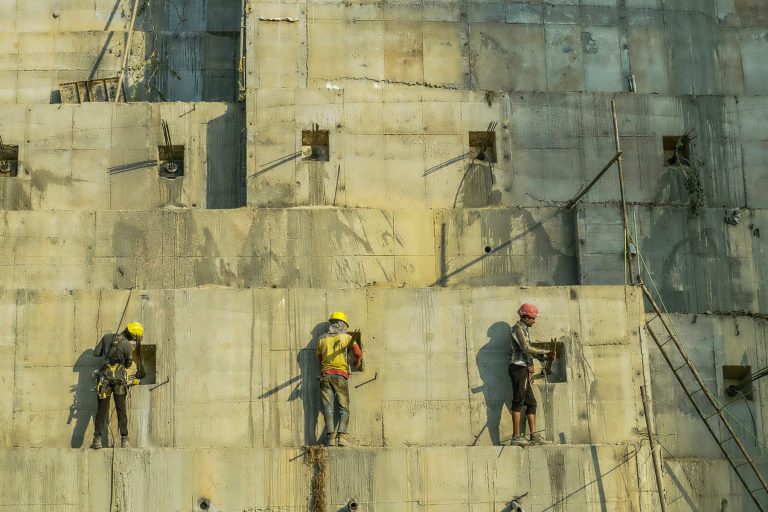
In this first installment of our series of articles tagged with the hashtag # Let's Talk About… We are going to analyze and review some of the fundamental aspects of Portland cement manufacturing, the most widely used type of cement worldwide.
Cement consumption in Spain rose by 21.5% in March, reaching 1.1 million metric tons, driven primarily by the resurgence of the real estate sector. Meanwhile, recent investments in Latin America aimed at boosting the public works sector are prompting cement companies to seek to expand their presence in these countries.
Everything seems to indicate, then, that cement will once again take center stage in the near future, so we’re going to review some of the key concepts needed to understand what this wonderful raw material is like and how it behaves.
Definition and Raw Materials:
Although it is widely known, we must begin by defining what cement is. It is a powdery substance used in construction as a binder that, when combined with aggregates and through hydration, has the ability to create the most well-known artificial stone of all time: concrete. It is nicknamed “Portland” because of the similarity between its color—an ivory white verging on slate gray—and the rocks found on the island of Portland in the United Kingdom, where this mixture was invented around 1824 by Joseph Aspdin.
To round out the definition, let's take a look at its raw materials:
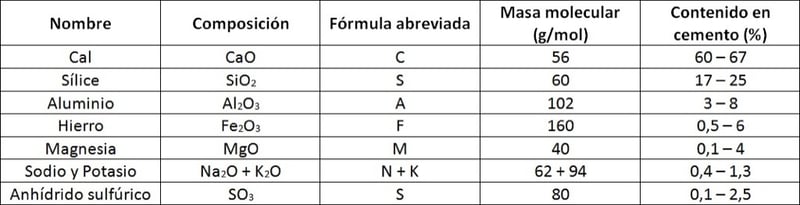
During the manufacturing process—which you can see in the video that follows this paragraph—an intermediate product is obtained called Portland cement clinker. After calcining the limestone and clay at more than 1,300 °C, this byproduct has a very specific composition that will determine the properties of the concrete produced with that cement.
{youtube}v=JE9mxBCaSsY{/youtube}
Given their importance, let's now review the main components of clinker and how they affect the strength of the final product.
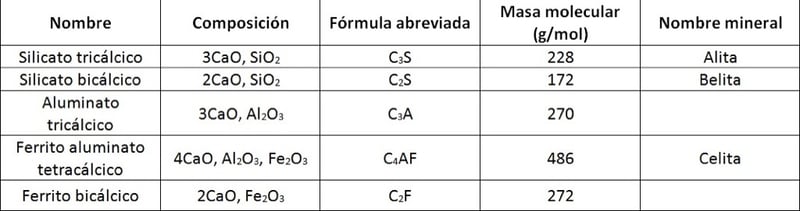
- Tricalcium silicate: It is the main component of clinker, giving cement high early strength. The heat of hydration released during its reaction with water is high (120 cal/g).
- Dicalcium silicate: It exhibits low strength initially, but subsequently develops strength progressively until it reaches the levels of tricalcium silicate. The heat generated during its hydration is less than that produced by C3S (60 cal/g).
- Tricalcium aluminate: On its own, it contributes very little to the final strength of the cement. It acts as a catalyst for the silicate reaction. It hydrates extremely rapidly, releasing a great deal of heat of hydration (207 cal/g). Gypsum is often used to slow its activity, acting as a setting retarder. It is a hazardous component, as it results in concrete that is more susceptible to sulfate attack.
- Tetracalcium ferric aluminate: It contributes very little to the strength of cements. It hydrates rapidly, although less so than aluminate, and also produces a significant amount of heat (100 cal/g). It is responsible for the greenish-gray color of some cements. Reducing its proportion results in white cements. It acts as a flux.
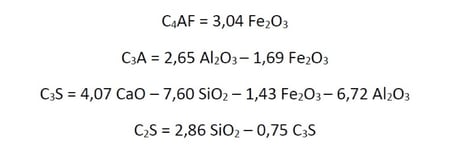
For those of you who need to determine the percentage composition of this cement clinker based on its raw materials, you will find the following very useful: Bogue's formulas:
And remember:
“What protects the rebar in concrete is its alkalinity; therefore, the higher the CaO content, the greater the protection against corrosion. On the other hand, it will have poorer chemical resistance, since lime reacts chemically with many compounds, which must be monitored.”
Hydration of Portland cement:
Cement hydration can be viewed as a process in which the components react with water to form a solution, followed by the diffusion and precipitation of the hydrated components. This process is based on the Le Chatelier's crystalloid theory and Michaelis's colloid theory, including a mechanism by which hydrated products are transported through the pores from the particles where the reaction has occurred to the voids.
The rate of chemical reactions increases with temperature. It should be noted that the hydration of C2S is more temperature-dependent than C3S.
If the dough were to receive an external supply of water, hydration would continue for a certain period of time until it reached a limit. Conversely, if the paste does not come into contact with external water during hydration, as the mixing water evaporates, the amount of water could drop to levels at which cement hydration would be interrupted. The correct water-to-cement ratio is approximately 0.3 by weight.
Moisturizing Formulas
Tricalcium silicate: It reacts rapidly with water to form tobermorite (C3S2H3) and portlandite (Ca(OH)2), abbreviated as CH, according to the following reaction:

Dicalcium silicate: It reacts more slowly according to the following formula:

Note that the hydration of the first silicate produces three times as much portlandite as the second. Portlandite ultimately breaks down into lime, which is chemically very unstable.
Tricalcium aluminate: The C's reaction3When mixed with water, it reacts very quickly due to water's high dissolving power, causing the paste to harden rapidly—a process known as “lightning-fast setting.”.
To prevent this phenomenon and create a workable mixture, a setting retarder—usually gypsum dihydrate (CaSO4 2H2Or, written in a simplified form, CSH2). Gypsum and aluminate react to form insoluble hydrated calcium sulfoaluminate, or “Candlot salt”, according to the reaction:

Although the C3A is attacked by sulfates, producing expansive sulfoaluminates; this is necessary because it facilitates the formation of the liquid phase, lowering the kiln temperature and helping to improve the reactions involving limestone and clay.
The amount of gypsum added to the clinker must be controlled, since a lack of gypsum results in the formation of C3S is present in the hydrated cement, posing a risk of sulfate attack.
Tetracalcium ferric aluminate: It reacts with water to form crystalline hydrated calcium aluminates and amorphous hydrated calcium ferrite, as well as iron hydroxide:

We hope this overview will help you recall the key characteristics of the raw material that makes up all concrete.