Japan’s commitment to developing specialized technology for extracting fuel ice from the seabed—as a new flagship material for its energy sector—appears to be quite strong. Below, we’ll tell you a little more about this material and this project. Since the end of World War II, Japan has cemented its role as one of the world's leading economies , a fact that is not without merit when we consider that this is a country that It does not have significant oil, coal, or natural gas deposits and that has has significantly scaled back its commitment to nuclear energy following the accident at the Fukushima power plant in 2011.
We therefore find ourselves in a country with a a strong tendency to import energy. In fact, it is estimated that the 90% of the energy consumed in Japan comes from other countries. Given this situation, it is no surprise that Japan is in the process of search for alternative energy sources to help them optimize their operations without increasing their energy bill.
Among these alternatives, the research and technological development work currently underway aimed at extracting a a substance found in abundance in the waters off the Japanese seabed, known as combustible ice , which holds great promise for being considered the new oil from the Asian country.
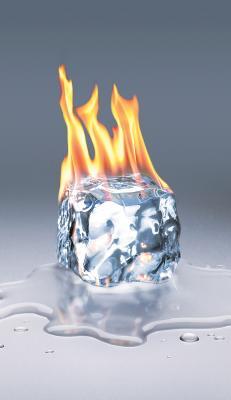
Although the road to a successful extraction still seems to be quite long, the high calorific value of the material makes it one of the the most prominent players in Japan's energy sector, to such an extent that the investment Government spending for the 2002–2017 period totals $1,000 million in this field. This is not at all unusual, considering the possibilities offered by the material: the The energy produced by one cubic meter of fuel ice is equivalent to that generated by the combustion of 164 cubic meters of methane gas.
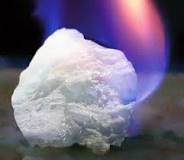
Combustible ice - or methane hydrate For chemistry enthusiasts—it is a naturally occurring substance consisting of a mixture of water and gas capable of catching fire at the slightest contact with a flame. It is a material stable under conditions of high pressure and low temperature, such as those that take place on the seafloor.
It is also estimated that their global reserves could end up outnumber the group of all the fossil fuels.
So, what's the problem?
Well, the problem stems from the extraction technology, for which a solution has not yet been found a safe, economically sustainable alternative that does not cause harmful effects important for the environment. In 2013, a scientific research group decided to attempt extraction using a mechanism that depressurization that would allow the hydrate to be melted and the water to be separated from the gas; this attempt failed due to infrastructure problems caused by sand in the pipelines, which have not yet been resolved.
But Japan isn't the only major economy on the hunt for this energy source. Other world powers, such as the U.S., Canada, China, and Australia It is also allocating funds for that purpose. In the case of Spain, samples of methane hydrates have already been obtained from the Gulf of Cádiz and the Alboran Sea. However, There is no legislation yet to regulate the extraction of gas hydrates. Will this be a sustainable and viable energy alternative for the future? Everything suggests that we’ll have to wait a few more years to find out…