3D printing in medicine has advanced rapidly over the past decade; models, prosthetics, and organs are helping to improve health.
What are the applications of 3D printing in medicine?
The 3D printing in medicine It is rapidly revolutionizing the field of healthcare thanks to the personalized solutions offered to each patient, even going so far as to bioprinting. This innovative process involves cell culture in a laboratory.
What Is 3D Printing?
This type of printing, also known as manufacturing by addition, print on successive layers. With it, we can create three-dimensional objects, rather than on a flat surface, as with traditional inkjet printers.
The first 3D printers were developed in the 1980s by American engineer Charles Hull. At that time, the «ink» was an acrylic liquid that solidified when exposed to ultraviolet light. Since then—and even more so during the pandemic—their use has skyrocketed and expanded into many areas, employing thermoplastic, metal alloys, concrete, drugs o living tissue.
Currently, additive manufacturing requires a team and software special, mainly CAD-type ones (computer-aided design) and CAM-type ones (computer-aided manufacturing) widely used in the engineering field. Based on a design or image, a three-dimensional model that the printer recognizes and reads.
Applications of 3D Printing in Medicine
Ever since we've been able to combine layered printing with CAD, CAM, and computer-integrated manufacturing, research began on the fabrication of three-dimensional structures biomimetic. In other words, models that mimic the anatomy and function of a tissue or organ using medical images of patients obtained from studies such as:
- Nuclear magnetic resonance.
- Computed Axial Tomography.
- X-ray images.
Based on the information gathered using these techniques, the 3D printing in medicine We can generally divide it into five categories.
1. Preoperative Planning
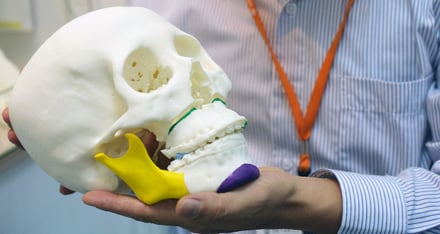
In the surgical field, 3D printing can be used as a tool to better understand any complex anomaly.
In this way, it is possible to improve and enhance the quality of the diagnosis and contribute to preoperative planning. Its benefits have been demonstrated in craniofacial and maxillofacial surgery, while in orthopedic, neurosurgical, spinal, cardiovascular, and abdominal surgeries, a significant improvement in diagnosis and treatment was observed. This was due to better structural assessment affected and the possibility of an appropriate planning.
The simulation Practicing complex surgical steps before surgery, using prototype models, helps anticipate intraoperative and postoperative complications. It helps reduce the time of the procedure and allows for efficient use of the operating rooms.
2. 3D-Printed Anatomical Models in Medicine
In this case, the 3D technology is used for the purpose of educational for patients as well as for physicians in training, students, and surgeons. With it, you can explain easily explain the condition to the patient and their family members so they can understand the nature of the procedure. In addition, medical students and specialists can follow the process step by step surgical.
In Spain, an exact replica of a tumor affecting a child was created using hard plastic for the surrounding structures and soft resin for the tumor itself. The surgeons practiced on this model, and the tumor was successfully removed.
3. Implants
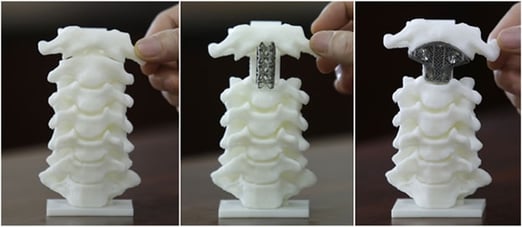
The 3D model printing has a significant impact on the generation of custom implants such as knee and hip replacements, since they are custom-made.
These structures (hip, femur, and knee) can be reconstructed using biocompatible materials, including metals, ceramics, and polymers. Of these, the bioceramics, such as hydroxyapatite, have become key to bone reconstruction.
4. Medical Research
3D printing opens up new opportunities for the study and scientific research, and helps shed light on anatomical and physiological processes that are not yet fully understood.
For example, blood flow dynamics within arteries, veins, and capillaries can be studied through optical flow measurements in transparent models.
5. Bioprinting: 3D Printing in Regenerative Medicine
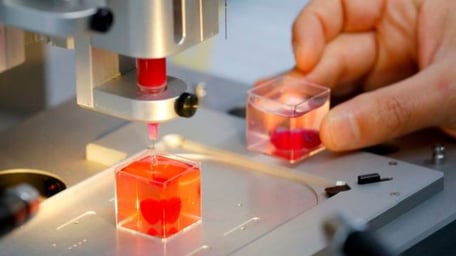
Repair or replacement of damaged cells, tissues, and organs is made possible by cellular engineering. In these cases, the biomedical scaffolds They are made from natural or synthetic polymers to replace or regenerate native tissues in terms of function and structure. 3D bioprinting technology is one of the most suitable methods for producing these cellular scaffolds using hydrogels or alginate, thereby enabling the assembly of biological material.
For 3D printing of human organs, tissue samples are taken from a tissue or stem cells from the patient, then cultured and expanded in the laboratory to produce an exact copy of the original tissue. Medical researchers hope that, when introduced into the body, these cells will integrate with the existing fabrics.
Ultimately, a fabric with certain properties is produced biological and mechanical for the clinical restoration of original tissue and organ function.
Limitations of 3D Printing in Medicine
Basically, there are three limitations to using this technology:
- The size of the object to be printed. This applies only to structures that do not exceed certain dimensions. However, this limitation has been overcome by creating a miniature version or by dividing the complete model into smaller parts.
- Time. The time required to produce a 3D object limits its use in emergency situations.
- Costs. However, in complicated cases, the additional cost may be offset by the minors shorter operating times and a higher surgical success rate.
In Strucuralia, the leading school in new technologies, offers a comprehensive digital training program that enables professionals to acquire the necessary knowledge in this field, such as the master's degree AutoCAD Civil 3D 2016 or the International Degree in Innovation Management.
In short… According to a report by Research and Markets, The 3D-printed medical device market is projected to reach $4900 million by 2026, a annual growth rate composed of 24.5 %. The demand for models, prostheses, and tissues has driven growth in the 3D Printing in Medicine. From ergonomic crutches, splints, and custom dental or ear prostheses to strips of human tissue, the effectiveness and efficiency of this technology is a pop-up field for the benefit of patients, their diagnosis, and the necessary treatments.