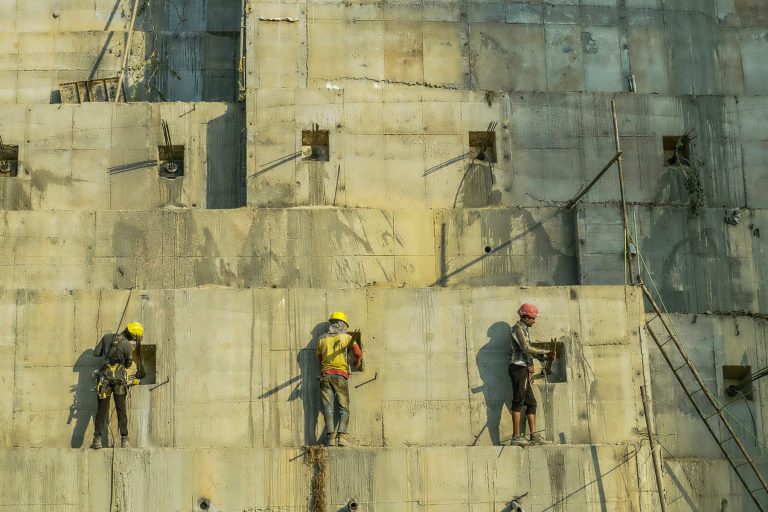
One of the factors that most negatively impacts the operational phase of a highway is the appearance of potholes and subsidence in the wearing course. In most cases, these undesirable obstacles to traffic stem from poor or inadequate compaction of the subgrade on which they rest. Let’s examine the causes of this phenomenon and some methods for repairing it.
On the embankments that are not properly compacted or in which suboptimal materials are used Differential settlement often occurs over time and due to heavy traffic loads. This settlement is reflected in the road surface grade. In such cases, the solution under maintenance contracts has been to level the surface by laying an asphalt mixture. In the case of concrete pavements, the problem is more serious, since this rigid pavement adapts very poorly to differential settlement, leading to the cracking of the concrete slabs. Water enters through cracks in the slabs, accelerating the problem. Various methods have been tested for repairing concrete slabs, such as partial repair with resins, complete replacement of the slab, splitting the slab in two to accommodate movement, reinforcing the slab, etc. In other cases, the concrete slab has been replaced with spot repairs using asphalt.
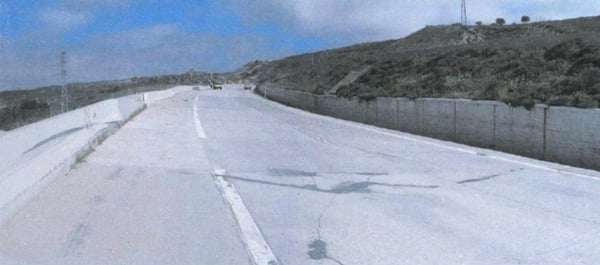
If the problem is widespread, it may be necessary to replace the concrete pavement with asphalt concrete. This solution was implemented on the A-2 between the Alhama de Aragón exit and the Monegrillo River viaduct. In this case, the embankment was raised to a depth of 2 meters. The concrete pavement was demolished and crushed on site, and the crushed material was used as a subbase. A gravel layer and an asphalt concrete pavement were then laid on top of this subbase. It should be noted that this work was carried out with traffic alternating between the two lanes while work was being performed on the other.
To minimize the impact on traffic, it is necessary to switch to another type of solutions that are faster to implement and that allow traffic to remain open. The most common solutions involve stabilizing the embankment by:
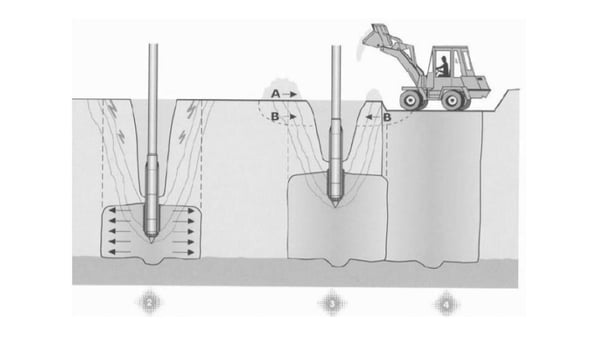
- Vibrocompaction. Vibrocompaction is a soil improvement technique that uses deep vibration. It is applicable to granular soils (generally with a fine content of less than 10%). Soil improvement is achieved by reducing voids between particles through the vibration produced by the vibrator as it moves in and out of the treated soil. During the treatment, which is carried out in a grid pattern, the soil is compacted, resulting in a reduction in the thickness of the treated layer; this thickness must be replenished and compacted if the original elevation needs to be restored.
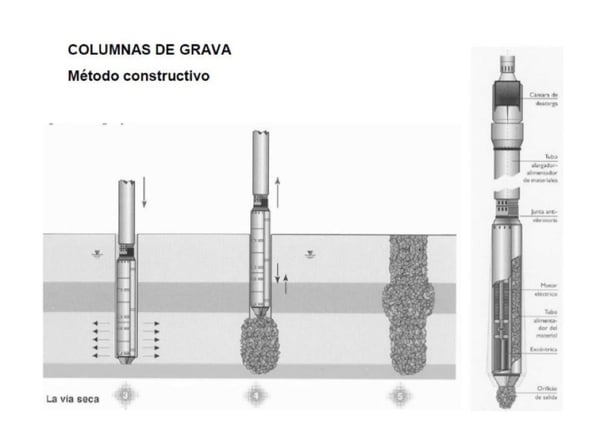
- Gravel columns. It involves driving gravel columns into soft soil, often with the aid of metal pipes to consolidate the soil. Gravel columns, also known as vibro-replacement, are a soil improvement technique that uses deep vibration and the addition of gravel to the soil. It is used to improve very soft to medium-soft soils (silty sand, silt, clayey silt, clay, heterogeneous fill, etc.). Gravel columns are typically installed using the dry method, in which vibro-drilling is performed using compressed air and the gravel is introduced through the vibrator, thereby reducing the number of operations required to remove and reinsert the vibrator, while ensuring the continuity of the column.
- Injection: Injection into a soil involves introducing a fluid mixture into the soil to reduce its permeability and/or improve its mechanical properties; this mixture subsequently sets and hardens. The most common types of injections are cement grouts with bentonite, clay, or other additives using the following techniques:
– Impregnation. The grout flows through the pores and cracks in the rock mass, filling the voids.
– Compaction or displacement. A thick mixture is forced under high pressure to displace the soil.
– Hydraulic fracturing. The grout is forced in under high pressure, opening and filling the cracks while also displacing the surrounding rock.
- Jet Grouting: This is a process that involves breaking up soil (or loosely compacted rock), mixing it, and partially replacing it with a cementing agent (usually cement). The breaking up is achieved using a high-energy fluid, which may include the cementing agent itself.
If you'd like to learn more about these techniques, check out our master's program:
Master's Degree in Highway Maintenance and Operations Engineering